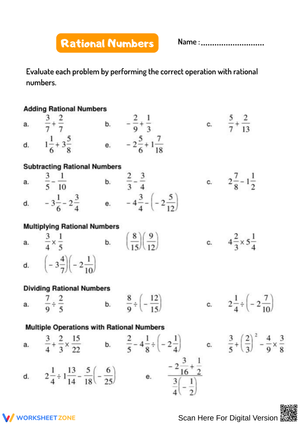
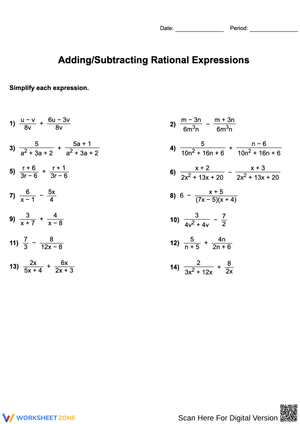
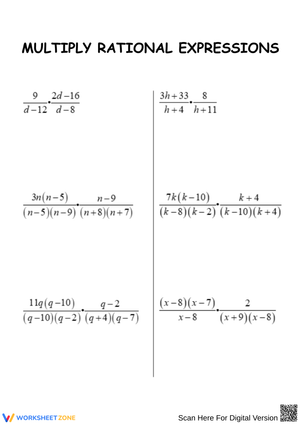
These 11th grade rational expressions printable worksheets give algebra teachers a ready progression of focused practice that mirrors the actual unit sequence — starting with factoring review, moving through simplification and operations, and ending with rational equations that require extraneous solution checks. Answer keys are included throughout, so the resources work well for classwork, independent practice, and sub days without modification.
The Specific Skills Targeted Across the Set
One reason teachers reach for 11th grade rational expressions printable worksheets organized by skill type — rather than mixed-operation sets throughout the unit — is that the sequencing itself does instructional work. Students who factor dozens of quadratics and trinomials in context on simplification and multiplication worksheets arrive at rational equations with that process already deeply grooved, which keeps the cognitive load manageable at the hardest stage of the unit. Each worksheet in the set concentrates on one clearly bounded skill:
- Simplifying rational expressions: Students factor numerators and denominators — trinomials, GCFs, and difference of squares — cancel common factors, and identify excluded domain values before moving on.
- Multiplying and dividing: Problems require full factoring before multiplying across numerators and denominators. Division problems ask students to rewrite as multiplication by the reciprocal first, then simplify.
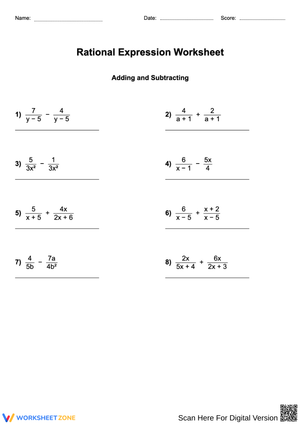
- Adding and subtracting: Each worksheet in this category demands a correct least common denominator, which means both denominators must be fully factored before any combining begins.
- Solving rational equations: Students clear denominators by multiplying through by the LCD, solve the resulting polynomial equation, and substitute each solution back into the original to confirm no denominator equals zero.
- Domain restrictions: Excluded values appear across the entire set, not only on simplification worksheets. Students record restrictions at the start of each problem — not as a closing afterthought.
Student Mistakes That Surface Early and Compound Later
Rational expressions produce a predictable cluster of errors, and most begin with incomplete factoring. A student who factors x² − 5x + 6 as (x − 2)(x − 4) instead of (x − 2)(x − 3) does not just miss one problem — that error cascades into an incorrect cancellation, a wrong least common denominator, and eventually a false solution to an equation. Checking factoring work before moving to the next step is more diagnostic than checking final answers.
Three other error patterns appear consistently enough that teachers should anticipate them before assigning practice:
- Canceling terms, not factors: Students cross out x from (x + 3)/x and incorrectly reduce it to 3. The numerator is a sum, not a product, so nothing cancels. Problems that include sums in the numerator surface this error quickly and reliably.
- Dropping restrictions after simplifying: A student who correctly reduces (x − 2)(x + 1) / (x − 2) to (x + 1) still must note that x cannot equal 2. Many students treat the restriction as a property of the unreduced form and stop recording it once the common factor cancels.
- Accepting extraneous solutions: Students who solve the algebra correctly but skip the verification step keep solutions that make a denominator zero. This is the most common reason students lose points on rational expressions exams — not equation-solving errors, but the missing check.
Worksheets that require students to annotate denominators at the start of each problem, rather than treating domain restrictions as a final step, push the checking habit into the actual workflow where it counts.
How to Work These Worksheets Into Your Rational Expressions Unit
The focused-skill worksheets fit cleanly into direct instruction days. After a worked example at the board, students move into 8 to 10 problems on a single operation while that technique is fresh. That arrangement produces better results than assigning a mixed worksheet during initial instruction, where students may not yet recognize which operation a given problem requires.
- Monday warm-ups: Three to five simplification problems at the start of class re-engage students after the weekend and immediately surface anyone who has lost the factoring thread over a few days away.
- Station rotations: Separate stations for simplifying, multiplying and dividing, adding and subtracting, and solving equations let partners work at their own pace while the teacher concentrates attention on whichever station shows the most confusion.
- Pre-exam mixed review: The mixed-operation worksheets — where problems are unlabeled and students must identify the required strategy before executing it — work well as the final two or three days before a unit exam.
- Sub days: Any focused-skill worksheet with an answer key runs cleanly as an independent lesson. Students can self-check, and the task is unambiguous enough to work without teacher facilitation.
One pattern worth knowing before assigning: a worksheet labeled adding rational expressions may actually be a factoring lesson in disguise if every denominator must be factored to find the LCD. Previewing each worksheet for the underlying skill barrier — not just the surface topic — makes grouping decisions and targeted support far more accurate.
Standard Alignment
This set aligns to three Common Core State Standards in high school algebra. HSA-APR.D.6 calls for rewriting rational expressions in different forms — the exact task in every simplification worksheet. HSA-APR.D.7 addresses operations on rational expressions, treating them as an algebraic system parallel to rational numbers, which is the conceptual grounding behind the multiplication, division, addition, and subtraction worksheets. HSA-REI.A.2 covers solving rational equations in one variable and identifying extraneous solutions — the explicit focus of the equation-solving worksheets, including the required verification step.
In most Grade 11 course sequences, these standards appear within Algebra 2 or Precalculus during the second semester. They are also prerequisite content for polynomial long division, partial fractions, and limit notation in AP Calculus and dual-enrollment courses, so the groundwork students build here extends well past the unit itself.
Adjusting the Set for Mixed Readiness in Grade 11
The most common readiness gap in a rational expressions unit falls between students who factor fluently and students who do not. Assigning a factoring review worksheet before the first rational expressions lesson changes what the rest of the unit actually teaches. Without that check, students who cannot factor reliably spend their practice time chasing algebraic errors rather than learning the new content.
For students working ahead, the mixed-operation worksheets raise the demand considerably — especially when problems are unlabeled and students must determine the operation before executing it. Rational equations with higher-degree polynomials or less obvious extraneous solutions add another layer. These 11th grade rational expressions printable worksheets include problems across that range, which means the same set can serve both groups within one class period without requiring two entirely separate resource tracks.
During small-group reteaching, asking students to circle every denominator before touching any algebra is a low-lift move that reduces two common errors at once: students are less likely to ignore domain restrictions and less likely to write an incorrect LCD. That one annotation habit, reinforced over several sessions, becomes internalized and eventually needs no prompting.
Frequently Asked Questions
What skill sequence should a rational expressions unit follow?
Begin with factoring review, then simplification, then multiplication and division, then addition and subtraction with a common denominator, and finally solving rational equations. Each stage depends directly on the previous one — students cannot determine a correct LCD without first factoring each denominator, and they cannot solve rational equations accurately without all the preceding operations in place.
How do the equation-solving worksheets handle extraneous solutions?
Students are required to check every solution by substituting back into the original equation before recording a final answer. Answer keys flag which solutions in each problem are extraneous, so teachers can distinguish students who solved the algebra correctly but skipped verification from students whose errors appeared earlier in the process.
Are these appropriate for students who need to rebuild foundational algebra knowledge?
The focused-skill worksheets work well for students who need to strengthen prior knowledge in a step-by-step format. A student who struggles with trinomial factoring can work through the factoring review worksheet and re-enter the class sequence at simplification without missing the full unit. The 11th grade rational expressions printable worksheets in this set are sequenced with enough granularity to make that kind of targeted re-entry manageable without requiring a completely separate resource track.
Can these be used across both Algebra 2 and Precalculus courses?
Yes. The core rational expressions content — simplification, operations, equations, and domain restrictions — appears in both courses. Precalculus teachers may also find the more demanding rational equation worksheets useful as a bridge toward polynomial long division and partial fraction decomposition later in the year.












 Interactive Worksheet Maker
 Quiz Maker
 Word Search Maker
 Crossword Puzzle Maker
 Word Scramble Generator
 Sentence Scramble Generator
 Handwriting Worksheet Generator
 Name Tracing Generator
 Fill In The Blank Generator