DNA Molecule of Heredity worksheets for 10th Grade
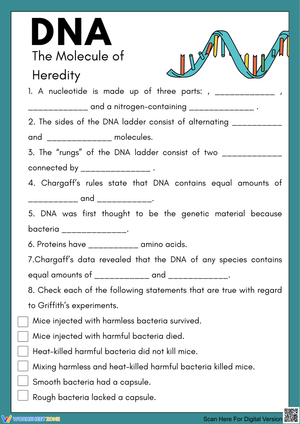
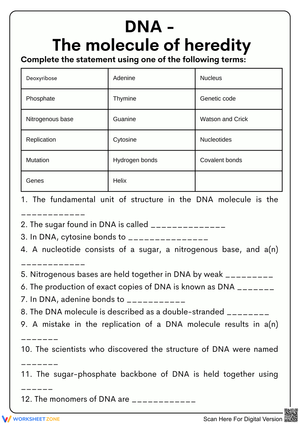
These DNA molecule of heredity worksheets for 10th grade give biology teachers a structured sequence of print-ready activities covering nucleotide structure, complementary base pairing, replication mechanics, and the central dogma — the core conceptual arc of every high school heredity unit. Each worksheet targets a specific phase of that arc so students build understanding incrementally rather than encountering every idea at once.
The Specific Skills Targeted Across the Set
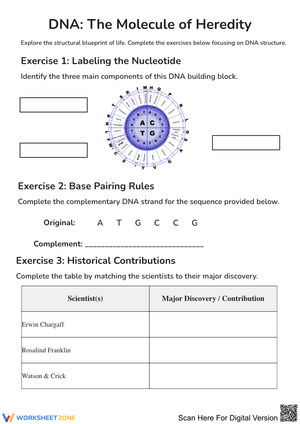
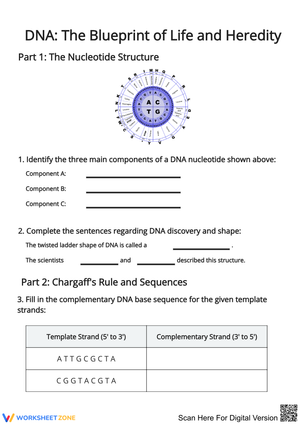
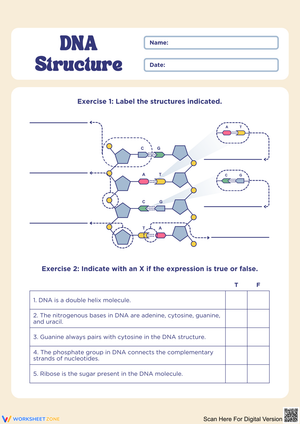
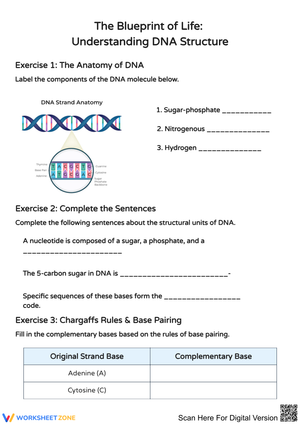
The foundation worksheets focus on nucleotide anatomy: students label the deoxyribose sugar, phosphate group, and nitrogenous base within a single nucleotide, then identify where adjacent nucleotides connect to form the sugar-phosphate backbone. A second layer asks students to draw and annotate the double helix itself — marking hydrogen bonds between base pairs, indicating the antiparallel orientation of the two strands, and distinguishing the 5' and 3' ends. Visual literacy at this level matters because students who cannot read a DNA diagram reliably will struggle with every subsequent topic in the unit.
Base-pairing worksheets ask students to write complementary strands for given DNA sequences and work through Chargaff's rules quantitatively. If a sample is 22% cytosine, students calculate guanine at 22% and divide the remaining 56% equally between adenine and thymine — a straightforward calculation that still produces errors when students misremember which bases are purines and which are pyrimidines. Replication worksheets introduce helicase and DNA polymerase in sequence, asking students to annotate a replication fork diagram with enzyme names, indicate the direction of synthesis on the leading and lagging strands, and explain why the lagging strand is built in fragments. The final worksheets in the set trace the central dogma: students follow a gene's base sequence through transcription into mRNA, identify codons, and use an amino acid table to translate a short polypeptide chain.
Why This Format Works for 10th Graders at This Stage of the Course
Tenth graders arrive at the DNA unit with uneven prior knowledge. Some remember Mendel from middle school; very few have any mental model of molecular-level processes. The conceptual load is genuinely high — students must hold structure, sequence, direction, and enzyme function in working memory simultaneously while also learning new vocabulary. Diagram-based worksheets reduce that load by externalizing the structure, giving students a concrete visual anchor while they work through relationships. Writing the complementary strand directly beneath a given sequence, for example, is a low-stakes procedural task that also reinforces the pairing rule through repetition — a form of spaced retrieval practice that works better than re-reading the textbook passage.
The worksheet format also makes misconceptions visible quickly. A completed labeling exercise tells you within 30 seconds which students reversed the sugar and phosphate positions, and a base-pairing strip tells you who is still guessing rather than applying the rule. That diagnostic speed is harder to achieve through discussion or a single end-of-unit test.
Mistakes Students Make That These Worksheets Help You Catch
The most persistent error in this unit is directional confusion during replication. Students understand that the two strands are antiparallel in the abstract but consistently draw both new strands synthesizing in the same direction on a replication fork diagram — usually left-to-right regardless of template orientation. The worksheets that require students to mark 5' and 3' labels on both the template and newly synthesized strands expose this confusion before it migrates to the unit exam.
A second common error involves Chargaff's rules: students who correctly pair adenine with thymine in a diagram will still answer a percentage question by distributing the remaining bases unevenly, because they have memorized the pairing rule as a matching fact without internalizing what it implies about quantity. The quantitative base-percentage exercises target this gap directly. A third pattern worth watching — especially visible in the central dogma worksheets — is students treating transcription and translation as one continuous step rather than two physically distinct processes. They will often write a protein sequence directly from a DNA template, skipping the mRNA intermediate. Catching this early, before the class reaches gene expression, saves significant reteaching time.
Building These Worksheets Into Your Unit Plan
Each worksheet fits naturally at the close-of-instruction phase of a lesson — after initial direct instruction or a model demonstration, before students attempt independent application on a longer assignment. The labeling worksheets work well as a 10- to 12-minute structured check during the first lesson on DNA structure; students complete them individually, compare with a partner, then surface disagreements for whole-class resolution. Doing this in the middle of the period, rather than at the end, preserves time to address the 5'-to-3' confusion before students leave.
The Chargaff's rules worksheet is well-suited to a warm-up slot at the start of day two, when the previous night's reading is still fresh but hasn't been consolidated. Replication worksheets run better after a physical or digital model demonstration — students who have watched helicase "unzip" a model complete the enzyme-annotation task more accurately than those working from text alone. The central dogma worksheet, because it synthesizes all prior content, functions best as a formative checkpoint before the unit test: collect and scan for the transcription-translation conflation error described above, and plan a brief whole-class correction if more than a quarter of the class shows it.
Adapting the Worksheets for a Range of Learners
For students who need scaffolding, pre-filling every third base in a complementary-strand exercise still requires them to apply the pairing rule, but removes enough blank space that the task feels tractable rather than overwhelming. Providing a labeled reference diagram of a single nucleotide alongside the double-helix worksheet eliminates the need to hold component names in working memory while students work on the larger structure. For students working above grade level, the replication worksheet becomes more demanding when you remove the enzyme name bank and ask students to write a brief justification for why DNA polymerase can only synthesize in the 5'-to-3' direction — a question that requires mechanistic reasoning rather than recall. The central dogma worksheet can be extended with a point mutation: change one base in the DNA sequence and ask students to trace how that single substitution propagates through transcription and translation to alter the final amino acid chain.
Standard Alignment
These worksheets align with NGSS performance expectation HS-LS1-1, which asks students to construct an explanation based on evidence for how the structure of DNA determines the structure of proteins that carry out the essential functions of life. In classroom terms, HS-LS1-1 is the anchor standard for the first half of any 10th-grade heredity unit — it comes before students tackle gene regulation, inheritance patterns, or biotechnology, because protein structure and function is the prerequisite concept for all of those topics. The labeling and base-pairing worksheets address the structure component of the standard; the replication and central dogma worksheets address the mechanism by which that structure produces functional proteins.
Frequently Asked Questions
Which worksheet in the set should I use first?
Start with the nucleotide anatomy and double-helix labeling worksheets before moving to base pairing or replication. Students who skip straight to complementary strand writing without a firm mental model of the molecule itself tend to treat the pairing rule as an arbitrary matching game rather than a structural constraint — and that surface-level understanding breaks down under exam conditions.
How do these DNA molecule of heredity worksheets handle vocabulary?
Key terms — nucleotide, deoxyribose, phosphate group, nitrogenous base, double helix, helicase, DNA polymerase, semi-conservative replication, transcription, translation, codon, and amino acid — appear consistently across the set rather than being introduced once and dropped. Students encounter the same terms in new contexts across multiple worksheets, which builds retention more reliably than a single vocabulary matching exercise.
Are answer keys available?
Many worksheets in this set include answer keys. Before distributing any worksheet, review the key against your classroom instruction to confirm that terminology and notation — particularly for strand directionality and enzyme labeling — match what you have taught. Small discrepancies between an answer key and classroom convention are the most common source of student confusion when keys are distributed for self-checking.
Clear All