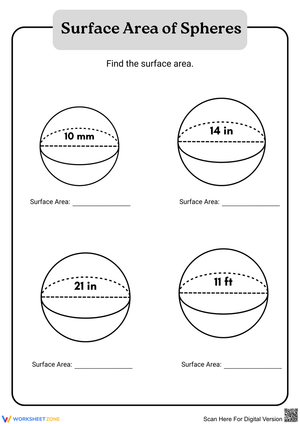
Surface Area of a Sphere Worksheets PDF for Grade 10
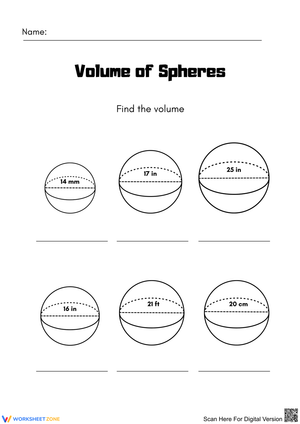
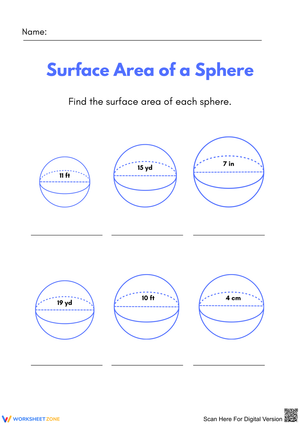
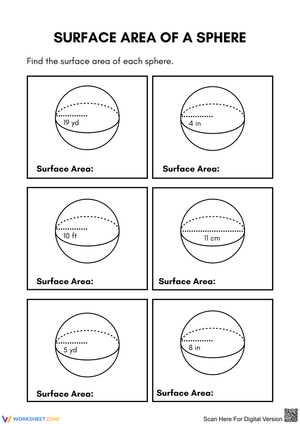
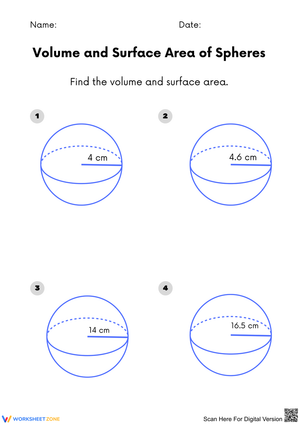
These surface area of a sphere worksheets for 10th grade give students structured, repeated practice with SA = 4πr² across problem types that mirror what actually shows up in assessments — labeled diagrams, radius-versus-diameter decisions, exact answers in terms of π, and decimal approximations. Each worksheet is a standalone practice sheet, and the set spans enough variation that teachers can pull from it across direct instruction, independent work, and review blocks without students seeing the same question format twice.
The Specific Skills Targeted Across the Set
Every worksheet in this set focuses on a manageable slice of the larger skill so students are not juggling too many decisions at once. The earliest worksheets ask students to identify whether a problem gives the radius or the diameter before any calculation begins — a small but important gatekeeping move that catches formula misapplication early. Later worksheets fold in word problems, mixed figure sets, and error analysis so students must retrieve and apply the formula without scaffolding.
- Direct substitution with radius: Students substitute a given radius into the formula and simplify, choosing between exact and decimal form based on the directions printed in each section.
- Diameter-to-radius conversion: Problems give a diameter value and require students to halve it before substituting — a step that produces one of the most consistent errors on assessments.
- Exact form in terms of π: Students leave answers as multiples of π rather than converting, reinforcing the difference between exact and approximate values.
- Decimal approximations: Students use π ≈ 3.14 or a calculator approximation and round to a specified place value, with rounding instructions stated clearly in each problem.
- Diagram reading: Several worksheets include labeled figures where the measure shown could be either the radius or diameter — students identify which before setting up the equation.
- Contextual word problems: Objects such as spherical water tanks, globes, and playground balls give students practice extracting the relevant measurement from a description and labeling the final answer in square units.
- Error analysis: Students examine a completed solution and identify where the calculation broke down, then correct it — a task that reveals whether they understand the formula's structure or are just mimicking procedure.
Standard Alignment
These worksheets align to CCSS.MATH.CONTENT.8.G.C.9, which addresses volume and surface area of cones, cylinders, and spheres. While that standard is formally introduced in Grade 8, most 10th grade geometry courses revisit it at greater depth — expecting fluency with both exact and decimal forms, multi-step problem setups, and correct unit labeling that the initial introduction does not always establish. Teachers using these worksheets in Grade 10 are typically reinforcing and extending prior learning, not introducing it for the first time, which is why the set emphasizes problem variety and formula flexibility over step-by-step scaffolding.
Mistakes Students Make That These Worksheets Help You Catch
The most common error — and the one most likely to go unnoticed in a homework check — is using the diameter value directly in 4πr² without halving it first. A student given a sphere with diameter 10 cm who writes 4π(10)² = 400π will produce an answer four times too large. That error looks like a computation choice, not a conceptual gap, unless the worksheet separates "identify the radius" from "compute the surface area" as distinct steps. Several worksheets in this set do exactly that.
A second persistent issue involves square units. Students who correctly substitute and simplify will write SA = 452.4 and stop — no unit, no "cm²," nothing. At the 10th grade level, this matters for standards alignment and for test scoring. Worksheets that ask students to circle the correct unit from a choice or write the unit in a blank before the final answer tend to improve this habit faster than reminders alone.
There is also the formula-confusion error that surfaces when sphere work immediately follows volume. Students who just spent a week on V = (4/3)πr³ will sometimes write it automatically when they see a round figure. The error analysis worksheets are the most useful tool here — asking a student to evaluate someone else's work activates a different kind of attention than solving their own problem.
How to Build These Worksheets Into Your Lesson Plans
The format supports different phases of instruction rather than a single use. After an introductory lesson, a short worksheet with six to eight radius-only problems functions well as the guided-release portion — students have the formula in front of them from the board and need to practice the mechanics before the diagram and diameter complexity arrives. That kind of low-stakes first repetition matters because working memory is still occupied with the formula itself.
Mid-unit, the mixed worksheets work well as 12- to 15-minute independent practice blocks. A question set that forces students to read the diagram, decide whether they are looking at a radius or diameter, and then choose the correct answer form produces meaningful formative data in one sitting. Circulating during those minutes, watching how students approach the first decision rather than the final calculation, tells you more about readiness than the final answer does.
For the days before a unit test, the error-analysis worksheet pulls double duty: it reviews the formula while also previewing the kinds of errors students need to avoid on the assessment. Pair it with a brief class discussion and you get a focused 20-minute review without re-teaching from scratch.
Adjusting the Worksheets for a Range of Learners
Students who struggle with the formula's structure benefit most from worksheets that include the formula printed at the top of the page and that label every diagram clearly. For these students, the goal during early practice is accurate substitution — the conceptual relationships can be revisited once the mechanical steps are reliable. Having them highlight the given measurement in each problem and write "r =" or "d =" before calculating reduces the number of things they track simultaneously.
For students who are ready for more, the scaffolding becomes a constraint. Assign worksheets with no formula bank and include problems that give surface area and ask for the radius — working the formula backward. Unit conversion problems (radius given in centimeters, answer requested in square meters) add another decision layer without requiring a different concept entirely. The equivalence extension — asking students to show algebraically why SA = πd² produces the same result as SA = 4πr² — turns a geometry worksheet into a brief moment of algebraic reasoning that connects two courses.
Frequently Asked Questions
Should students use SA = 4πr² or SA = πd²?
Both are correct and both appear across this set. SA = 4πr² is the standard form students should know, but SA = πd² is genuinely useful when a problem gives the diameter and a quick answer matters more than showing the halving step. Students who can explain why the two expressions are equivalent have a stronger grasp of the formula than students who have memorized only one version.
How many worksheets are in the set, and how long does each take?
The set includes multiple standalone worksheets at varying levels of difficulty. A focused computation worksheet typically takes 10 to 15 minutes. Word problem and error-analysis worksheets run closer to 15 to 20 minutes depending on the class. Answer keys are included so teachers can use any worksheet as a self-checking station without additional prep.
Can these be used for homework, or are they better for in-class practice?
Both work, and the answer depends on which worksheet in the set. The early, scaffolded worksheets are better for in-class guided or independent practice where you can observe the decision-making. Mixed and error-analysis worksheets make reasonable homework once students have demonstrated basic formula fluency in class — sending home an error-analysis task before students understand the correct process creates confusion rather than consolidation.
What if a student consistently gets the right number but the wrong unit?
That is a documentation habit, not a computation error, and it responds well to a targeted fix: require students to write the unit in the answer blank before they begin calculating, not after. Several worksheets in this set structure the answer line as SA = _______ ___² with a separate blank for the unit, which prompts the habit without requiring a separate lesson about it.
Clear All