10th Grade Sector Area worksheets – Printable Geometry Practice
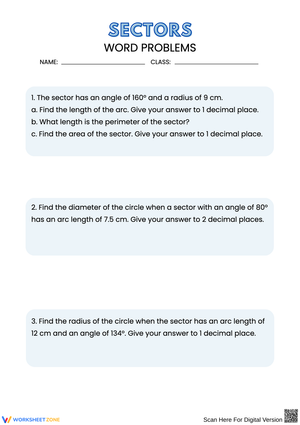
These 10th grade sector area worksheets resources give geometry teachers a ready-made progression — from straightforward formula application to composite-region problems — without requiring them to assemble that sequence from multiple sources. Each worksheet targets a specific layer of the concept, and the set as a whole covers what students need before a unit assessment on circles.
What the Set Covers
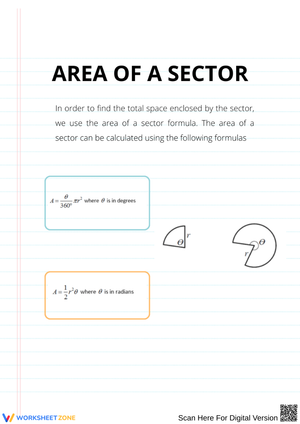
The core skill is computing sector area using the degree formula A = (θ/360) × πr², but the worksheets don't stop at basic substitution. Students also work with the radian version — A = ½r²θ — including problems that require converting between units before solving. A meaningful portion of each worksheet asks students to reverse the formula: given the area and the radius, find the central angle. That algebraic move is where formula-memorization errors get exposed, because students have to understand the equation's structure rather than simply recognize which numbers go where.
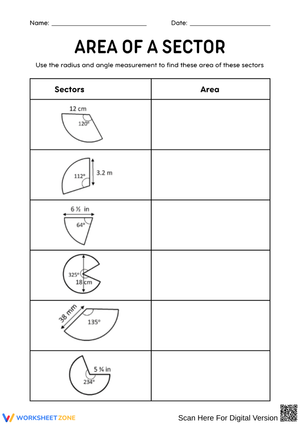
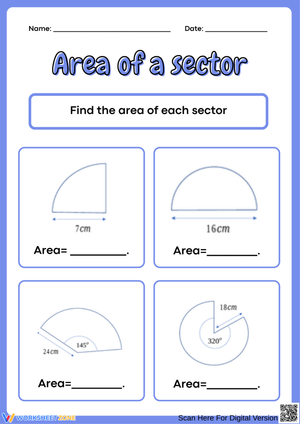
Visual diagrams of shaded sectors accompany most problems. Students identify the radius and central angle directly from the figure before applying any formula — a deliberate sequence, because the end-of-unit test asks students to read a diagram and extract values before computing. Skipping that reading step during practice is common, and students pay for it on assessments not because they forgot the formula but because they misread the figure.
Student Errors Worth Anticipating Before the Test
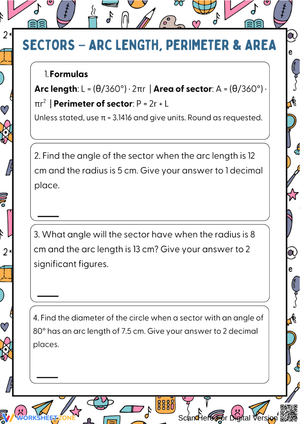
Two errors show up in student work on sector area consistently enough to plan around explicitly. The first is swapping the arc length formula for the sector area formula. Both involve the fraction θ/360, so students who have memorized the forms without understanding them will write L = (θ/360) × 2πr where they should write A = (θ/360) × πr². Placing both formulas side by side during instruction — one measuring a one-dimensional boundary, the other measuring a two-dimensional region — and holding that comparison for five minutes before assigning independent practice is time well spent.
The second error appears specifically in radian problems. When a central angle is given as π/3 radians, some students substitute 1/3 into the formula rather than treating π/3 as a single numerical value (approximately 1.047). This compounds when the problem asks for an exact answer, because students aren't sure whether to leave π in the expression or evaluate it numerically. The worksheets address this by labeling the angle unit explicitly on every problem and by including separate problems asking for exact form versus decimal approximation, so students practice making that distinction deliberately rather than guessing.
Working These Worksheets Into Your Lesson Sequence
A three-day rollout tends to work well. On day one, students work through the introductory worksheet during guided practice immediately after direct instruction — problems use degree measures only, diagrams are labeled clearly, and radius values are small enough that arithmetic doesn't compete with the new formula. On day two, a mid-level worksheet goes home for homework; the reverse-formula problems generate the most disagreement when students compare answers the next morning, and that disagreement produces a more productive discussion than reteaching from scratch. On day three, the composite-region worksheet runs as a small-group station before the unit quiz, where students can talk through multi-step setups without working alone under pressure.
These 10th grade sector area worksheets resources include step-by-step answer keys for every problem, which makes them practical for homework assignments, peer-checking rotations, or independent practice at a station. Teachers on a block schedule can run the introductory and mid-level worksheets in the same period, saving the composite-region problems for a separate class session.
Standard Alignment
Sector area sits under CCSS.MATH.CONTENT.HSG.C.B.5, which asks students to derive the formulas for arc length and sector area using proportional reasoning. The word derive matters here — the standard expects students to understand why the fraction θ/360 scales the full circle's area, not just apply a memorized result. Problems in the set ask students to explain or justify their setup before computing, which keeps that proportional reasoning in view rather than reducing the task to arithmetic. In most course maps, sector area falls after arc length and circle area and before inscribed angle theorems, so these worksheets drop into the unit without reorganization. Teachers reviewing for state assessments that test HSG.C.B.5 directly will find that the 10th grade sector area worksheets format — tiered by difficulty, answer-keyed, and printable — holds up for both initial instruction and later review.
Adjusting the Worksheets for a Range of Learners
Students who need additional support do best starting with sectors where the central angle is a familiar fraction of 360° — problems with 90°, 120°, or 180° central angles keep the arithmetic manageable while students focus on applying the formula correctly. Having those students write out the given values (central angle, radius, formula) before computing preserves working memory for the actual calculation. A short conversion warm-up — practicing the multiplication of degrees by π/180 — before the radian problems removes what is otherwise the single most common sticking point in that problem type.
Students working above grade level can be directed to the composite-region problems with the added constraint of expressing answers in exact form, leaving π unsimplified. Several of these problems require finding triangle dimensions using trigonometry before the sector area calculation can begin, which previews content from later in the course and reflects the actual complexity of HSG.C.B.5 items when that standard is tested at a rigorous level. These aren't busy-work extensions — they match what appears on honors assessments.
Frequently Asked Questions
What is the difference between the degree formula and the radian formula, and which one should students learn first?
The degree formula, A = (θ/360) × πr², is the better starting point because students already understand that a full circle spans 360°. The proportional reasoning is immediately accessible: a 90° sector covers one-fourth of the circle, so its area is one-fourth of πr². The radian version, A = ½r²θ, follows once students have a working understanding of radian measure. The worksheets sequence problems in that order — degree problems first, radian problems after — which mirrors the instructional sequence most geometry courses follow.
How is sector area different from arc length, and why do students mix them up?
Arc length measures the curved edge of the sector, a one-dimensional distance along the circle's boundary. Sector area measures the enclosed two-dimensional region. Both formulas use the fraction θ/360, which is exactly what causes the confusion — students who memorize forms without understanding them will pull the wrong one under pressure. The distinction is in what that fraction scales: arc length scales the circumference (2πr), while sector area scales the total circle area (πr²). Worksheets that include both problem types, clearly labeled, help students build the habit of checking what they are solving for before setting up any formula.
Are these worksheets appropriate for both standard and honors geometry classes?
The introductory and mid-level worksheets fit standard geometry without modification. The composite-region problems — particularly those requiring trigonometric reasoning to find triangle dimensions before computing sector area — match honors-level expectations. That range makes this 10th grade sector area worksheets set practical for teachers running standard and honors sections, or for mixed-ability classes where different student groups work to different depths on the same material.
Clear All