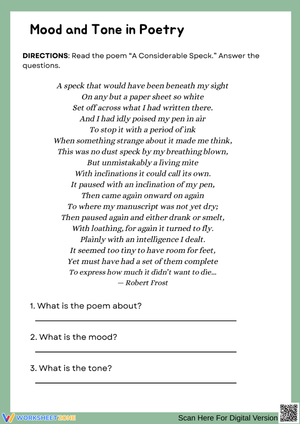
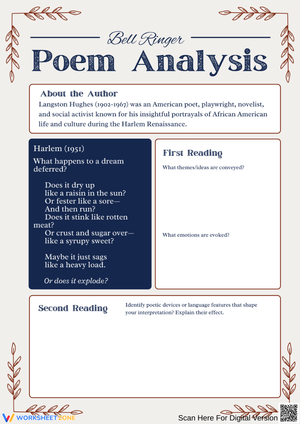
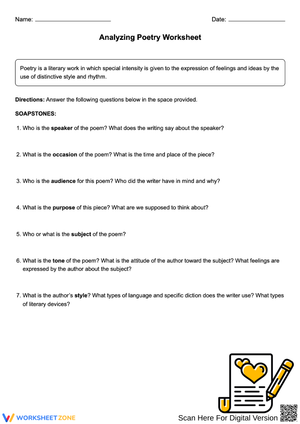
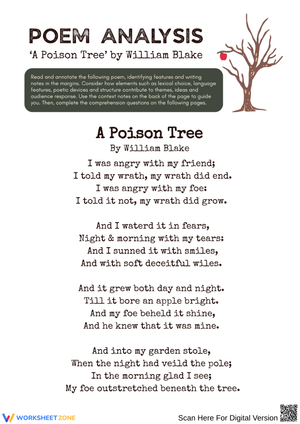
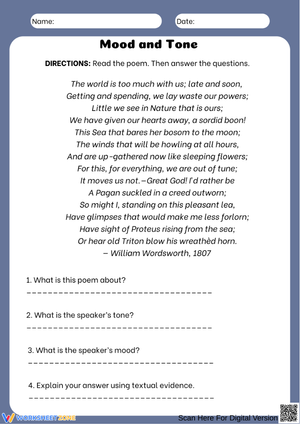
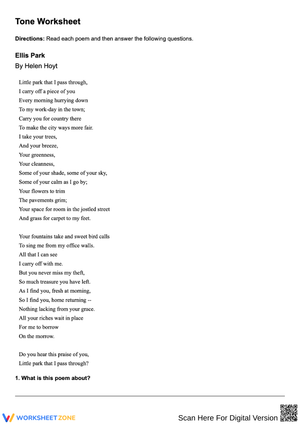
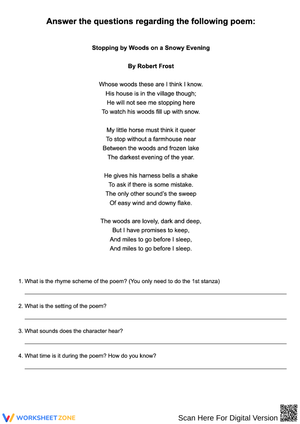
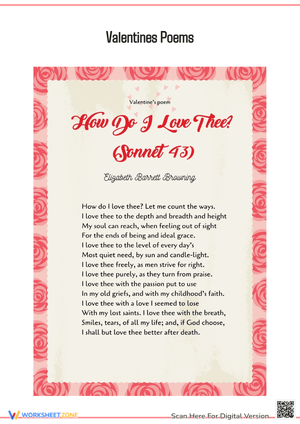
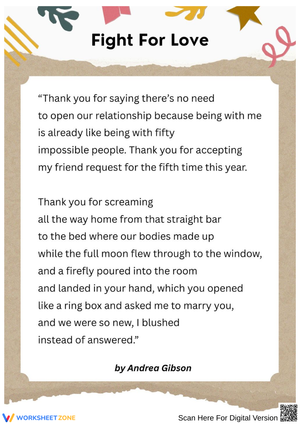
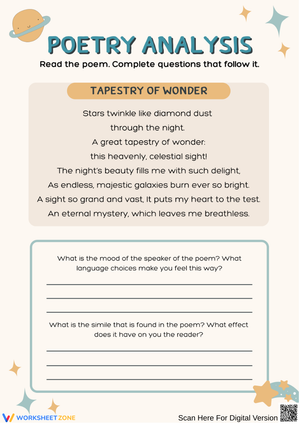
These 10th grade poetry analysis printable worksheets move students through a full reading-to-writing sequence — annotation, text-dependent questioning, and a short evidence-based response — without letting the poem collapse into a vocabulary exercise. Most print-and-go poetry materials stop at term identification. This set pushes students to explain what a poet's language choices actually do.
The Specific Skills Each Worksheet Targets
Each worksheet addresses one poem with prompts organized around the analytical moves that matter most at this level:
- Speaker and perspective: Students identify who is speaking and explain how that position shapes the poem's meaning — not just "the speaker feels isolated," but how the speaker's limited vantage point constrains what the poem can say outright.
- Tone: Students select specific words that establish tone, then explain the connotations those words carry. This prevents the common shortcut of labeling tone without any evidence.
- Imagery and figurative language: Prompts direct students to mark sensory details and comparisons, then analyze their cumulative effect on the poem's central idea rather than treating each device as a separate checklist item.
- Structure and form: Students note line breaks, stanza divisions, and shifts in voice or tense, then explain what those formal choices contribute to meaning.
- Theme development: The final analytical prompt on each worksheet asks students to trace how a larger idea builds across the poem, supported by at least two specific pieces of textual evidence.
The written response that closes each worksheet is the skill that pays off most in formal assessment. Students practice moving from noticing a technique to explaining what it accomplishes — the core intellectual move tested on AP exams, state ELA assessments, and most district writing benchmarks.
Frequent Student Errors Worth Watching For
Three patterns appear persistently in tenth-grade poetry analysis. First, students conflate tone with mood. They write that a poem "feels hopeless" when the prompt asks about tone — they are describing their own emotional response, not the speaker's attitude as constructed through word choice. The prompts counter this by requiring students to quote the specific words that create the effect before naming it.
Second, when asked to support a claim about theme, students tend to cite sprawling sections: "In the whole third stanza, the poet shows…" That kind of evidence is unquotable in a formal essay. Prompts in the set require a specific line or phrase, and they ask students to explain the word-level choices rather than summarize broadly.
Third — and this is the trickiest error to correct — students treat metaphors as decoration. A student who reads "The winter of her years had settled in" will write "The poet compares the woman to winter" and stop. The prompts push students to ask what the comparison does: what does winter connote that spring or autumn would not, and how does that choice shift the poem's emotional register? That additional analytical step is where analysis separates from summary, and it is the step most students skip without a direct prompt forcing it.
How to Build These Worksheets Into Your Lesson Plans
The most effective approach splits the work across two class periods rather than treating each worksheet as a single sitting. On day one, students do a first reading with minimal direction — reactions and surface-level observations only — before returning to the analytical prompts on day two with fresh eyes and a clearer sense of the poem's structure. For dense or ambiguous poems, that two-pass approach produces noticeably stronger written responses than pushing through in one block.
For the Friday review block or the last ten minutes before a unit test, one worksheet makes a clean formative check: students annotate and answer two or three prompts rather than the full sequence, and teachers can scan responses quickly for gaps in evidence use before assessment day. In a sub plan context, a well-sequenced worksheet with numbered prompts holds up without direct instruction — there is enough built-in structure for students to work through the poem independently.
One move worth trying: print two copies of the poem, one for open annotation and one attached to the worksheet. Students who know one copy is purely for marking tend to annotate more freely — arrows, margin tangents, crossed-out first impressions. All of that productive clutter migrates to the reading copy, which keeps the worksheet version clean and produces more precise, selective evidence when students move to the written response.
Standard Alignment
The set connects directly to CCSS ELA-Literacy RL.9-10.4, which asks students to determine the meaning of words and phrases, including figurative and connotative meanings, and to analyze the cumulative impact of specific word choices on meaning and tone. That standard drives most of the prompts. RL.9-10.5 is addressed through structure-focused questions — students examine how stanza breaks, line length, and formal shifts contribute to meaning rather than simply noting that they exist. RL.9-10.2 appears in the theme prompts, where students trace a central idea across the full poem and support their interpretation with specific textual evidence. W.9-10.9b, the evidence-based writing standard for literary analysis, is addressed every time students write a short analytical response.
In classroom terms, RL.9-10.4 is the standard that trips up most tenth graders because it requires holding two things simultaneously: what a word denotes and what it implies. The tone prompts on these 10th grade poetry analysis printable worksheets isolate that exact skill before students have to apply it under pressure in a longer essay — which is exactly where students need the deliberate practice most.
Adjusting the Worksheets for a Range of Learners
Within a typical Grade 10 class, reading confidence with poetry can span several levels. Students who have strong fiction comprehension often struggle specifically with compressed syntax and line breaks — they read a poem like a paragraph and miss the white space entirely. Asking those students to read the poem aloud once before writing, paying attention to where their voice naturally pauses, helps them hear the structure before they analyze it.
For students who need more entry points into the task without reducing the analytical demand, a few targeted adjustments work well:
- Stanza-by-stanza summaries first: Before attempting tone or theme prompts, students write a one-sentence summary of each stanza. This builds a basic map of the poem before analysis begins, which reduces the feeling that the poem is impenetrable.
- Sentence frames for evidence: The poet's use of ___ in line ___ suggests ___ because ___ gives students the analytical sentence structure without supplying the thinking.
- Single-element first reads: Direct some students to mark only imagery on the first pass, only repetition on the second. Narrowing the focus reduces cognitive overload and produces more usable material before students write across multiple elements at once.
- Oral rehearsal before writing: Partner talk before the written response lets students test an interpretation aloud before committing it to paper — a small step that consistently improves written response quality.
Advanced students can work through the same 10th grade poetry analysis printable worksheets with one additional constraint: every piece of evidence they select must connect the poem's formal choices — line breaks, stanza structure, sound patterns — to its meaning. That requirement produces noticeably stronger writing and remains challenging even for students who find the standard prompts straightforward.
Frequently Asked Questions
Do these worksheets include the poem text, or do teachers need to supply it separately?
Each worksheet includes the poem printed directly on the same page, with numbered lines to support citation. Teachers do not need to locate or format the poem separately before class.
Can these worksheets be used alongside poems already in an existing unit?
Teachers can use these 10th grade poetry analysis printable worksheets with their own text selections, though the prompts are written around specific poems and may require minor adjustments when paired with different texts. The analytical framework — tone, imagery, structure, theme, evidence-based response — transfers across most poems appropriate for Grade 10.
How long does a full worksheet typically take in class?
For most Grade 10 students, the annotation and questioning sequence runs roughly 35 to 45 minutes. The written response, completed in the same period, adds another 10 to 15 minutes. Many teachers split the work: annotation and questions on day one, timed written response on day two. That approach consistently produces stronger final writing.
Are teacher answer keys included?
Yes. Each worksheet comes with an answer key that includes sample responses for the analytical questions and the written response. The sample responses model the evidence-citation format that RL.9-10.4 and W.9-10.9b require, which makes them useful for direct instruction as well as independent teacher review.












 Interactive Worksheet Maker
 Quiz Maker
 Word Search Maker
 Crossword Puzzle Maker
 Word Scramble Generator
 Sentence Scramble Generator
 Handwriting Worksheet Generator
 Name Tracing Generator
 Fill In The Blank Generator