Why spacing between words matters in 1st grade literacy
Spacing between words is one of the first print habits that helps young readers make sense of a sentence. In Grade 1, students are moving from hearing words in speech to seeing those words clearly separated in print. When that visual separation is missing, connected text can look like one long string, and that makes both reading and writing harder than it needs to be.
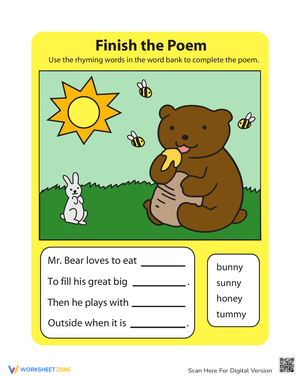
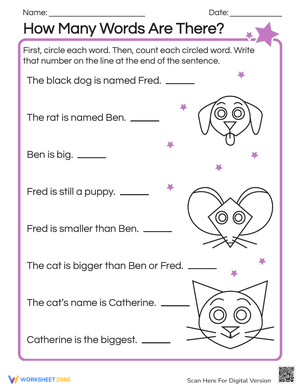
That is why spacing between words fill in the blank worksheets printable for 1st grade are so useful in early literacy blocks. They keep the task small and visible. Instead of asking students to manage a long passage, teachers can focus attention on a short sentence pattern, a missing word, or a simple rewrite that shows where one word ends and the next begins.
These pages also fit naturally inside concept-of-print instruction. Students are still strengthening left-to-right tracking, one-to-one matching, and the difference between a letter, a word, and a sentence. A printable spacing page gives teachers a fast way to review those ideas while students practice readable sentence construction.
What strong fill-in-the-blank spacing worksheets include
The best Grade 1 spacing pages do not overwhelm students with too much print. They use familiar language, short lines, and sentence frames that keep attention on word boundaries. When the worksheet design is simple, teachers can tell whether a student understands spacing or is just guessing through a crowded page.
- Short, decodable, or familiar sentence patterns that first graders can read aloud.
- Clear blanks that direct attention to one missing word or one spacing choice at a time.
- Large enough print for students to point, track, and rewrite comfortably.
- Visual separation between items so students are not distracted by a dense layout.
- Tasks that let teachers spot whether spacing breaks down during copying, dictation, or sentence repair.
For classroom planning, that matters more than decorative features. Teachers usually want a page they can print quickly, model once, and reuse during centers, intervention, morning work, or a quick check at the end of a lesson. A focused worksheet does that well because it keeps the target skill visible from the first sentence to the last.
How spacing practice supports reading and writing at the same time
Spacing work is often grouped with writing, but it supports reading development too. When students can identify spaces between words, they are better able to track print accurately and connect spoken language to what appears on the page. That concept-of-word understanding is especially important in first grade, when students are expected to read short sentences with more independence.
Fill-in-the-blank tasks are effective because they slow the sentence down just enough. A student has to notice the sentence frame, think about the missing word, and then place it in a structure where the spaces make the sentence readable. Sentence rebuild tasks do something similar. Students may cut apart or rewrite a line such as a simple patterned sentence, and the teacher can immediately see whether they group letters correctly into words.
This is also where spacing practice differs from phonics or handwriting practice. Phonics asks students to connect sounds to letters and patterns. Handwriting focuses on letter formation, size, and control. Spacing worksheets sit in a different lane: they help students recognize and produce boundaries between whole words in connected print. Those skills overlap during literacy instruction, but the teaching goal is not identical.
Why printable pages work well for centers and quick checks
Teachers often need concept-of-print review that does not require a long setup. Printable pages are useful because they can be introduced in under five minutes and then used across several routines. In a literacy center, students can complete one page independently after a short teacher model. During intervention, the same format can be used with closer prompting and immediate feedback. For morning work, one short page can reactivate a skill students practiced the day before.
These worksheets also work well as formative checks because the evidence is easy to read. If a student consistently writes a sentence with letters bunched together, the teacher knows the issue is not just accuracy on the missing word. If the missing word is correct and the spacing holds across the sentence, that suggests the student is transferring print awareness into written work.
For Grade 1 classrooms, that efficiency matters. Teachers are usually balancing phonics, read-aloud, shared reading, small groups, and writing in the same block. A short printable that targets spaces between words gives a narrow, manageable checkpoint without turning the lesson into a full assessment event.
Classroom Implementation
One practical routine is to model a sentence first, complete a worksheet second, and finish with a quick oral check. For example, the teacher reads a short sentence aloud, tracks each word with a finger, and asks students to identify where the spaces belong. Students then complete a fill-in-the-blank or sentence repair page that mirrors the model.
- Use one page during small group review when students need direct prompting on where words begin and end.
- Place the same format in literacy centers later in the week so students practice with less support.
- Keep an extra copy for fast finishers who still benefit from simple concept-of-print reinforcement.
- Use completed pages as a quick sorting tool: secure, developing, or needs reteaching.
It also helps to keep the language familiar. If the sentence pattern is new and the vocabulary is challenging, the worksheet may turn into a decoding task instead of a spacing task. In most cases, first graders show their understanding more clearly when the text uses common classroom words, predictable syntax, and short statements they can say aloud before they write.
How to differentiate without changing the core skill
Spacing instruction is more effective when the task stays constant but the support changes. Some students need strong visual cues, such as wider blanks or fewer words on a line. Others are ready for sentence editing where the spaces are removed and must be restored. Both groups are practicing the same concept of print, but the entry point is adjusted.
Teachers can also vary the amount of language on the page. A student who is still developing concept-of-word understanding may do best with three to five short items. A student who is closer to independence can handle several complete sentences and then explain how the spaces help the sentence make sense.
A useful pattern in first-grade intervention is to watch for spacing breakdown during copying rather than only during dictation. When a child can say a sentence clearly but still compresses words while copying a 6-word line, the issue is often visual attention to print boundaries, not vocabulary knowledge. That distinction helps teachers choose a tighter concept-of-print review instead of assigning more handwriting volume.
What the cited literacy sources suggest for planning
Reading Rockets' Basics - Print Awareness explains that early readers need to understand how print works, including that spaces separate words. Reading Rockets' Concepts of Print Assessment also frames print awareness as observable in how students handle tracking and word boundaries. The Florida Center for Reading Research emergent literacy snapshot supports teaching foundational print ideas in explicit, focused routines rather than in overloaded tasks.
Reading Rockets and the Florida Center for Reading Research point in the same direction for classroom use: keep the target visible, keep the text manageable, and observe student behavior closely. For a first-grade worksheet, that usually means a small set of short sentences rather than a long reading passage or an open-ended writing demand.
According to Reading Rockets' print awareness overview and concepts-of-print assessment guidance, children need explicit practice noticing that spaces mark separate words in print. Paired with the Florida Center for Reading Research snapshot on emergent literacy foundations, a 5- to 10-sentence worksheet becomes a strong instructional check because it is brief, repeatable, and easy for teachers to review for word-boundary errors.
Frequently Asked Questions
1. What do spacing between words worksheets teach in 1st grade?
They teach students to notice and use spaces to separate one word from the next. In first grade, that supports concept-of-print development, more accurate tracking while reading, and clearer sentence writing.
2. How can teachers use fill-in-the-blank spacing pages in literacy centers?
Teachers can model one sentence first, then let students complete a short printable independently or with a partner. The best center use keeps the language familiar so the main demand stays on spacing, not on solving unfamiliar vocabulary.
3. What should educators look for in printable concept-of-print worksheets?
Look for short sentences, uncluttered layout, readable print size, and tasks that make word boundaries visible. Pages should help you tell whether students can apply spaces between words, not just whether they can guess a missing word.
4. How is spacing practice different from phonics or handwriting practice?
Spacing practice focuses on where words begin and end in connected print. Phonics focuses on sound-symbol relationships, and handwriting focuses on letter formation and control. In the classroom, these areas interact, but the instructional purpose of a spacing worksheet is narrower and easier to observe.












 Interactive Worksheet Maker
 Quiz Maker
 Word Search Maker
 Crossword Puzzle Maker
 Word Scramble Generator
 Sentence Scramble Generator
 Handwriting Worksheet Generator
 Name Tracing Generator
 Fill In The Blank Generator