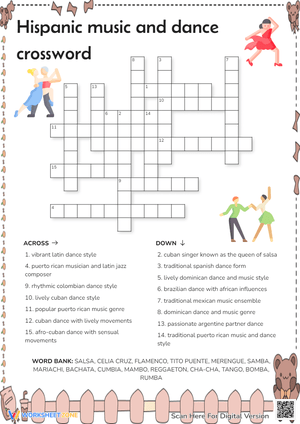
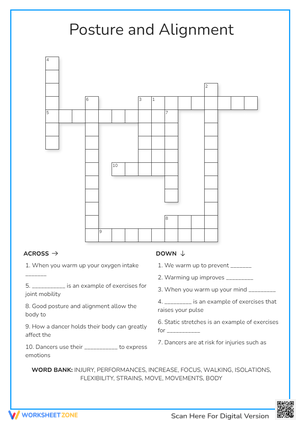
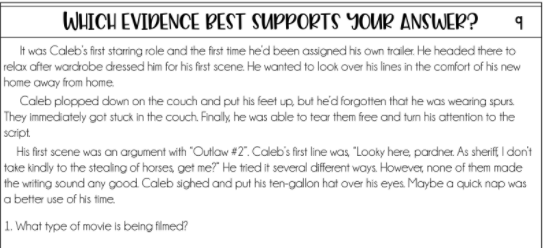
These dance worksheets give elementary arts teachers a written anchor for movement experiences that would otherwise leave no trace once the music stops. The set covers spatial concepts, dance vocabulary, movement-quality analysis, and basic choreography planning — the core language students need to talk about dance the way practitioners do, not just the way movers do.
What the Set Teaches
The skills targeted here run from foundational vocabulary through applied observation. Students identify and sort locomotor movements — traveling across space: walking, sliding, galloping — from non-locomotor ones, which are axial movements that stay in place: twisting, swaying, stretching. They label diagrams showing the three levels (high, medium, and low) and practice matching each level to movement examples. Pathway work asks students to trace floor patterns: straight, curved, and zigzag. Movement quality descriptors — sharp, smooth, heavy, light — appear in matching tasks and short written responses.
Several worksheets address choreography planning at an introductory level. Students fill in simple sequence maps showing beginning, middle, and end, then add notations for the level and energy quality of each movement. This is where writing and physical practice connect most directly: a student who can map a four-count phrase on paper has begun internalizing structure that stronger dancers carry in their bodies without thinking about it.
Student Misconceptions Worth Catching Early
The most common error across movement vocabulary work is conflating "pathway" with "direction." A student who understands that sliding to the right is movement in a sideward direction will still describe it as a "straight pathway" — because it is. What they miss is that pathways refer to the floor pattern of travel over time, not a single movement's orientation. When asked to draw their pathway during a galloping exercise, many students draw an arrow pointing sideways rather than a winding floor map. Naming this distinction explicitly before the worksheet, not during it, prevents most of that confusion.
A second recurring problem: students use everyday language instead of dance terminology even after vocabulary instruction. They write "she goes up" instead of "the dancer moves to a high level," or "it's fast and strong" instead of "the movement has a sharp, heavy quality." This is less an error than a translation problem — the professional terms haven't yet displaced the informal ones in working memory. Worksheets that require students to locate the precise term in a word bank before writing it in a sentence force that translation step deliberately, and it works.
Working These Worksheets Into Your Arts Block
The most reliable approach is to use each worksheet immediately after a movement experience rather than before it. Students who have just spent eight minutes practicing three different pathway types will fill in a pathway-labeling worksheet with a specificity they cannot fake — they can feel the difference between a curved and a zigzag route because they just traced both across the gym floor. Giving the worksheet first, as a preview, tends to produce guessing rather than genuine recall.
For teachers who have a short arts integration block rather than a dedicated dance period, the observation and analysis worksheets work well independently. Cue up a three-minute clip of a professional or student performance, hand out the relevant worksheet, and watch students annotate what they see. These work cleanly as ten-minute warm-up activities at the start of a Friday period, or as the closing task after a movement session — students drop from high-energy movement into quiet analytical writing while the experience is still fresh.
The choreography planning worksheets are most productive when used as paired or small-group tasks. Two students working together on a sequence map produce better notation than students working alone, partly because they have to argue about what to write. "Is that a medium level or a low level?" is exactly the kind of productive disagreement that deepens vocabulary retention. Collecting these worksheets before and after students perform their sequences surfaces a useful gap: what they planned and what they actually did rarely match, and that gap is a natural conference point.
Adjusting the Work Across Ability Levels
For students who are newer to formal dance vocabulary, the matching and labeling worksheets provide enough structure to complete successfully without prior knowledge — students can reason through unfamiliar terms by eliminating options. Adding a visual glossary card alongside each worksheet gives those students reference support without modifying the task itself. These dance worksheets are formatted with enough white space that teachers can write in additional context or quick visual cues for students who need it, without reprinting anything.
Students who move through vocabulary tasks quickly benefit from the analysis tasks pushed further. Instead of identifying the level used in a performance clip, ask them to argue in writing why a choreographer chose that level — what effect does a sequence at a low level create that a high-level version would not? This shifts the work from identification to interpretation, a meaningfully higher cognitive demand without requiring entirely different materials. Teachers working in gifted programming have also used the choreography planning worksheets as a framework for longer independent projects spanning several weeks.
Standard Alignment
These worksheets align with the 2014 National Core Arts Standards for Dance, specifically Anchor Standard 1 (Generate and conceptualize artistic ideas and work) and Anchor Standard 7 (Perceive and analyze artistic work). In classroom terms, Anchor Standard 1 maps onto the choreography planning and sequence worksheets — students are building and notating original movement ideas. Anchor Standard 7 maps onto the observation and analysis worksheets, where students watch a performance and document what they perceive. Both anchor standards appear across grade bands from PreK through grade 8, which means most worksheets in the set are usable across multiple elementary levels with adjustments only to the expected volume and depth of written output.
Frequently Asked Questions
Can these worksheets be used by classroom teachers who don't have a dance background?
Yes, and that is largely the point. The vocabulary and concept work on each worksheet is self-contained enough that a classroom teacher facilitating a movement brain break can hand one out without introducing the terminology in depth beforehand. The matching and sorting tasks do that work for you. Where background knowledge matters more — performance analysis, choreography feedback — a quick review of the answer key before class is enough preparation for most generalist teachers.
How do these fit into a physical education setting versus an arts setting?
Physical education teachers tend to use the locomotor and non-locomotor worksheets, the spatial concepts work (levels, pathways, directions), and the movement-quality vocabulary tasks — all of which connect directly to National PE Standards and motor skill development units. Arts specialists lean more heavily on the observation, analysis, and choreography worksheets. There is enough overlap that dance worksheets from this set have been used productively by both PE generalists and dedicated arts teachers without modification.
Are there worksheets in the set appropriate for kindergarten students?
The labeling and matching worksheets work at the kindergarten level when students are read the terms aloud or paired with a visual glossary. The observation and written-analysis tasks assume some independent writing ability and fit better from second grade up. Teachers who want to use these dance worksheets with younger students often have the whole class complete a worksheet together as a shared writing exercise before using it as independent practice — a useful approach when the vocabulary is new but the movement concepts are already familiar from classroom routines.












 Interactive Worksheet Maker
 Quiz Maker
 Word Search Maker
 Crossword Puzzle Maker
 Word Scramble Generator
 Sentence Scramble Generator
 Handwriting Worksheet Generator
 Name Tracing Generator
 Fill In The Blank Generator