


























0
Views
0
Downloads

0.0
0
Save
0 Likes
Share
Chemical vs Physical Properties Worksheet
0 Views
0 Downloads
Paste this activity's link or code into your existing LMS (Google Classroom, Canvas, Teams, Schoology, Moodle, etc.).
Students can open and work on the activity right away, with no student login required.
You'll still be able to track student progress and results from your teacher account.
Information
Description
What It Is:
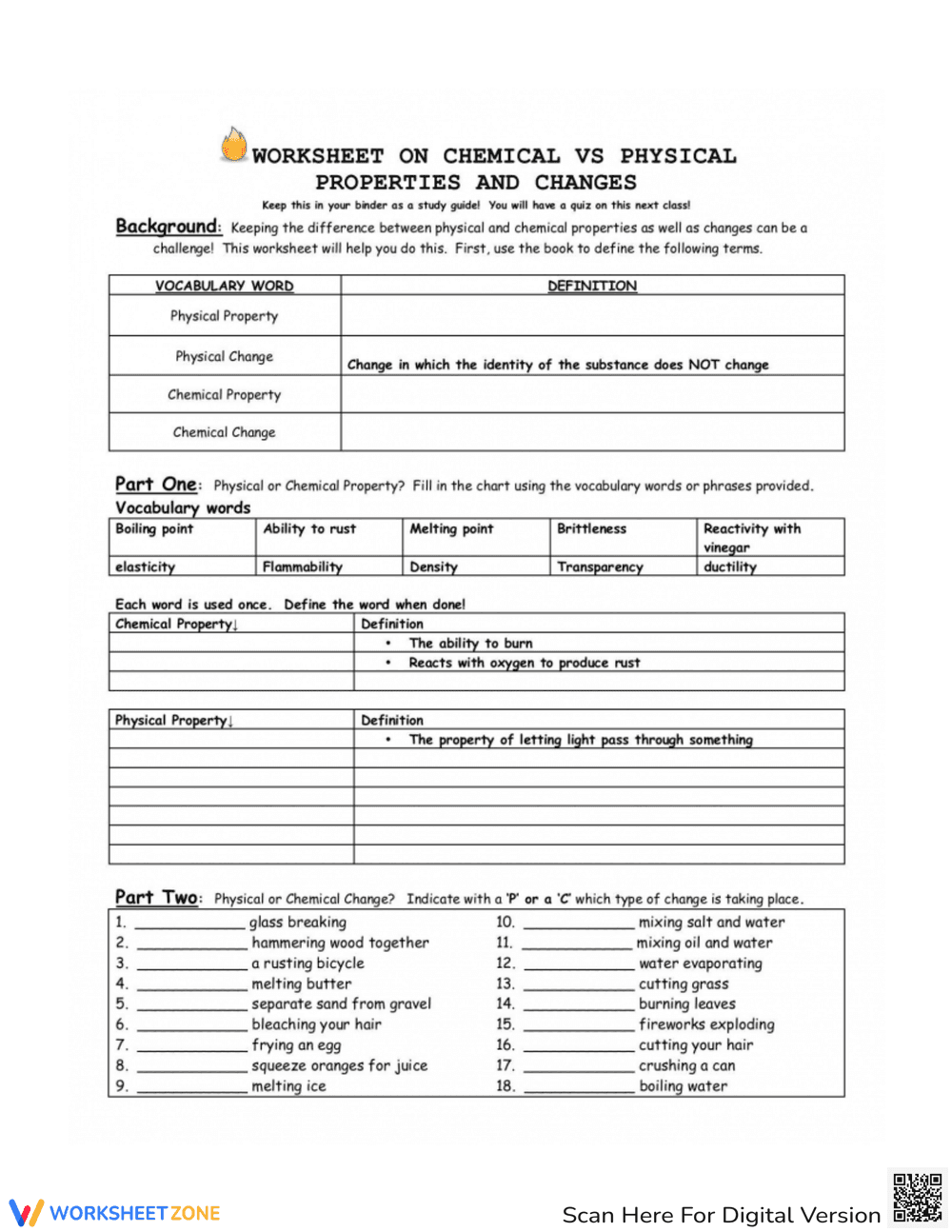
This is a worksheet focused on teaching the difference between chemical and physical properties and changes. It includes a vocabulary section where students define terms like 'Physical Property,' 'Physical Change,' 'Chemical Property,' and 'Chemical Change.' Part one requires students to categorize vocabulary words such as 'boiling point,' 'flammability,' and 'density' as either physical or chemical properties. It also asks students to define 'Chemical Property' and 'Physical Property' using provided definitions. Part two lists various scenarios like 'glass breaking' and 'a rusting bicycle' and asks students to identify each as either a physical or chemical change by writing 'P' or 'C.'
Grade Level Suitability:
This worksheet is suitable for middle school (grades 6-8) and early high school (grade 9). The concepts of physical and chemical properties are typically introduced around these grade levels. The vocabulary and activities are designed to reinforce understanding of these concepts.
Why Use It:
This worksheet helps students solidify their understanding of the differences between physical and chemical properties and changes. It encourages critical thinking by requiring them to apply these concepts to real-world examples. The worksheet reinforces vocabulary and provides a structured way to learn and review the material.
How to Use It:
Start by having students define the vocabulary words in the first section using a textbook or other resources. Then, guide them through part one, discussing the characteristics of physical and chemical properties. Finally, have them complete part two independently or in small groups, justifying their choices for each scenario. Review the answers as a class to address any misconceptions.
Target Users:
This worksheet is designed for students in middle school and early high school science classes who are learning about physical and chemical properties and changes. It can also be used for review or as a supplemental activity for students who need extra practice with these concepts.
This is a worksheet focused on teaching the difference between chemical and physical properties and changes. It includes a vocabulary section where students define terms like 'Physical Property,' 'Physical Change,' 'Chemical Property,' and 'Chemical Change.' Part one requires students to categorize vocabulary words such as 'boiling point,' 'flammability,' and 'density' as either physical or chemical properties. It also asks students to define 'Chemical Property' and 'Physical Property' using provided definitions. Part two lists various scenarios like 'glass breaking' and 'a rusting bicycle' and asks students to identify each as either a physical or chemical change by writing 'P' or 'C.'
Grade Level Suitability:
This worksheet is suitable for middle school (grades 6-8) and early high school (grade 9). The concepts of physical and chemical properties are typically introduced around these grade levels. The vocabulary and activities are designed to reinforce understanding of these concepts.
Why Use It:
This worksheet helps students solidify their understanding of the differences between physical and chemical properties and changes. It encourages critical thinking by requiring them to apply these concepts to real-world examples. The worksheet reinforces vocabulary and provides a structured way to learn and review the material.
How to Use It:
Start by having students define the vocabulary words in the first section using a textbook or other resources. Then, guide them through part one, discussing the characteristics of physical and chemical properties. Finally, have them complete part two independently or in small groups, justifying their choices for each scenario. Review the answers as a class to address any misconceptions.
Target Users:
This worksheet is designed for students in middle school and early high school science classes who are learning about physical and chemical properties and changes. It can also be used for review or as a supplemental activity for students who need extra practice with these concepts.


