




























0
Views
0
Downloads

Save
0 Likes
Share
Label the Animal Cell: Biology Worksheet
0 Views
0 Downloads

Paste this activity's link or code into your existing LMS (Google Classroom, Canvas, Teams, Schoology, Moodle, etc.).
Students can open and work on the activity right away, with no student login required.
You'll still be able to track student progress and results from your teacher account.
Information
Description
What It Is:
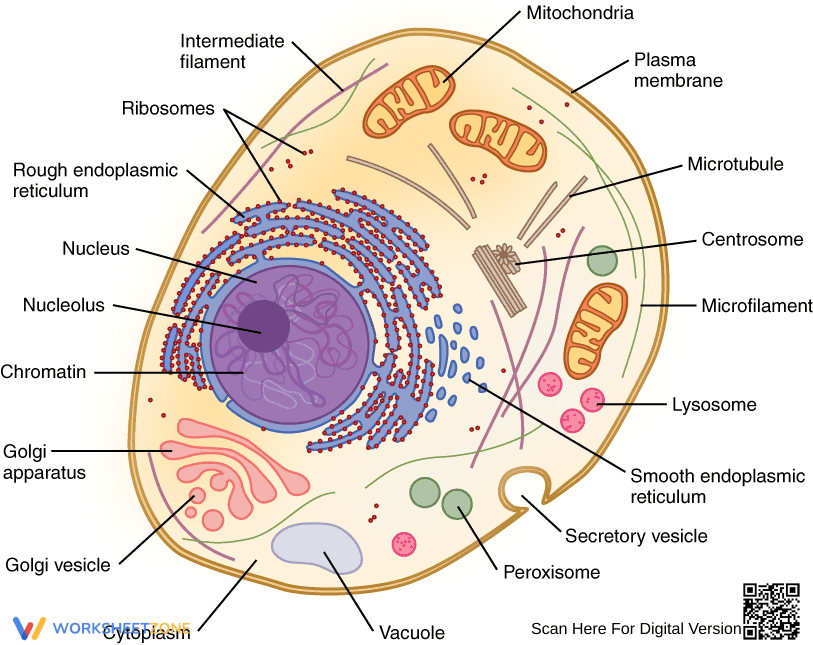
This is a labeled diagram of an animal cell. It identifies and labels key organelles within the cell, including the nucleus, nucleolus, chromatin, ribosomes, rough endoplasmic reticulum, smooth endoplasmic reticulum, Golgi apparatus, Golgi vesicle, mitochondria, plasma membrane, lysosomes, peroxisome, secretory vesicle, cytoplasm, vacuole, intermediate filament, microtubule, centrosome and microfilament.
Grade Level Suitability:
This worksheet is suitable for middle school (grades 6-8) and high school (grades 9-12) biology classes. The diagram provides a clear visual representation of cell structure, which is a fundamental concept in biology. The labels help students learn the names and locations of the different organelles.
Why Use It:
This diagram helps students visualize the complex structure of an animal cell and learn the names and locations of its organelles. It can be used to introduce cell biology, reinforce learning, or as a review tool. It promotes visual learning and helps students build a strong foundation in cell structure.
How to Use It:
Use this diagram as a reference while learning about cell structure. Students can use it to label their own diagrams, create flashcards, or study for quizzes and tests. Teachers can use it as a visual aid during lectures or as part of a worksheet activity.
Target Users:
This worksheet is designed for students learning about cell biology in middle school and high school. It is also useful for teachers who need a clear and accurate diagram of an animal cell for their lessons.
This is a labeled diagram of an animal cell. It identifies and labels key organelles within the cell, including the nucleus, nucleolus, chromatin, ribosomes, rough endoplasmic reticulum, smooth endoplasmic reticulum, Golgi apparatus, Golgi vesicle, mitochondria, plasma membrane, lysosomes, peroxisome, secretory vesicle, cytoplasm, vacuole, intermediate filament, microtubule, centrosome and microfilament.
Grade Level Suitability:
This worksheet is suitable for middle school (grades 6-8) and high school (grades 9-12) biology classes. The diagram provides a clear visual representation of cell structure, which is a fundamental concept in biology. The labels help students learn the names and locations of the different organelles.
Why Use It:
This diagram helps students visualize the complex structure of an animal cell and learn the names and locations of its organelles. It can be used to introduce cell biology, reinforce learning, or as a review tool. It promotes visual learning and helps students build a strong foundation in cell structure.
How to Use It:
Use this diagram as a reference while learning about cell structure. Students can use it to label their own diagrams, create flashcards, or study for quizzes and tests. Teachers can use it as a visual aid during lectures or as part of a worksheet activity.
Target Users:
This worksheet is designed for students learning about cell biology in middle school and high school. It is also useful for teachers who need a clear and accurate diagram of an animal cell for their lessons.


