


























Views
Downloads
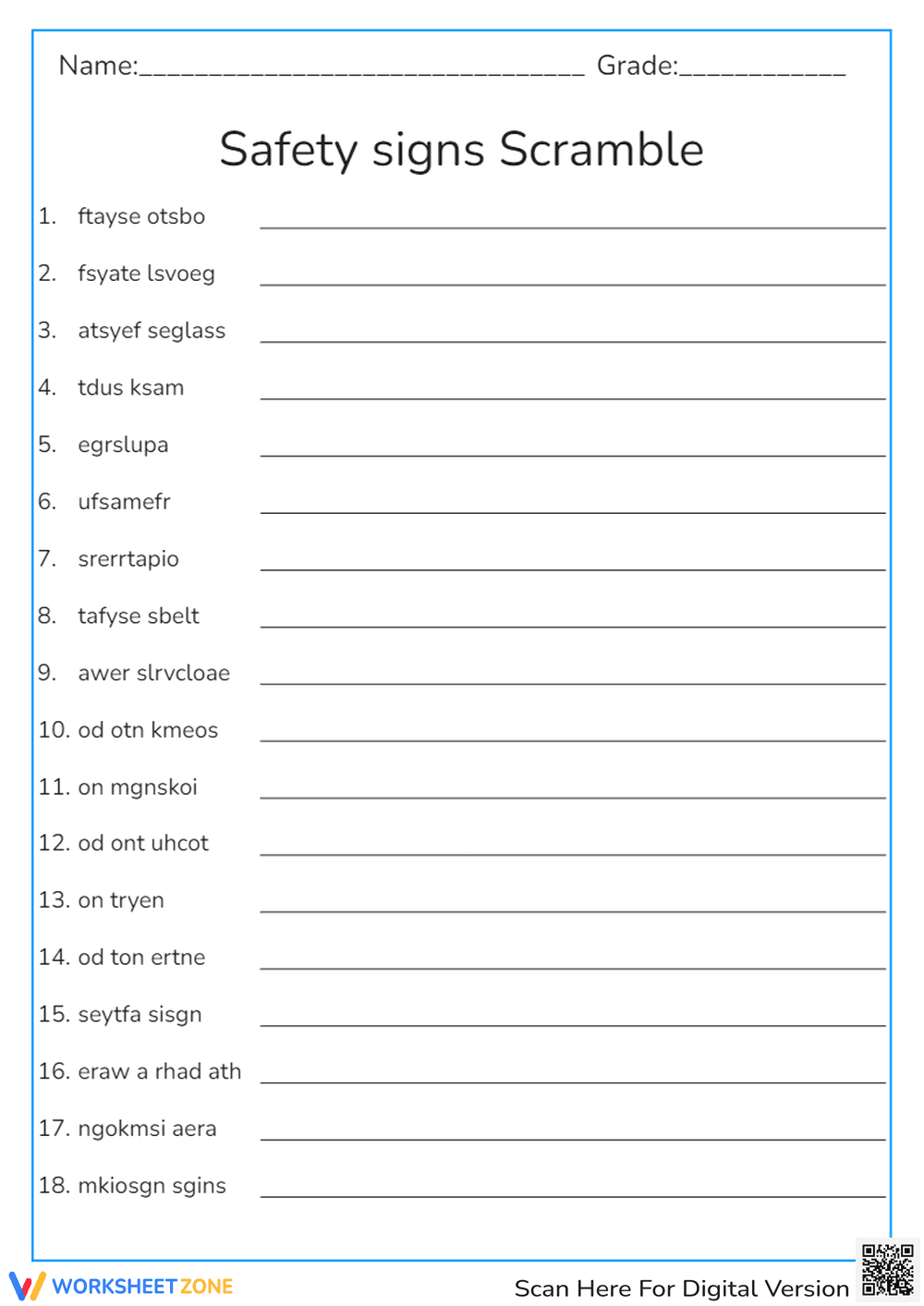

Grade 2 Safety Words — Printable No-Prep Worksheet
Paste this activity's link or code into your existing LMS (Google Classroom, Canvas, Teams, Schoology, Moodle, etc.).
Students can open and work on the activity right away, with no student login required.
You'll still be able to track student progress and results from your teacher account.
This Grade 2 spelling and vocabulary worksheet provides students with targeted practice decoding and writing essential safety terminology. By unscrambling eighteen common safety signs and equipment names, learners reinforce their spelling skills while building practical life-skills vocabulary necessary for recognizing real-world warnings and instructions.
At a Glance
- Grade: 2 · Subject: ELA
- Standard:
CCSS.ELA-LITERACY.L.2.2— Spell words correctly using learned patterns- Skill Focus: Spelling and Vocabulary
- Format: 1 page · 18 problems · Answer key included · PDF
- Best For: Independent practice and morning work
- Time: 15–20 minutes
Inside this single-page resource, educators will find eighteen scrambled word puzzles focused entirely on safety signs and protective equipment. Students rearrange jumbled letters to form recognizable phrases like "safety boots" and "do not enter." The straightforward layout provides clear writing lines for each solved phrase, ensuring neat handwriting practice alongside spelling reinforcement. A complete answer key supports quick grading.
- Print (1 minute): Simply download the PDF and print the required number of copies. The black-and-white design ensures minimal ink usage.
- Distribute (1 minute): Hand out the worksheets during morning work, literacy centers, or as a quick transition activity. No additional materials or teacher setup are required.
- Review (3 minutes): Use the included answer key to quickly check student responses or project the answers for a whole-class self-correction session. Total teacher prep time is under two minutes, making this an ideal addition to any emergency sub plan.
This activity aligns directly with CCSS.ELA-LITERACY.L.2.2, requiring students to demonstrate command of the conventions of standard English spelling when writing. By decoding scrambled letters, students apply their knowledge of phonics, word patterns, and sight words to reconstruct meaningful phrases. Both standard codes can be copied directly into lesson plans, IEP goals, or district curriculum mapping tools.
This worksheet serves as an excellent morning work activity to settle students into the day while activating their spelling and problem-solving skills. Alternatively, it functions perfectly as an independent literacy center task following a broader lesson on community safety or life skills. While students work, teachers can conduct formative assessments by observing how quickly learners recognize common spelling patterns versus relying on trial and error. Expect most second graders to complete the eighteen items within a fifteen to twenty-minute timeframe.
This resource is designed primarily for second-grade students developing their spelling fluency and practical vocabulary. It is particularly beneficial for visual learners who enjoy puzzle-based challenges. For students requiring additional support, teachers might provide a word bank of the correct safety phrases to reduce frustration. This worksheet pairs naturally with a social studies or health lesson focused on community signs, safety rules, or a classroom discussion about protective gear.
Mastering foundational spelling conventions, as outlined in CCSS.ELA-LITERACY.L.2.2, requires students to spell words correctly using learned patterns and phonemic awareness. Engaging students with puzzle-based formats like word scrambles encourages active cognitive processing and pattern recognition. According to Fisher & Frey (2014), providing students with structured, independent practice tasks that connect academic skills to real-world contexts significantly improves vocabulary retention and overall student engagement. By integrating essential life-skills terminology—such as safety signs and protective equipment—into a standard spelling activity, educators can simultaneously address literacy standards and practical knowledge. This dual-purpose approach ensures that instructional time is maximized, offering young learners a highly meaningful context for their spelling practice while reinforcing the critical safety vocabulary they will inevitably encounter in their daily environments, schools, and local communities.


