


























Views
Downloads
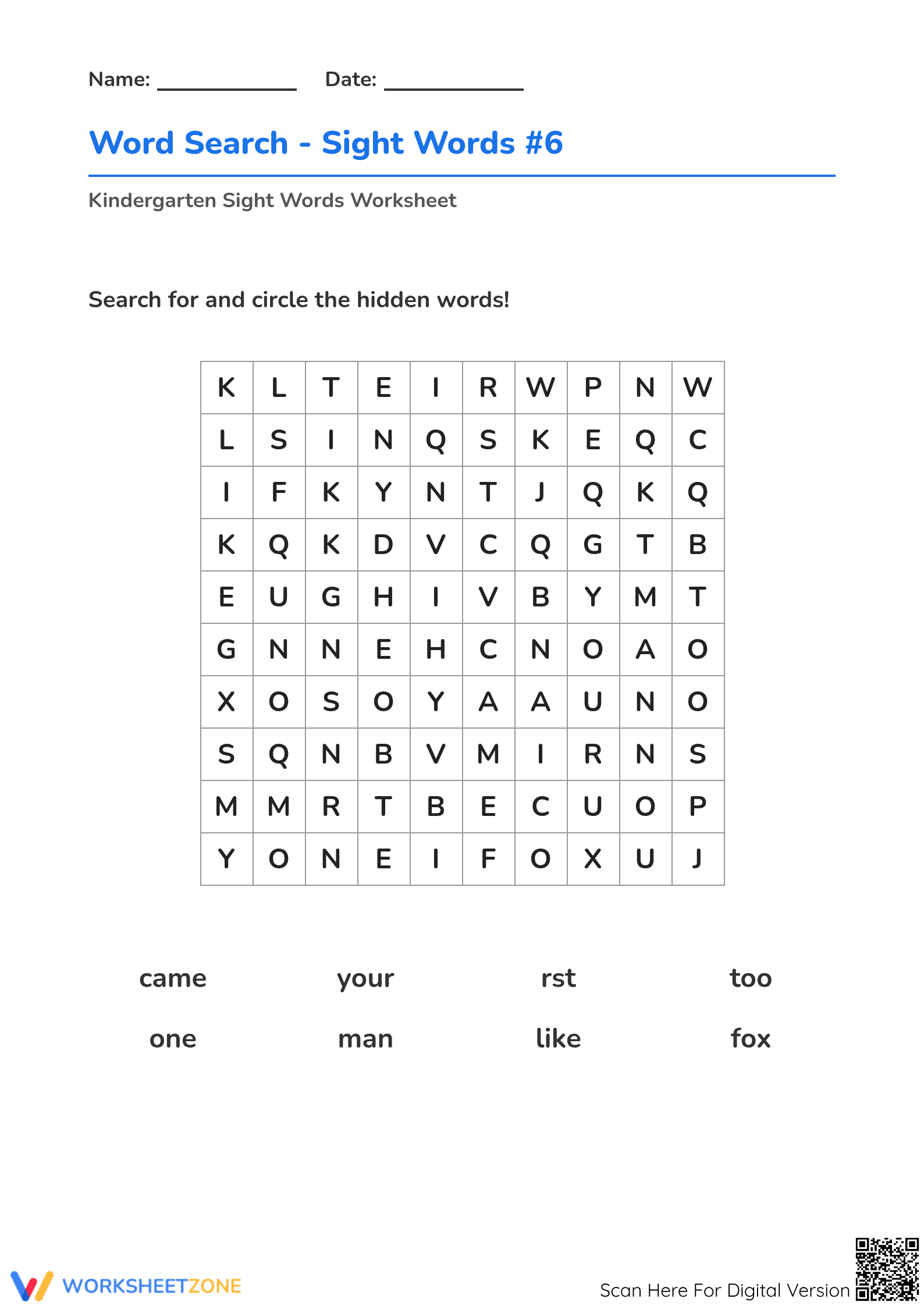

Kindergarten Sight Words Word Search — Printable Worksheet
Paste this activity's link or code into your existing LMS (Google Classroom, Canvas, Teams, Schoology, Moodle, etc.).
Students can open and work on the activity right away, with no student login required.
You'll still be able to track student progress and results from your teacher account.
This Kindergarten sight words word search helps early readers build automaticity with high-frequency vocabulary. By actively scanning for target words within a letter grid, students reinforce visual memory and spelling patterns. This targeted practice supports reading fluency, ensuring young learners can quickly recognize essential words without needing to sound them out.
At a Glance
- Grade: Kindergarten · Subject: ELA
- Standard:
CCSS.ELA-LITERACY.RF.K.3.C— Read common high-frequency words by sight- Skill Focus: Sight word recognition
- Format: 1 page · 8 problems · Answer key included · PDF
- Best For: Independent practice or morning work
- Time: 10–15 minutes
This single-page printable features a clear, age-appropriate letter grid containing eight hidden high-frequency words. A word bank at the bottom provides visual support, listing the exact terms students need to locate, such as "came," "your," "like," and "one." The layout is clean and distraction-free, designed specifically for early childhood visual tracking. A complete answer key is included to allow for rapid teacher grading or guided peer review.
Zero-Prep Workflow
This resource requires under two minutes of teacher preparation.
- Print (1 minute): Print the PDF file. The black-and-white design is economical.
- Distribute (1 minute): Hand out the sheets during morning arrival. The familiar format means students begin immediately.
- Review (3 minutes): Display the answer key on a smartboard to check for understanding.
Because it requires no specialized setup, this activity functions perfectly as an emergency sub plan.
Standards Alignment
This activity is directly aligned to CCSS.ELA-LITERACY.RF.K.3.C: Read common high-frequency words by sight. By requiring students to hold the target word in working memory while scanning the grid, the task reinforces orthographic mapping. Both standard codes can be copied directly into lesson plans, IEP goals, or district curriculum mapping tools.
How to Use It
Use this word search during morning work to settle students with a familiar task. Alternatively, assign it as an independent literacy center activity while the teacher conducts small-group guided reading. As a formative assessment observation tip, watch how students search for words: do they scan letter-by-letter, or look for initial consonant chunks? This observation informs future phonics instruction. Expected completion time ranges from 10 to 15 minutes.
Who It's For
This worksheet is primarily designed for Kindergarten students mastering their initial sight word lists. It also serves as an effective review tool for first-grade students needing additional reinforcement. For differentiation, teachers can highlight the first letter of each hidden word for students requiring extra scaffolding. Pair this activity with a shared reading of a predictable text to maximize vocabulary retention.
Developing automaticity with high-frequency vocabulary is a critical milestone in early literacy. According to Fisher & Frey (2014), repeated visual exposure and active engagement with target vocabulary significantly improve word retrieval speeds, which directly correlates with overall reading comprehension. This worksheet supports that cognitive process by requiring students to actively search for and identify specific letter sequences. Aligned with CCSS.ELA-LITERACY.RF.K.3.C, the activity ensures students practice how to read common high-frequency words by sight. By moving beyond simple flashcards and incorporating visual tracking exercises, educators can strengthen the neural pathways responsible for orthographic mapping. This foundational skill reduces the cognitive load required for decoding, allowing young readers to focus their mental energy on understanding the text. Integrating structured word searches into daily literacy routines provides the necessary repetition for long-term vocabulary retention.


