




























Views
Downloads
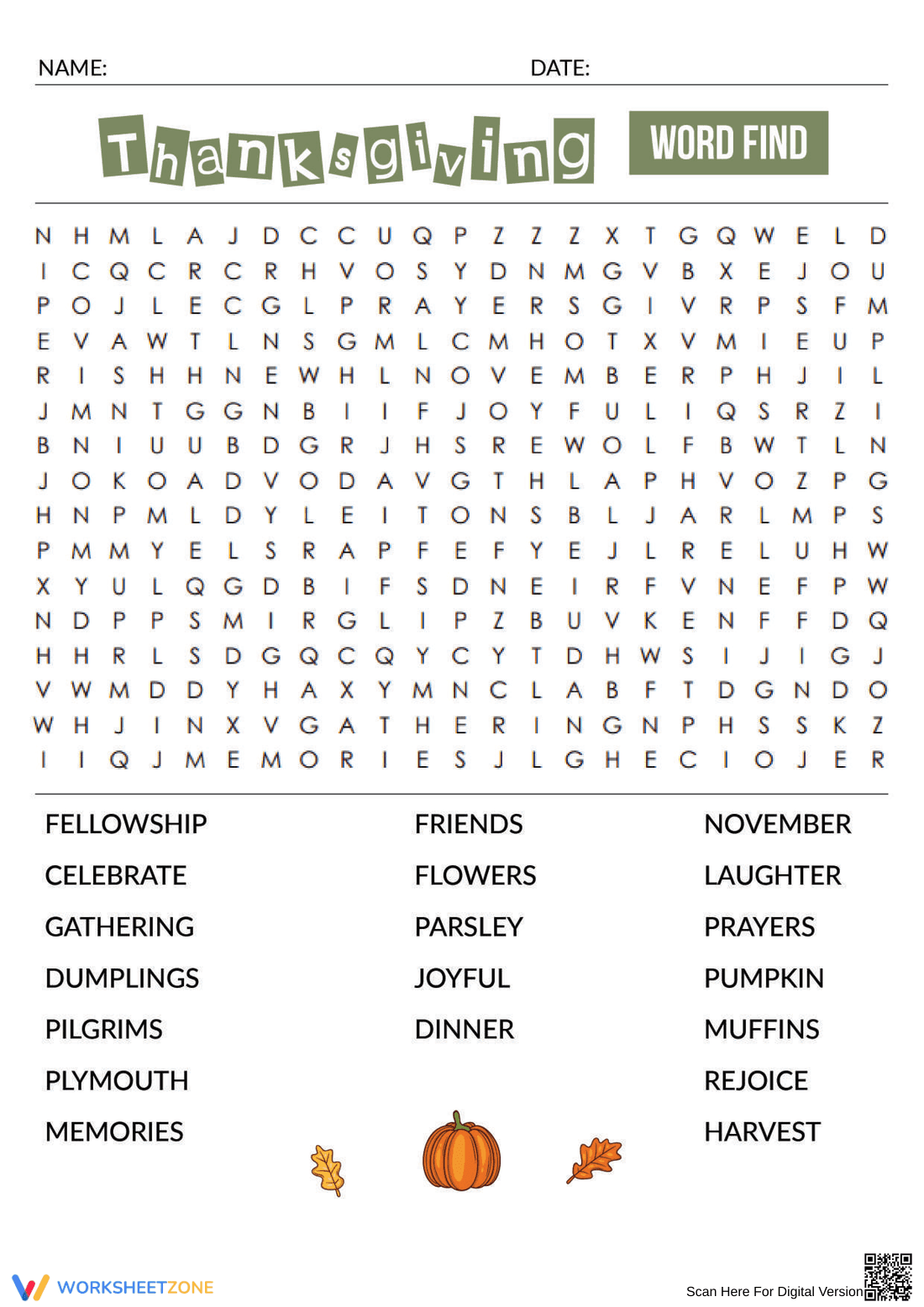

Grade 9 Thanksgiving Words — Printable No-Prep Worksheet

Paste this activity's link or code into your existing LMS (Google Classroom, Canvas, Teams, Schoology, Moodle, etc.).
Students can open and work on the activity right away, with no student login required.
You'll still be able to track student progress and results from your teacher account.
This high school Thanksgiving word search worksheet builds vocabulary recognition and spelling accuracy. Students locate nineteen thematic terms hidden within a complex letter grid. The activity reinforces domain-specific holiday vocabulary while providing a focused, independent task suitable for the days preceding the autumn break.
At a Glance
- Grade: 9 · Subject: ELA
- Standard:
CCSS.ELA-LITERACY.L.9-10.6— Acquire and use domain-specific words- Skill Focus: Vocabulary recognition
- Format: 1 page · 19 problems · PDF
- Best For: Independent practice
- Time: 15–20 minutes
This single-page resource features a dense letter grid containing nineteen Thanksgiving-themed vocabulary words. The terms range from historical references like Plymouth and Pilgrims to conceptual words such as Fellowship and Rejoice. A clear word bank sits below the puzzle, allowing students to track their progress as they identify each term horizontally, vertically, or diagonally.
This resource requires zero teacher preparation, making it an ideal addition to any autumn lesson plan.
- Print (1 minute): Generate copies directly from the PDF file. The black-and-white design ensures crisp, economical printing across all classroom devices.
- Distribute (1 minute): Hand out the puzzle during transition periods, morning work, or as a supplementary activity for early finishers.
- Review (3 minutes): Students self-monitor using the provided word bank. Teachers can quickly verify completion by scanning the circled terms within the grid.
Total teacher prep time remains under two minutes. The self-explanatory format makes it highly suitable for emergency sub plans.
This activity aligns with CCSS.ELA-LITERACY.L.9-10.6: "Acquire and use accurately general academic and domain-specific words and phrases, sufficient for reading, writing, speaking, and listening at the college and career readiness level." The puzzle format encourages repeated visual exposure to correct spelling patterns for these specific terms. Both standard codes can be copied directly into lesson plans, IEP goals, or district curriculum mapping tools.
Deploy this worksheet as a calming, focused activity during the often-hectic days immediately preceding the Thanksgiving holiday. It serves effectively as an independent task after direct instruction or as a reliable anchor activity for students who complete their primary assignments early. For formative assessment, observe how quickly students recognize complex letter patterns and whether they rely heavily on the word bank for spelling verification. Expected completion time ranges from fifteen to twenty minutes depending on the student's visual scanning proficiency.
This resource serves ninth-grade general education students, though the visual nature of the task makes it accessible for English Language Learners building their holiday vocabulary. The straightforward format requires no complex instructions, supporting students who benefit from clear, predictable tasks. Pair this word search with a reading passage about the historical context of the Plymouth settlement to create a comprehensive, thematic lesson block.
Integrating thematic vocabulary exercises supports broader language acquisition goals across the curriculum. According to the RAND AIRS 2024 report, consistent exposure to domain-specific terminology through varied visual formats improves long-term retention and spelling accuracy among secondary students. This worksheet targets CCSS.ELA-LITERACY.L.9-10.6 by requiring students to acquire and use domain-specific words associated with the Thanksgiving holiday. The process of scanning for terms like "Fellowship" and "Rejoice" forces learners to process orthographic patterns, reinforcing their mental lexicon. While word searches are often viewed as simple activities, they provide necessary cognitive downtime while maintaining academic engagement with target vocabulary. This structured exposure ensures students interact with the terminology multiple times, moving the words from passive recognition toward active vocabulary integration. Such targeted practice remains a reliable staple in effective literacy instruction.


