


























Views
Downloads
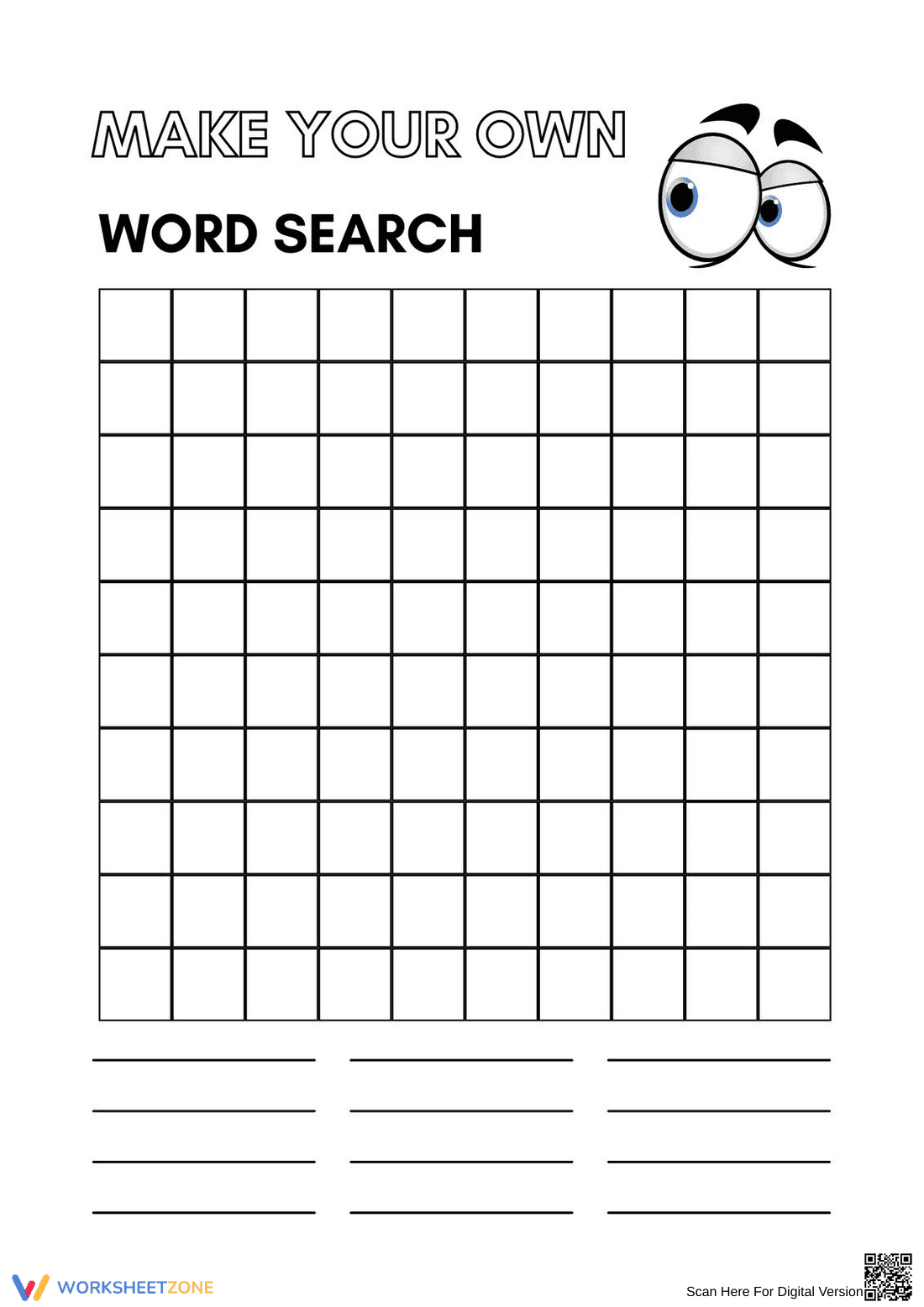

Grade 3 Word Search Template — Printable No-Prep Worksheet
Paste this activity's link or code into your existing LMS (Google Classroom, Canvas, Teams, Schoology, Moodle, etc.).
Students can open and work on the activity right away, with no student login required.
You'll still be able to track student progress and results from your teacher account.
This blank word search template empowers students to take ownership of their spelling practice. By designing puzzles, learners actively engage with word structures. This student-led activity transforms routine drills into an interactive challenge that reinforces word recognition.
At a Glance
- Grade: 3 · Subject: ELA
- Standard:
CCSS.ELA-LITERACY.L.3.2.E— Use conventional spelling for studied words- Skill Focus: Spelling and Vocabulary
- Format: 1 page · 12 word slots · No answer key · PDF
- Best For: Independent spelling practice
- Time: 15–20 minutes
This single-page printable features a blank ten-by-ten grid where students hide vocabulary terms. Below the grid, twelve blank lines provide a structured word bank. The clean layout includes a fun visual element to maintain engagement. Because this is an open-ended creation tool, an answer key is not included, allowing infinite variations based on your curriculum.
Zero-Prep Workflow
This resource is designed for immediate classroom implementation with minimal teacher effort.
- Print (1 minute): Generate enough copies for your literacy center or whole-class activity.
- Distribute (1 minute): Hand out the templates along with the week's spelling list or vocabulary words.
- Review (0 minutes): The instructions are self-explanatory. Students simply write their words in the bank, hide them in the grid, and fill the remaining squares with random letters.
Total teacher prep time is under two minutes, making this an excellent, reliable option for emergency sub plans or fast-finisher stations.
Standards Alignment
This activity aligns with CCSS.ELA-LITERACY.L.3.2.E: Use conventional spelling for high-frequency and other studied words and for adding suffixes to base words. By physically writing the words in the bank and then mapping them letter-by-letter into the grid, students reinforce their orthographic mapping skills. Both standard codes can be copied directly into lesson plans, IEP goals, or district curriculum mapping tools.
How to Use It
Deploy this template during independent literacy centers after introducing a new weekly spelling list. Students can spend 15 to 20 minutes creating a puzzle, which they can then trade with a partner to solve. As a formative assessment observation tip, watch how students place their words in the grid; students who confidently overlap words sharing common letters demonstrate a higher orthographic awareness. It also serves as an excellent Friday review activity before a spelling test.
Who It's For
This template is ideal for third-grade students developing their foundational spelling and vocabulary skills. It naturally differentiates itself, as students can use words at their specific reading level, making it suitable for mixed-ability classrooms. Pair this blank grid with a targeted phonics anchor chart or a specific science vocabulary list to integrate cross-curricular literacy practice.
Effective spelling instruction requires active engagement with word forms rather than passive memorization. When students utilize this template aligned to CCSS.ELA-LITERACY.L.3.2.E to use conventional spelling for studied words, they transition from consumers of content to creators. According to Fisher & Frey (2014), instructional routines that require students to manipulate and reconstruct vocabulary significantly increase long-term retention and orthographic mapping. Creating a word search demands that learners analyze letter sequences, consider spatial orientation, and repeatedly verify spelling accuracy as they build the puzzle. This generative process strengthens neural pathways associated with word recognition, ensuring that high-frequency and domain-specific vocabulary terms are committed to long-term memory. By integrating this creative task into regular literacy rotations, educators provide a rigorous yet accessible method for reinforcing essential spelling conventions without relying on repetitive rote copying exercises.


