


























Views
Downloads

Grade 2 Vocabulary — Printable No-Prep Worksheet
Paste this activity's link or code into your existing LMS (Google Classroom, Canvas, Teams, Schoology, Moodle, etc.).
Students can open and work on the activity right away, with no student login required.
You'll still be able to track student progress and results from your teacher account.
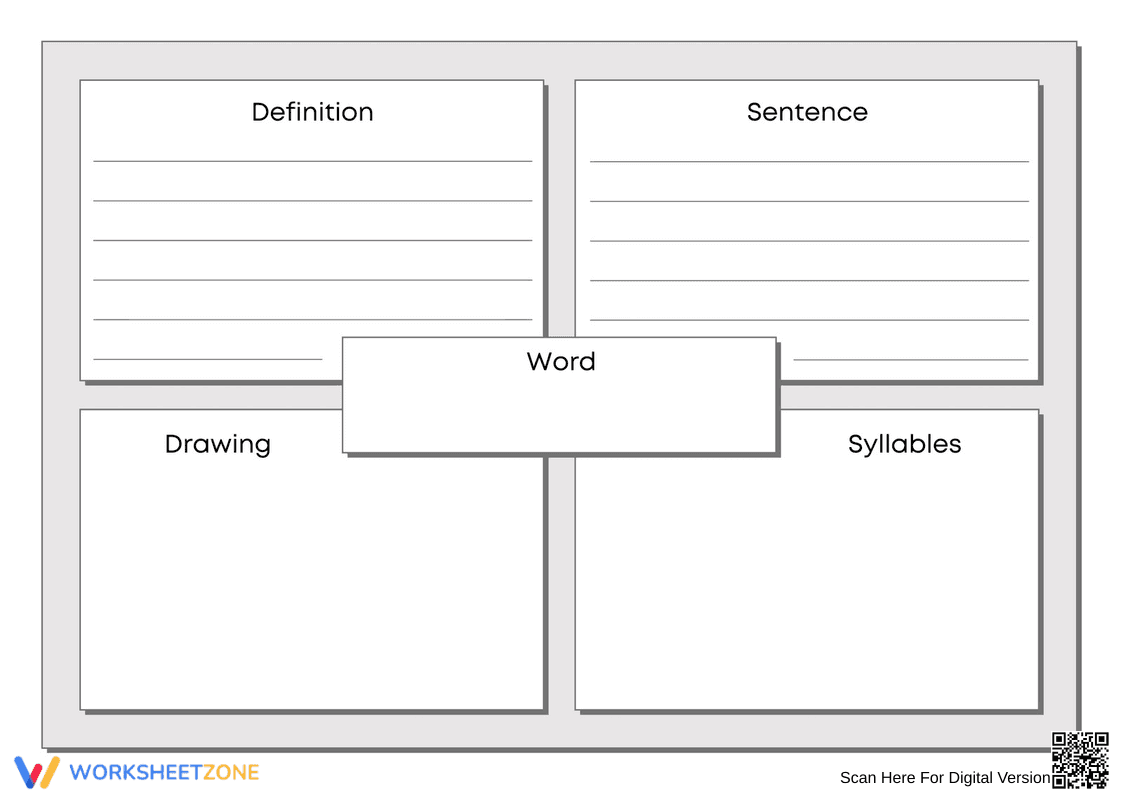
This Grade 2 vocabulary worksheet helps students master new terms by breaking them down into manageable components. By completing a four-part graphic organizer, learners actively construct word meaning through definitions, contextual sentences, visual representations, and syllable counting, ensuring deep retention of foundational language skills.
At a Glance
- Grade: 2 · Subject: ELA
- Standard:
CCSS.ELA-LITERACY.L.2.4— Determine the meaning of unknown words- Skill Focus: Vocabulary Acquisition
- Format: 1 page · 4 tasks · No answer key · PDF
- Best For: Independent practice
- Time: 10–15 minutes
Inside this single-page resource, educators will find a clean graphic organizer centered around a target word. The layout features four quadrants requiring students to write a definition, compose an original sentence, create a drawing, and identify the number of syllables. This open-ended format allows teachers to assign any current vocabulary word, making it a versatile addition to daily literacy routines.
Zero-Prep Workflow
- Print (30 seconds): Select your target vocabulary words for the week and print the required number of copies. The black-and-white design saves ink.
- Distribute (1 minute): Hand out the organizers during literacy centers or morning work. Write the target words on the board for students to copy into the center box.
- Review (2 minutes): Quickly scan student drawings and sentences to assess comprehension.
Total teacher prep time is under two minutes, making this an ideal, self-explanatory activity for emergency sub plans or quick transitions.
Standards Alignment
This resource is directly aligned to CCSS.ELA-LITERACY.L.2.4: Determine or clarify the meaning of unknown and multiple-meaning words and phrases based on grade 2 reading and content. By requiring students to use context (sentences) and structural analysis (syllables), it supports comprehensive language development. Both standard codes can be copied directly into lesson plans, IEP goals, or district curriculum mapping tools.
How to Use It
Deploy this organizer during independent literacy centers after introducing a new text. Students can select an unfamiliar word from their reading and complete the four quadrants to build comprehension. Alternatively, use it as a whole-class morning work activity where the teacher provides a "Word of the Day." As a formative assessment tip, observe the "Sentence" quadrant to verify if the student understands the word's part of speech and practical application. Expected completion time ranges from 10 to 15 minutes per word.
Who It's For
This worksheet is designed for second-grade students building foundational vocabulary skills. The inclusion of a drawing quadrant provides a crucial scaffold for English Language Learners (ELLs) and visual learners who benefit from non-verbal expression. It pairs perfectly with any grade-level reading passage or a classroom anchor chart detailing dictionary skills.
Effective vocabulary instruction requires multiple exposures and varied interactions with new terms. This resource targets CCSS.ELA-LITERACY.L.2.4 by asking students to determine the meaning of unknown words through definitions, context, and visual representation. According to Fisher & Frey (2014), graphic organizers that prompt students to analyze words from multiple angles significantly improve long-term retention and reading comprehension compared to traditional rote memorization techniques. By integrating syllable counting, sentence generation, and drawing into a single task, this worksheet addresses both structural word analysis and semantic understanding. This multidimensional approach ensures that learners do not just memorize a definition, but actively integrate the new vocabulary into their expressive language repertoire. Teachers can rely on this evidence-based format to build robust academic language skills in early elementary classrooms.


