


























Views
Downloads

Apple Seed Sink or Float Experiment | Essential Grade 3-5
Paste this activity's link or code into your existing LMS (Google Classroom, Canvas, Teams, Schoology, Moodle, etc.).
Students can open and work on the activity right away, with no student login required.
You'll still be able to track student progress and results from your teacher account.
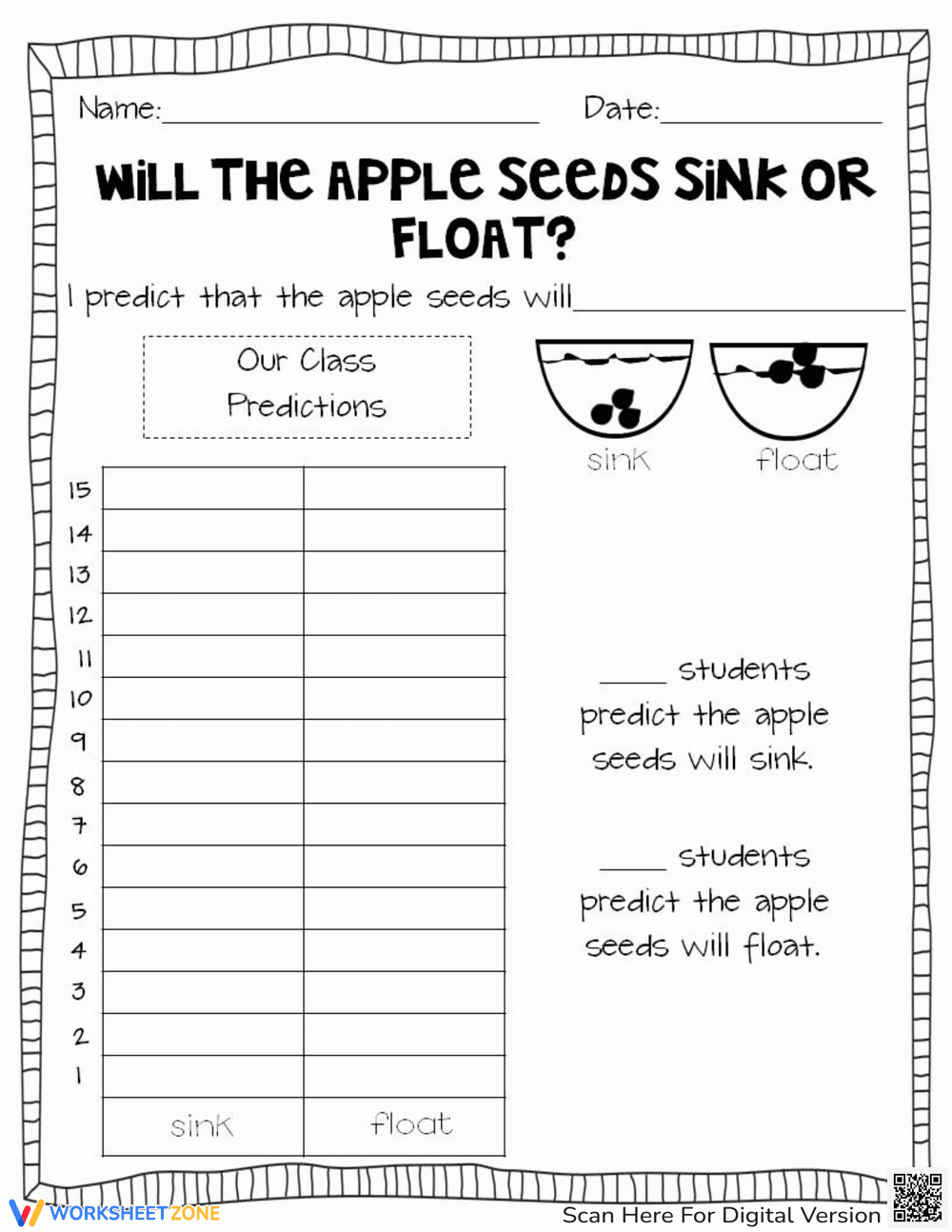
This Grade 3-5 science worksheet provides a structured framework for students to explore physical properties through a hands-on buoyancy experiment. By predicting and graphing whether apple seeds sink or float, learners develop inquiry skills and practice data representation. This activity transforms simple observation into a rigorous lesson on density and scientific evidence.
At a Glance
- Grade: 3-5 · Subject: Science
- Standard:
5-PS1-3— Make observations and measurements to identify materials based on their properties- Skill Focus: Buoyancy prediction and data graphing
- Format: 1 page · 3 tasks · No-prep · PDF
- Best For: Fall science labs and data lessons
- Time: 15–20 minutes
What's Inside
The worksheet features a clean, one-page layout that guides students through the scientific process. It includes space for individual predictions, a visual bar graph template scaled from 1 to 15 for recording class data, and summary sentences. Sink and float icons provide visual support for younger learners, ensuring the task is accessible for all students.
Zero-Prep Workflow
The workflow is designed for maximum efficiency. First, print the PDF for each student (30 seconds). Second, have students record predictions before the class-wide test (5 minutes). Finally, test the seeds and have students fill in the bar graph to represent class data (10 minutes). This streamlined process requires less than 2 minutes of teacher preparation.
Standards Alignment
This resource aligns with 5-PS1-3, asking students to make observations to identify materials based on properties. By testing buoyancy, students identify a specific physical property of organic matter. It also supports CCSS.MATH.CONTENT.3.MD.B.3 by requiring a scaled bar graph to represent a data set. Both standard codes can be copied directly into lesson plans, IEP goals, or district curriculum mapping tools.
How to Use It
Use this worksheet during a fall science unit or as an introduction to the scientific method. It works well during the 'explore' phase, allowing students to gather data before formal explanations of density. For assessment, observe how students translate the class tally into the bar graph format. Expected completion time ranges from 15 to 20 minutes.
Who It's For
This activity is for elementary students in grades 3-5 beginning to explore physical science. It is effective for kinesthetic learners who benefit from hands-on materials. This worksheet pairs naturally with fall-themed lessons or anchor charts detailing the parts of an apple. It provides a bridge between simple observation and mathematical data analysis.
This resource focuses on physical properties through buoyancy and density. By engaging in the 'sink or float' experiment, students practice hypothesis formation and data representation. According to Fisher & Frey (2014), data collection tools support the gradual release of responsibility, moving students from guided observation to independent analysis. This structured approach ensures students are actively synthesizing information through mathematical representation, bridging the gap between science and math standards for an engaging, rigorous experience. The inclusion of the 5-PS1-3 standard ensures that the activity remains grounded in NGSS expectations for identifying materials based on observable properties. By utilizing a scaled bar graph, the worksheet also meets 3.MD.B.3 requirements, providing a multi-disciplinary tool that fits easily into a 20-minute instructional block. This combination of science inquiry and mathematical precision creates a high-utility resource for elementary educators seeking to maximize instructional time and student engagement.


