


























Views
Downloads


Grade 2 Vocabulary — Printable No-Prep Worksheet
Paste this activity's link or code into your existing LMS (Google Classroom, Canvas, Teams, Schoology, Moodle, etc.).
Students can open and work on the activity right away, with no student login required.
You'll still be able to track student progress and results from your teacher account.
This Grade 2 ELA worksheet focuses on fundamental vocabulary acquisition through a farm-themed matching activity. Students identify high-frequency nouns and connect them to vivid visual representations to solidify word-object association. By engaging with familiar items like peaches, barns, and animals, learners develop the essential linguistic building blocks required for more complex reading comprehension and descriptive writing tasks.
At a Glance
- Grade: 2 · Subject: English Language Arts
- Standard:
CCSS.ELA-LITERACY.L.2.5— Identify real-life connections between words and their use- Skill Focus: Noun-picture matching and vocabulary building
- Format: 2 pages · 5 problems · Answer key included · PDF
- Best For: Literacy centers and independent vocabulary practice
- Time: 5–10 minutes
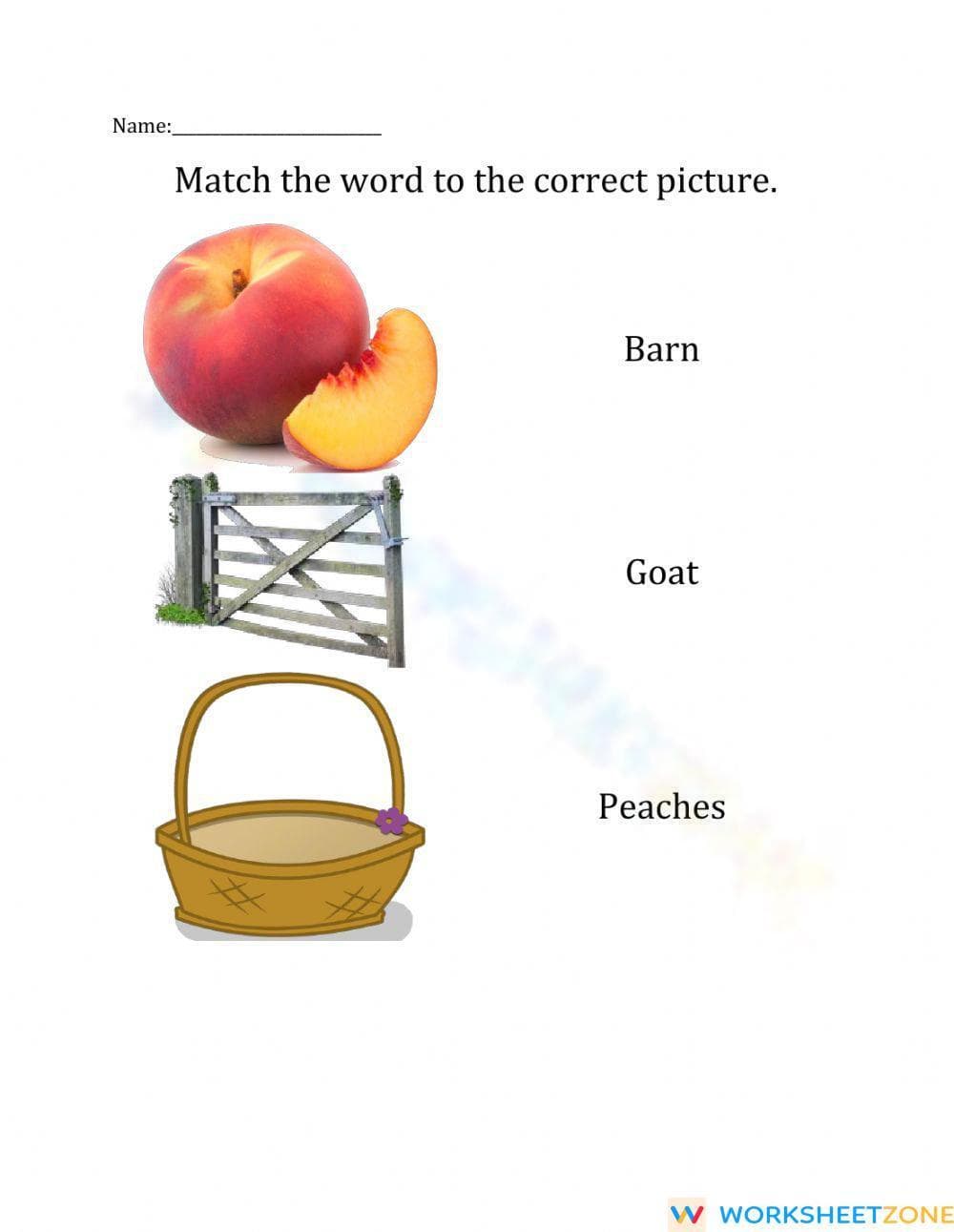
This resource contains two pages of visual matching tasks featuring high-quality illustrations and clear, legible typography. The five primary tasks require students to draw lines between nouns (Peaches, Gate, Basket, Barn, Goat) and their corresponding images. The layout is intentionally spacious to accommodate developing fine motor skills, and the clean design ensures that the focus remains entirely on word recognition and association.
This worksheet is designed for maximum teacher efficiency with a total preparation time of less than 60 seconds. Simply print the two-page PDF, distribute to students during a literacy block or as a morning warm-up, and review the results together as a class. Because the instructions are intuitive and the visual cues are self-explanatory, this activity serves as an ideal "plug-and-play" resource for substitute folders or emergency lesson plans when time is limited.
The activity aligns directly with CCSS.ELA-LITERACY.L.2.5, which requires students to demonstrate an understanding of word relationships and nuances in word meanings. By matching specific nouns to their physical counterparts, students practice identifying real-life connections between words and their use (L.2.5.A). This standard code can be copied directly into lesson plans, IEP goals, or district curriculum mapping tools to ensure instructional accountability.
Use this worksheet as a formative assessment during a unit on farm life or healthy eating to gauge student familiarity with common environmental nouns. Teachers should observe students as they complete the matching lines, noting if they hesitate or rely on process of elimination for specific words. This activity is expected to take between 5 and 10 minutes, making it a perfect transition task or a quick check for understanding following a read-aloud.
This resource is primarily designed for Grade 2 students but is highly effective for Kindergarten or Grade 1 learners requiring an extra challenge, as well as Special Education students working on basic noun identification. It pairs naturally with a farm-themed picture book or an anchor chart displaying "Words Around the Farm" to provide additional scaffolding for English Language Learners who are still building their foundational vocabulary.
This Grade 2 vocabulary worksheet leverages the CCSS.ELA-LITERACY.L.2.5 standard to help students identify real-life connections between words and their use. Research from Fisher & Frey (2014) emphasizes that vocabulary development is most effective when students engage in multiple exposures to words across different contexts, particularly when supported by visual aids. Matching activities provide a low-stakes environment for students to test their word knowledge and receive immediate feedback through visual confirmation. By focusing on concrete nouns and their representative images, this worksheet supports the "Gradual Release of Responsibility" model, moving students from teacher-led identification to independent word recognition. The integration of high-quality visuals and clear text ensures that the material is accessible to diverse learners, supporting long-term retention of essential ELA building blocks as noted in recent ScienceDirect TpT Analysis reports.


