


























Views
Downloads
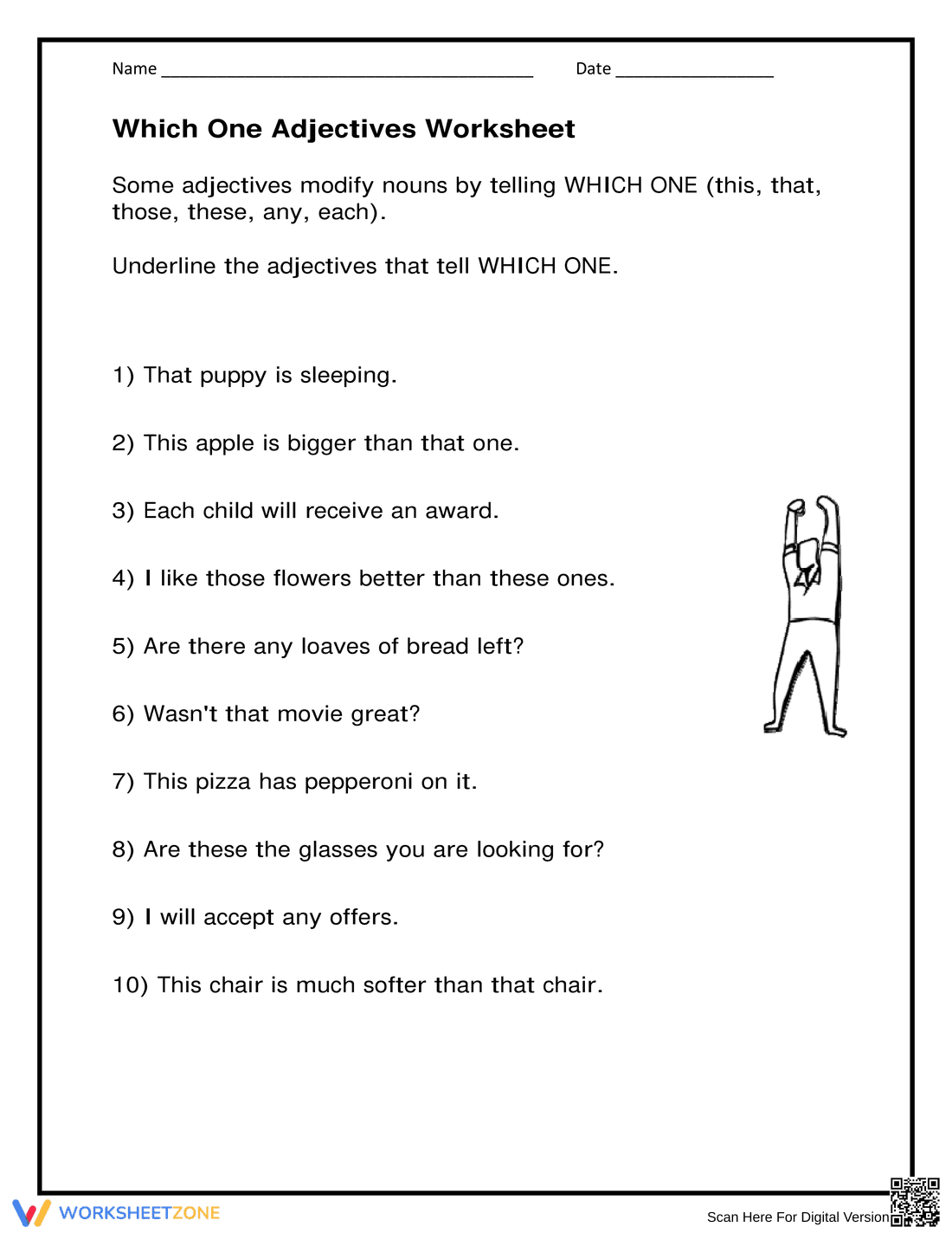

Essential Which One Adjectives Worksheet | Grade 2-3
Paste this activity's link or code into your existing LMS (Google Classroom, Canvas, Teams, Schoology, Moodle, etc.).
Students can open and work on the activity right away, with no student login required.
You'll still be able to track student progress and results from your teacher account.
Mastering demonstrative and indefinite adjectives is a core milestone in early elementary grammar. This worksheet helps students identify words like "this," "that," "these," and "those" that specify which noun is being discussed. By underlining modifiers in ten practice sentences, learners build the precision required for descriptive writing and effective communication.
At a Glance
- Grade: 2-3 · Subject: Grammar
- Standard:
CCSS.ELA-LITERACY.L.2.1.E— Use adjectives and adverbs to modify nouns and verbs accurately- Skill Focus: Identifying Which-One Adjectives
- Format: 1 page · 10 problems · Answer key included · PDF
- Best For: Independent grammar practice or homework
- Time: 10–15 minutes
What's Inside
This single-page PDF features ten carefully constructed sentences that require students to locate and underline adjectives describing "which one." The worksheet covers demonstrative adjectives (this, that, these, those) and indefinite adjectives (any, each). Each sentence provides a clear context, such as "That puppy is sleeping," ensuring students see these modifiers in action. A comprehensive answer key is provided for rapid grading.
Zero-Prep Workflow
Designed for immediate classroom integration, this resource requires under two minutes of total preparation. 1. Print (30 seconds): Download the PDF and print copies for your class. 2. Distribute (30 seconds): Hand out the worksheets as a transition activity or bell-ringer. 3. Review (60 seconds): Use the answer key for rapid grading or group review. Its self-explanatory layout makes it an excellent choice for sub-plans or emergency grammar sessions.
Standards Alignment
This resource is primary aligned to CCSS.ELA-LITERACY.L.2.1.E, which requires students to use adjectives and adverbs, choosing between them depending on what is to be modified. By focusing specifically on adjectives that answer the question "which one?", it also supports broader grammar fluency in CCSS.ELA-LITERACY.L.3.1. Both standard codes can be copied directly into lesson plans, IEP goals, or district curriculum mapping tools.
How to Use It
Use this worksheet as a formative assessment after an introductory lesson on demonstrative adjectives. It works perfectly as a "quick check" to see which students can distinguish between "this" and "that." Alternatively, assign it as a low-stress homework task or a sub-plan activity. Teachers should observe whether students correctly identify "any" and "each" as these indefinite forms often require more direct instruction.
Who It's For
Designed for Grade 2 and Grade 3 students, this resource is ideal for general education classrooms, ESL/ELL support, and special education settings. It provides focused, distraction-free practice that builds confidence for struggling readers. The simple sentence structures make it a natural pairing for an anchor chart displaying common adjectives that tell "which one."
Mastering adjective-noun relationships is essential for student success in reading comprehension and clear writing. According to Fisher & Frey (2014), focused grammar practice within a gradual release of responsibility model—such as this "Which One" adjectives worksheet—helps students internalize language conventions. This Grade 2-3 resource targets the CCSS.ELA-LITERACY.L.2.1.E standard by providing ten specific practice items that isolate the skill of identifying demonstrative and indefinite adjectives. Research from RAND AIRS 2024 suggests that high-quality, targeted supplemental materials like this PDF can bridge gaps in foundational literacy by allowing for repeated exposure to linguistic structures. By correctly identifying which-one adjectives in varied contexts, students build the syntactic awareness needed for more complex textual analysis. This worksheet serves as an essential tool for teachers looking for printable, standards-aligned grammar practice that requires zero preparation time.


