


























Views
Downloads
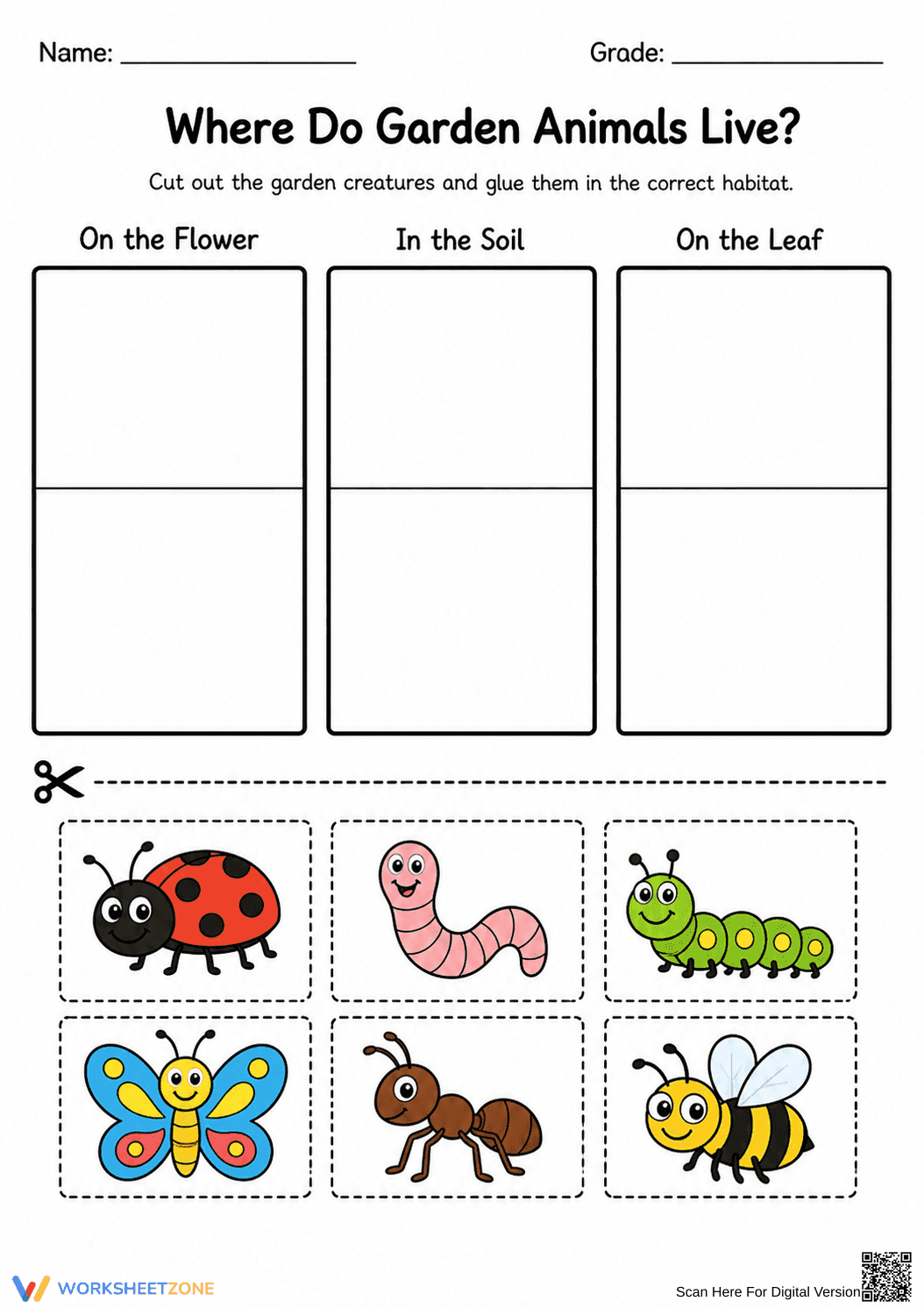

Essential Garden Habitat Sorting Worksheet | Grade K
Paste this activity's link or code into your existing LMS (Google Classroom, Canvas, Teams, Schoology, Moodle, etc.).
Students can open and work on the activity right away, with no student login required.
You'll still be able to track student progress and results from your teacher account.
This Kindergarten garden animals habitat sorting worksheet helps young learners identify and classify common creatures based on their natural environments. Students engage in a hands-on cut-and-paste activity to determine if insects belong on flowers, in the soil, or on leaves. It builds foundational observation skills and scientific vocabulary in early learners.
At a Glance
- Grade: Kindergarten · Subject: Science
- Standard:
K-ESS3-1— Represent the relationship between animals and the places they live- Skill Focus: Classification and habitat identification
- Format: 1 page · 6 problems · Answer key included · PDF
- Best For: Early finishers or science center activity
- Time: 15–20 minutes
This high-quality PDF includes one comprehensive activity page featuring six distinct garden creatures: a ladybug, worm, caterpillar, butterfly, ant, and bee. The worksheet is divided into three sorting categories: On the Flower, In the Soil, and On the Leaf. A clear dotted-line section provides easy-to-follow cutting paths for students, ensuring the focus remains on the scientific classification task.
Zero-Prep Workflow
- Print: Generate the single-page PDF for your class in roughly 10 seconds.
- Distribute: Provide students with the sheet, scissors, and glue (30 seconds).
- Review: Check student work using the included answer key (1 minute).
This total teacher prep time of under two minutes makes it an ideal choice for substitute lesson plans or spontaneous science lessons during a busy school day.
The primary standard for this activity is K-ESS3-1: "Use a model to represent the relationship between the needs of different plants or animals and the places they live." By associating specific insects with their preferred micro-habitats, students demonstrate an understanding of how environments support living things. Both standard codes can be copied directly into lesson plans, IEP goals, or district curriculum mapping tools.
Use this worksheet as a summative assessment after a lesson on living things or as a guided activity during a unit on insects. For a powerful instructional moment, encourage students to observe a real garden first, then use this worksheet to record their findings. Teachers can perform formative assessment by observing if students correctly place the worm in the soil versus the butterfly on the flower. Expected completion time is 15-20 minutes.
This resource is tailored for Preschool, Kindergarten, and Grade 1 students who are beginning to explore biological classifications. It is particularly effective for tactile learners who benefit from fine motor engagement through cutting and pasting. Pair this worksheet with a garden-themed picture book or a set of insect anchor charts to provide a rich learning experience for all students.
The integration of tactile sorting activities in early childhood science is supported by the RAND AIRS 2024 report, which emphasizes the importance of hands-on classification for developing cognitive schemas in young learners. By mapping 6 specific garden creatures to their respective habitats, students practice the essential skill of identifying relationships between living things and their environments as outlined in the K-ESS3-1 standard. Research from Fisher & Frey (2014) indicates that such structured sorting tasks provide the necessary scaffolding for students to move from simple observation to complex scientific reasoning. This worksheet offers a targeted way to measure student mastery of basic ecological concepts while simultaneously strengthening fine motor skills. As an evidence-based tool, it ensures that students are meeting rigorous science benchmarks through developmentally appropriate practice.


