


























Views
Downloads
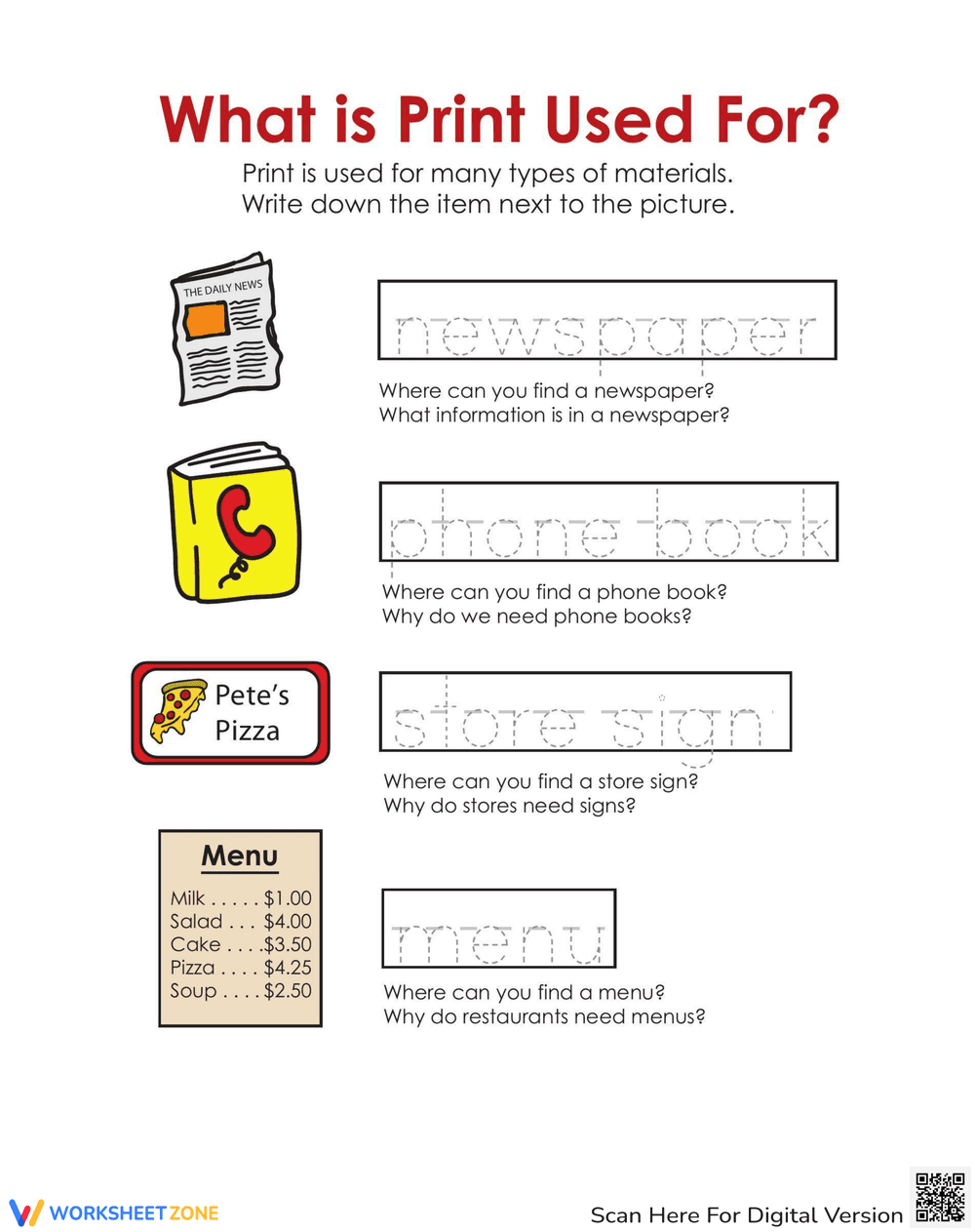

Preschool Print Concepts — Printable No-Prep Worksheet
Paste this activity's link or code into your existing LMS (Google Classroom, Canvas, Teams, Schoology, Moodle, etc.).
Students can open and work on the activity right away, with no student login required.
You'll still be able to track student progress and results from your teacher account.
This foundational early literacy worksheet introduces preschool students to the real-world purposes of print. By examining everyday items like menus and store signs, young learners build essential concepts of print while practicing fine motor skills through guided word tracing. This resource connects classroom learning to their daily environment.
At a Glance
- Grade: Preschool · Subject: ELA
- Standard:
CCSS.ELA-LITERACY.RF.K.1— Understand the organization and basic features of print- Skill Focus: Concepts of print and tracing
- Format: 1 page · 4 problems · PDF
- Best For: Independent practice or centers
- Time: 10–15 minutes
This single-page printable features four distinct sections, each highlighting a common printed material: a newspaper, a phone book, a store sign, and a menu. Students trace the corresponding vocabulary word using dashed guidelines to reinforce letter formation. Below each tracing exercise, two targeted discussion questions prompt educators or parents to explore where these items are found and why they are useful, bridging the gap between decoding and comprehension.
Designed for immediate classroom implementation, this resource requires minimal setup:
- Print (1 minute): Generate the single-page PDF for the entire class or a small group.
- Distribute (1 minute): Hand out the worksheets along with pencils or crayons for tracing.
- Review (5 minutes): Guide students through the discussion questions orally as they complete the tracing tasks.
With a total teacher prep time of under two minutes, this activity is highly suitable for morning work, literacy centers, or as a reliable addition to a substitute teacher plan.
This activity aligns directly with CCSS.ELA-LITERACY.RF.K.1: Demonstrate understanding of the organization and basic features of print. It also supports early vocabulary development by introducing functional environmental print. Both standard codes can be copied directly into lesson plans, IEP goals, or district curriculum mapping tools.
Integrate this worksheet during whole-group morning meetings by displaying it on a smartboard and discussing the environmental print examples before having students complete the tracing independently. Alternatively, use it in a small-group literacy center where an educator can facilitate the discussion questions to assess oral language skills. As a formative assessment tip, observe whether students trace left-to-right, noting their developing understanding of print directionality. Expected completion time ranges from 10 to 15 minutes.
This resource is ideal for preschool and early kindergarten students who are just beginning to recognize letters and understand that text carries meaning. It provides excellent fine motor scaffolding for learners developing pencil grip. Pair this worksheet with a classroom environmental print walk or a read-aloud session featuring books with varied text types to reinforce the concepts.
Developing early concepts of print is a critical predictor of future reading success. When students understand the organization and basic features of print, as outlined in CCSS.ELA-LITERACY.RF.K.1, they build the necessary foundation for decoding and comprehension. According to EdReports 2024, integrating environmental print into early childhood instruction significantly enhances student engagement and contextual vocabulary acquisition. By connecting abstract letters to tangible, real-world items like menus and store signs, educators can foster a deeper appreciation for literacy. This targeted practice not only supports fine motor development through tracing but also encourages critical thinking via guided discussion prompts. Early exposure to functional text formats ensures that young learners recognize reading as a meaningful, everyday activity rather than an isolated academic task, setting the stage for lifelong literacy achievement.


