


























Views
Downloads

Philosophy of Education Guide | Grade 5-10 Essential
Paste this activity's link or code into your existing LMS (Google Classroom, Canvas, Teams, Schoology, Moodle, etc.).
Students can open and work on the activity right away, with no student login required.
You'll still be able to track student progress and results from your teacher account.
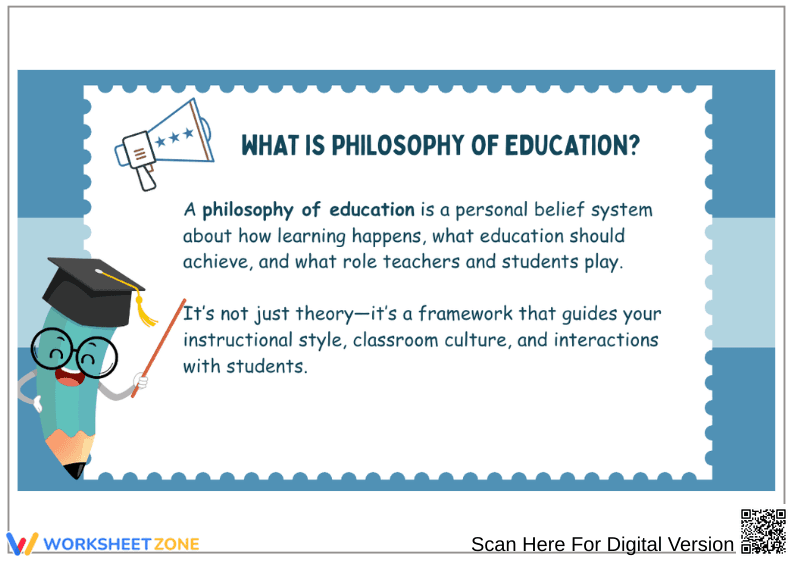
This Grade 5-10 informational worksheet provides a clear, accessible definition of educational philosophy. It helps students and educators identify the personal belief systems that govern classroom culture and instructional styles. By breaking down complex theoretical frameworks into simple terms, it enables learners to articulate their own values regarding how learning happens and the roles of participants.
At a Glance
- Grade: 5-10 · Subject: ELA / Social Studies
- Standard:
CCSS.ELA-LITERACY.RI.8.2— Determine central ideas and provide an objective summary of informational text- Skill Focus: Defining abstract educational concepts
- Format: 1 page · 1 reflection task · No-prep · PDF
- Best For: Introduction to pedagogy or student-led classroom design
- Time: 10–15 minutes
Inside this resource, you will find a concise informational block that defines philosophy of education as a framework for instructional style and classroom culture. The layout features a student-friendly mascot and clear typography to reduce cognitive load. It includes a primary definition followed by a breakdown of how these beliefs manifest in real-world interactions between teachers and students.
Zero-Prep Workflow
The zero-prep workflow for this resource is designed for immediate implementation. First, print the single-page PDF (30 seconds). Second, distribute the sheet to students as a bell-ringer or introductory hook (1 minute). Third, facilitate a brief 5-minute discussion or reflection based on the provided text. Total teacher preparation time is under 2 minutes, making it an ideal choice for sub plans or sudden schedule changes.
Standards Alignment
This resource aligns with `CCSS.ELA-LITERACY.RI.8.2`, requiring students to determine central ideas and summarize informational text. It also supports RI.9-10.4 by exploring how specific terms shape the meaning of a text. Both standard codes can be copied directly into lesson plans, IEP goals, or district curriculum mapping tools.
How to Use It
Use this worksheet during a "Back to School" week to help older students understand the logic behind your classroom rules. Alternatively, use it in a social studies or civics unit to discuss how different societies value education. A formative assessment tip: ask students to highlight the three components of the definition and rank them by personal importance. Completion takes 10-15 minutes.
Who It's For
This guide is for middle and high school students exploring the foundations of learning. It is particularly effective for student teachers, peer mentors, or advanced learners in leadership roles. It pairs naturally with a personal reflection journal or an anchor chart about classroom community values.
According to the RAND AIRS 2024 report on instructional materials, high-quality informational texts that simplify complex professional concepts are essential for developing student agency and metacognition. This worksheet addresses the core requirements of CCSS.ELA-LITERACY.RI.8.2 by providing a structured definition of educational philosophy, allowing students to identify central ideas within a concise framework. Research from Fisher & Frey (2014) emphasizes that "simply explained" resources serve as critical scaffolds for students transitioning from concrete to abstract reasoning. By defining a personal belief system as a framework for instructional style, this resource bridges the gap between theory and practice. It ensures that Grade 5-10 learners can articulate the purpose of their education, a key indicator of academic engagement. This standalone summary confirms the resource's utility in fostering a deeper understanding of pedagogical values through evidence-based text analysis and structured reflection.


