


























Views
Downloads
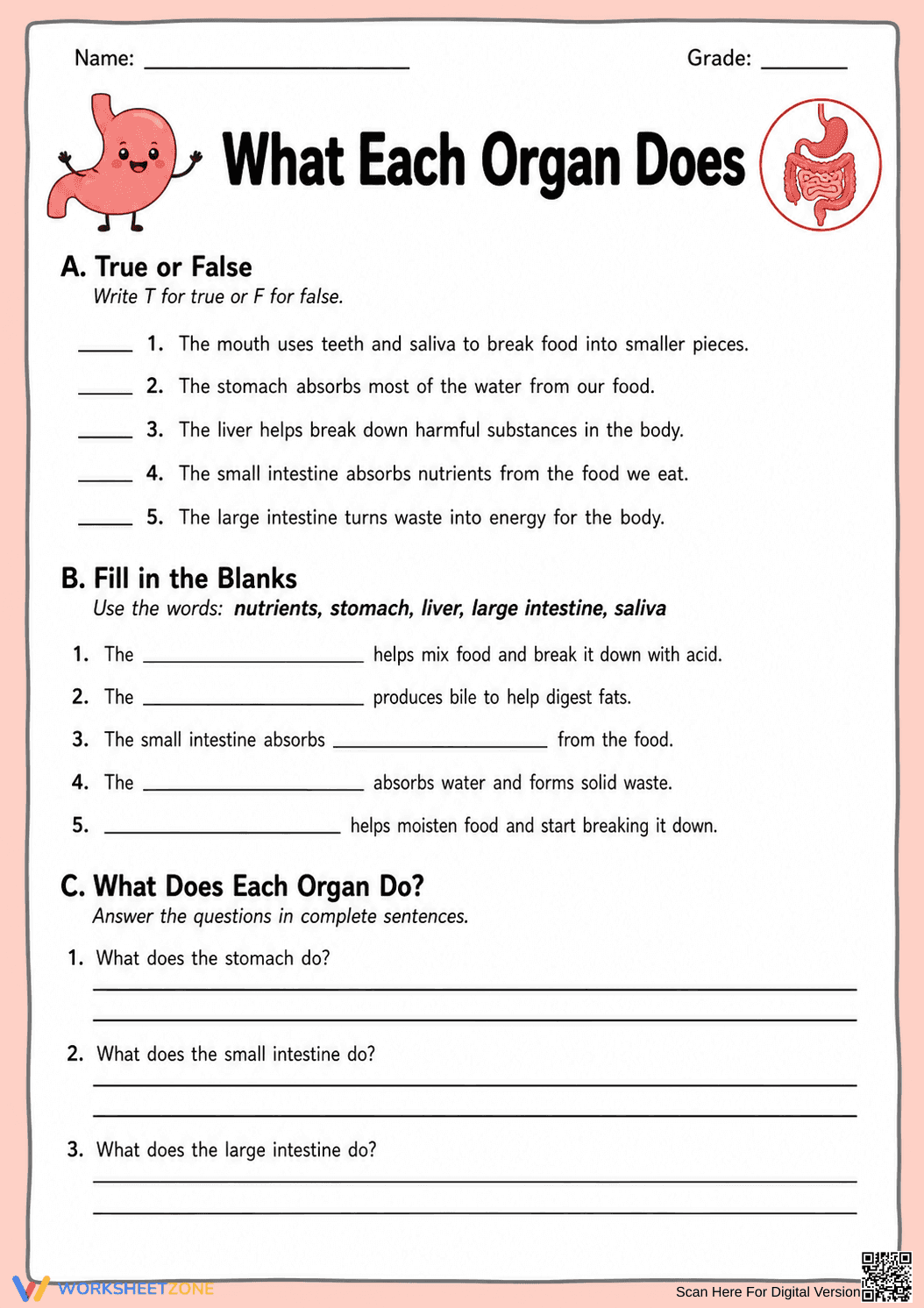

Grade 4 Digestive System — Printable No-Prep Worksheet
Paste this activity's link or code into your existing LMS (Google Classroom, Canvas, Teams, Schoology, Moodle, etc.).
Students can open and work on the activity right away, with no student login required.
You'll still be able to track student progress and results from your teacher account.
This printable science worksheet helps students master the specific functions of major digestive system organs. By evaluating statements and applying vocabulary, learners will understand exactly how the stomach, intestines, and liver work together to break down food and absorb vital nutrients for the human body.
At a Glance
- Grade: 4 · Subject: Science
- Standard:
4-LS1-1— Describe how internal structures function to support survival- Skill Focus: Digestive organ functions
- Format: 1 page · 13 problems · Answer key included · PDF
- Best For: Independent practice
- Time: 15–20 minutes
This single-page resource features three distinct sections to build comprehensive understanding. Students begin with five true-or-false questions to correct common misconceptions about digestion. Next, a five-question fill-in-the-blank activity utilizes a provided word bank to reinforce essential science vocabulary. Finally, three short-answer prompts require students to articulate the specific roles of the stomach, small intestine, and large intestine in complete sentences. A complete answer key is included for accurate grading.
Designed for immediate classroom implementation, this resource requires minimal teacher preparation.
- Print (1 minute): Simply download the PDF and print a class set. The clean layout ensures high-quality copies.
- Distribute (1 minute): Hand out the worksheet after your introductory lesson on the human body. The instructions are completely self-explanatory.
- Review (3 minutes): Use the included answer key to quickly check student responses or guide a whole-class review session.
With under two minutes of total teacher prep time, this worksheet is an excellent addition to emergency sub plans or busy instructional days.
This activity is directly aligned to 4-LS1-1, requiring students to construct an argument that plants and animals have internal and external structures that function to support survival, growth, behavior, and reproduction. By identifying the specific roles of digestive organs, students demonstrate their understanding of how these internal structures process energy for the body. Both standard codes can be copied directly into lesson plans, IEP goals, or district curriculum mapping tools.
Deploy this worksheet during independent practice immediately following direct instruction on the digestive system. It serves as an effective formative assessment tool; teachers can quickly scan the short-answer section to observe whether students can accurately describe organ functions in their own words. Expected completion time ranges from 15 to 20 minutes, making it ideal for a science center rotation or a focused homework assignment.
This resource is primarily designed for fourth and fifth-grade general education students studying human body systems. The included word bank provides built-in differentiation, offering necessary scaffolding for English Language Learners and students needing vocabulary support. It pairs perfectly with a visual anchor chart of the human body or a hands-on digestion demonstration.
Aligning instructional materials to 4-LS1-1 ensures students can accurately describe how internal structures function to support survival. According to a ScienceDirect TpT Analysis (2024), science worksheets that combine multiple question formats—such as true/false evaluation, vocabulary application, and constructed response—significantly improve long-term retention of complex biological processes. By requiring students to interact with the material in three distinct ways, this resource moves beyond simple memorization and encourages deeper cognitive processing. The structured progression from recognition tasks to expressive writing helps solidify the specific roles of the stomach, liver, and intestines. Providing targeted practice on these internal systems builds a crucial foundation for middle school life science curricula, ensuring learners are fully prepared to understand how interacting subsystems sustain human life.


