


























Views
Downloads

Essential Mohs Scale Hardness Worksheet | Grade 5 Science
Paste this activity's link or code into your existing LMS (Google Classroom, Canvas, Teams, Schoology, Moodle, etc.).
Students can open and work on the activity right away, with no student login required.
You'll still be able to track student progress and results from your teacher account.
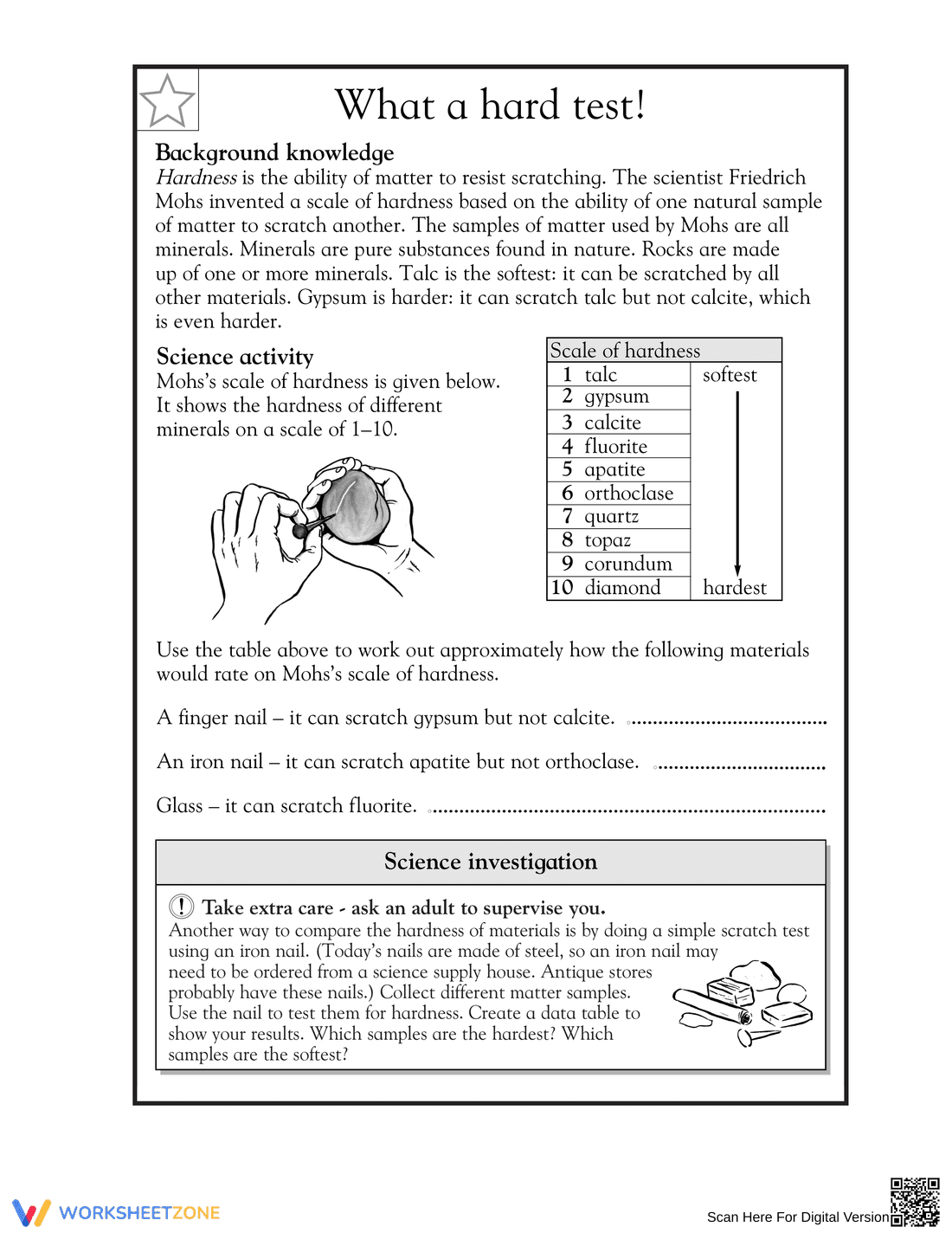
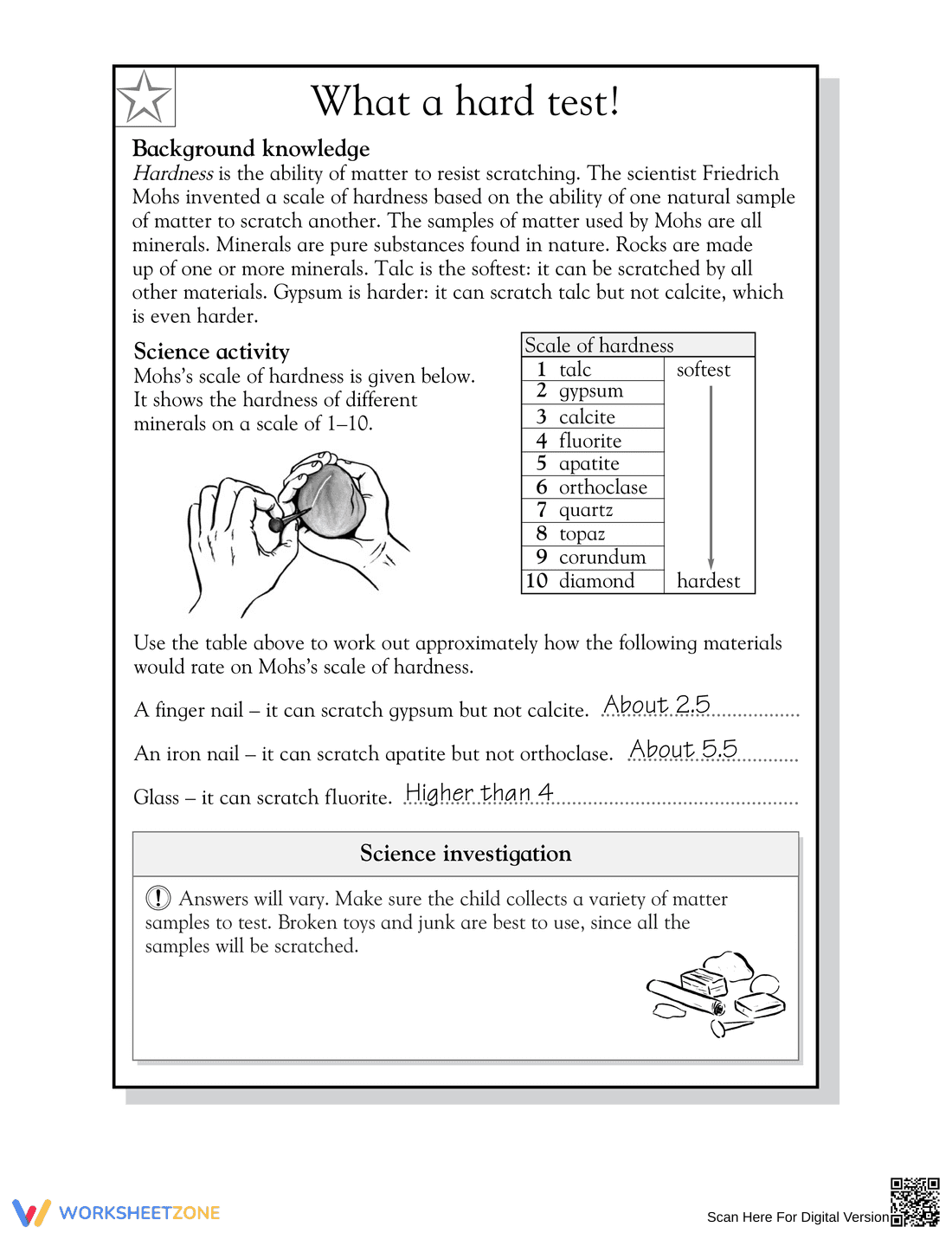
This Grade 5 science worksheet helps students master the physical properties of matter by exploring the Mohs scale of mineral hardness. Students will analyze a data table of ten materials and apply logical reasoning to predict how everyday objects like fingernails and glass interact with natural minerals. It establishes a strong foundation for scientific observation and classification through evidence-based analysis.
At a Glance
- Grade: 5 · Subject: Physical Science
- Standard:
5-PS1-3— Make observations and measurements to identify materials based on their physical properties and hardness- Skill Focus: Hardness of matter and data interpretation
- Format: 1 page · 4 tasks · Answer key included · PDF
- Best For: Classroom physical science practice and assessment
- Time: 20–30 minutes
What's Inside
The worksheet includes a comprehensive background knowledge section explaining Friedrich Mohs's scale and the definition of hardness as the ability to resist scratching. It features a detailed reference table ranking minerals from talc to diamond. Students are guided through three logical application problems and a culminating science investigation prompt that outlines a supervised scratch test protocol for hands-on learning.
Zero-Prep Workflow
Implementing this worksheet requires minimal teacher intervention. The print-ready format allows for a three-step integration: Print the single-page resource (30 seconds), Distribute to students for independent or small-group work (1 minute), and Review findings collectively (10 minutes). This streamlined workflow makes it an ideal choice for substitute lesson plans, end-of-unit reviews, or as a self-contained science center activity that requires zero additional setup.
Standards Alignment
This resource is specifically aligned with the 5-PS1-3 standard, which requires fifth-grade students to use physical properties to identify substances. By evaluating the relative hardness of various materials, students engage in the core practices of making evidence-based claims. Both standard codes can be copied directly into lesson plans, IEP goals, or district curriculum mapping tools to ensure compliance with state and national frameworks.
How to Use It
Use this worksheet during the Explain or Elaborate phase of a science lesson on the properties of matter. For a formative assessment observation tip, watch how students navigate the data table; those who can accurately place glass relative to fluorite demonstrate a high level of inferential reasoning. The expected completion time for the written portion is roughly fifteen minutes, followed by a brief classroom discussion.
Who It's For
This activity is designed for Grade 5 students but is adaptable for middle school earth science remediation. It provides built-in scaffolds through the reference table, making it accessible for diverse learners. Naturally pair this resource with a physical mineral kit or a digital simulation of scratch tests to provide a multi-modal learning experience that reinforces the core scientific concepts.
The scientific study of material properties in elementary education, particularly regarding the physical attributes of matter like hardness, is fundamental to developing empirical reasoning. Aligned with NGSS standard 5-PS1-3, this worksheet requires students to identify materials based on their properties using the Mohs scale of hardness. Research from RAND AIRS 2024 emphasizes that structured data interpretation tasks significantly enhance scientific literacy by connecting abstract scales to observable physical phenomena. By analyzing how a finger nail, iron nail, or glass interacts with minerals like talc and quartz, learners build a conceptual framework for relative measurement. This resource bridges the gap between theoretical knowledge and practical application through its guided science investigation, encouraging students to perform scratch tests in a supervised environment. Mastering these classification skills provides the cognitive scaffolding necessary for advanced geological and chemical studies in middle school and beyond, ensuring a robust foundation in physical science.


