


























Views
Downloads
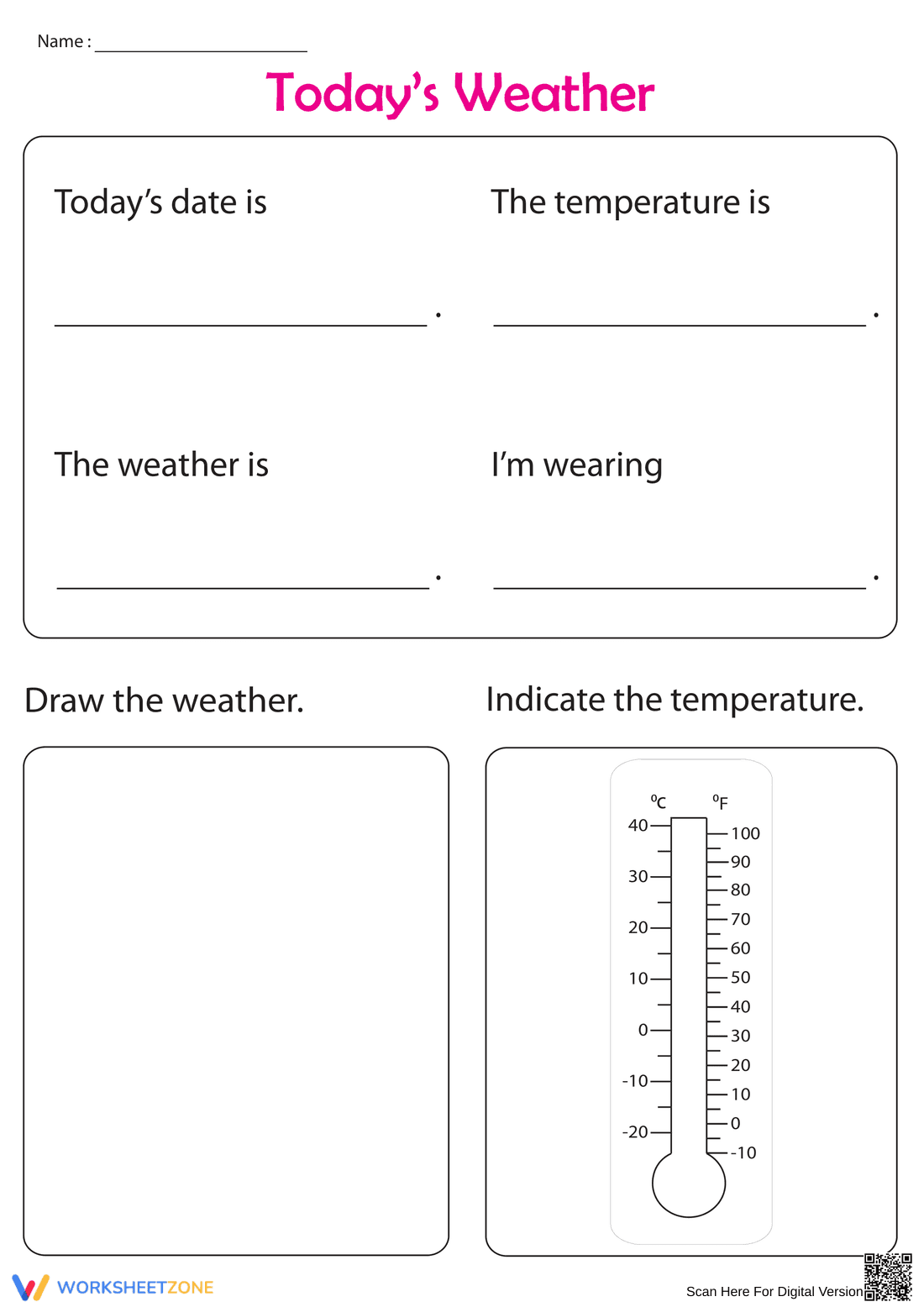

Grade 1-2 Today's Weather Printable Science Worksheet
Paste this activity's link or code into your existing LMS (Google Classroom, Canvas, Teams, Schoology, Moodle, etc.).
Students can open and work on the activity right away, with no student login required.
You'll still be able to track student progress and results from your teacher account.
This worksheet empowers young learners to become active meteorologists by observing and recording daily weather phenomena. Students develop critical scientific inquiry skills as they bridge the gap between abstract concepts like temperature and their tangible, lived experiences. By documenting the date, sky conditions, and appropriate attire, children build a foundational understanding of Earth's systems.
At a Glance
- Grade: 1–2 · Subject: Science
- Standard:
K-ESS2-1— Use and share observations of local weather conditions to describe patterns- Skill Focus: Weather observation and recording
- Format: 1 page · 6 problems · Teacher-led review · PDF
- Best For: Daily morning meetings and science journals
- Time: 5–10 minutes
Inside this printable resource, you will find a structured observation log designed for immediate use. The worksheet features four guided writing prompts where students identify the current date, measure the temperature, describe the sky, and select appropriate clothing. Below these prompts, two interactive zones invite students to visualize their findings: a dedicated space for drawing weather symbols and a realistic thermometer graphic for marking numerical data.
This resource is designed for a friction-less classroom experience. Step one: Print the single-page PDF, which takes less than 30 seconds for a full class set. Step two: Distribute the worksheet during your morning transition or science block, requiring zero teacher explanation thanks to the intuitive layout. Step three: Review student observations as a group to identify classroom-wide patterns, completing the entire formative cycle in under 15 minutes. Total teacher preparation time is under two minutes, making this an ideal resource for sub-plans or unexpected schedule changes.
Standards Alignment
Aligned to `K-ESS2-1`, this worksheet requires students to share observations of local weather to describe patterns. Students practice the science habit of collecting data through direct observation, supporting instructional goals regarding Earth's systems. Both standard codes can be copied directly into lesson plans, IEP goals, or district curriculum mapping tools.
How to Use It
Use this as a morning routine to ground students before the academic day begins. It serves as a formative assessment for checking the ability to relate temperature to physical sensations. Assign this as part of a weekly science journal to track changes over time. Teachers should observe if students accurately match clothing choices to the recorded temperature.
Who It's For
This resource is ideal for first and second-grade students developing descriptive writing and scientific vocabulary. The visual nature makes it accessible for English Language Learners and students with sensory processing needs. It pairs naturally with a classroom weather station or digital thermometer app, allowing students to verify sensory observations with objective data points during direct instruction.
Fisher & Frey (2014) emphasize that early science instruction should rely on structured observation logs to build scientific literacy. This worksheet targets the `K-ESS2-1` standard by requiring children to translate sensory input into descriptive data. Research indicates that when students participate in daily recording tasks, they develop a more robust understanding of seasonal patterns. According to a NAEP analysis, active participation in data collection during primary years correlates with higher science literacy scores in later grades. This resource provides the necessary scaffolding for students to move from simple naming to environmental analysis. By providing 6 distinct tasks on a single page, the activity ensures high engagement without cognitive overwhelm. This standalone resource allows for rapid integration into existing curriculum frameworks without additional teacher preparation or materials beyond a standard pencil.


