


























Views
Downloads

Area of Rectangles Worksheet | Essential Grade 6 Math
Paste this activity's link or code into your existing LMS (Google Classroom, Canvas, Teams, Schoology, Moodle, etc.).
Students can open and work on the activity right away, with no student login required.
You'll still be able to track student progress and results from your teacher account.
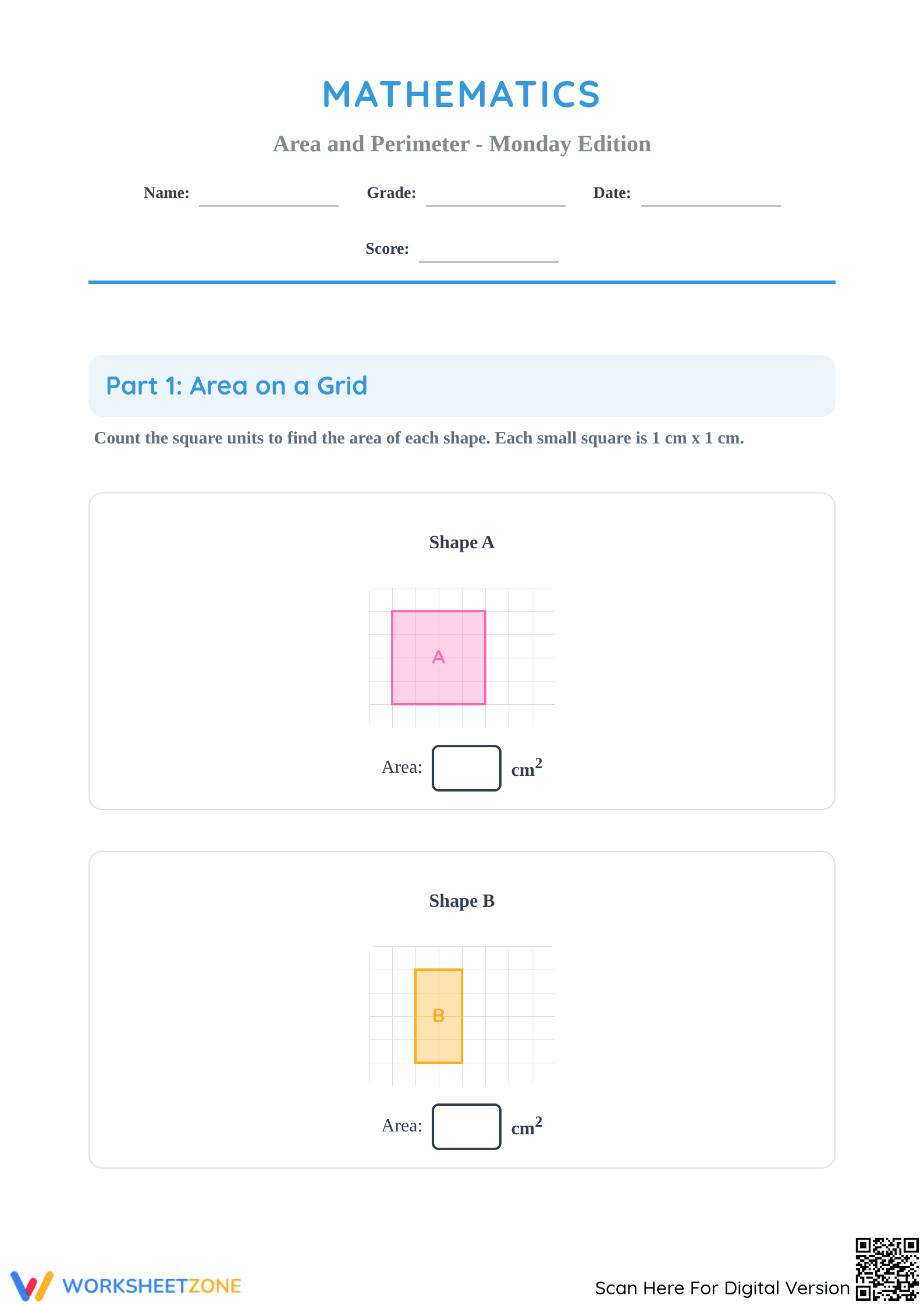
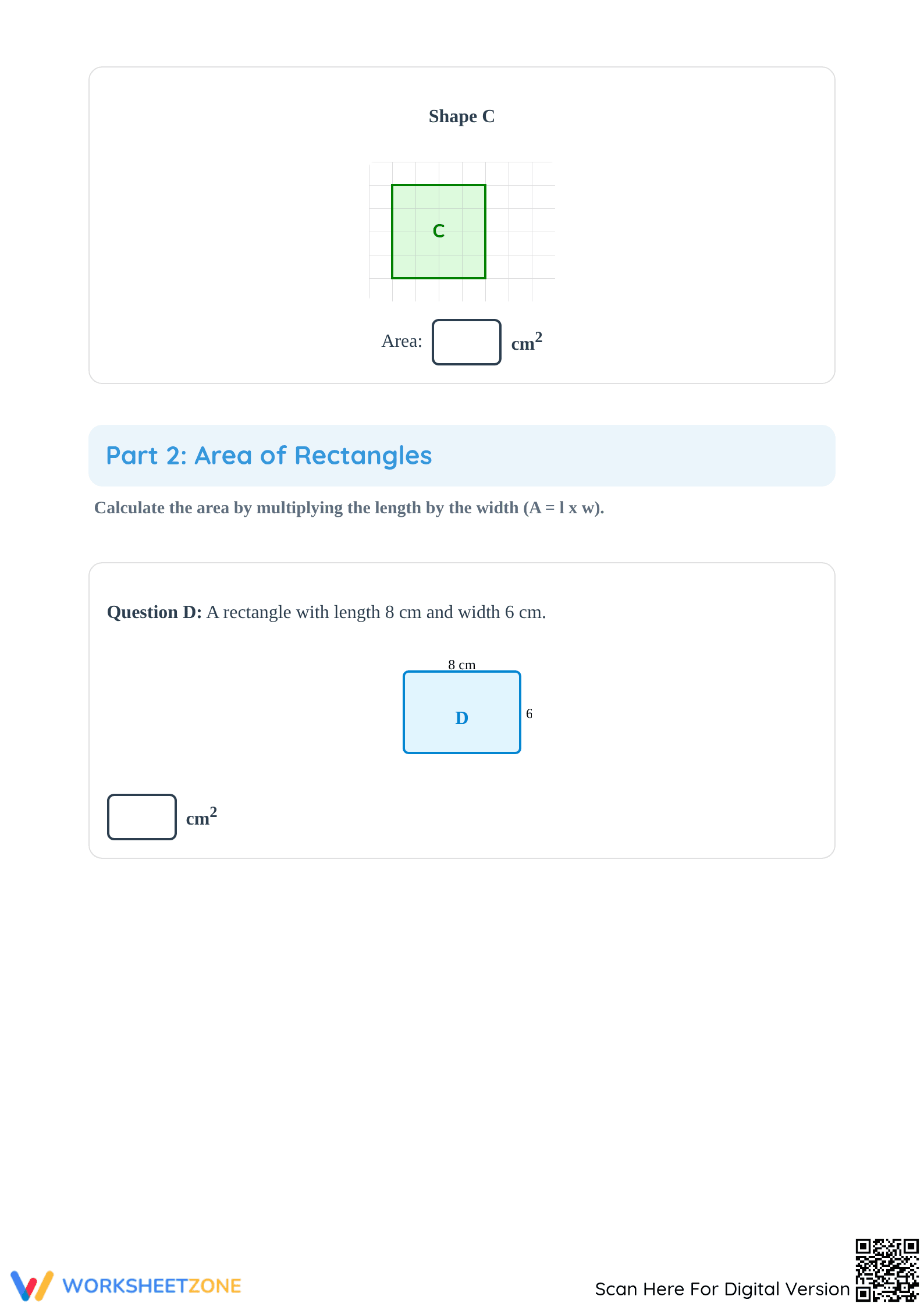
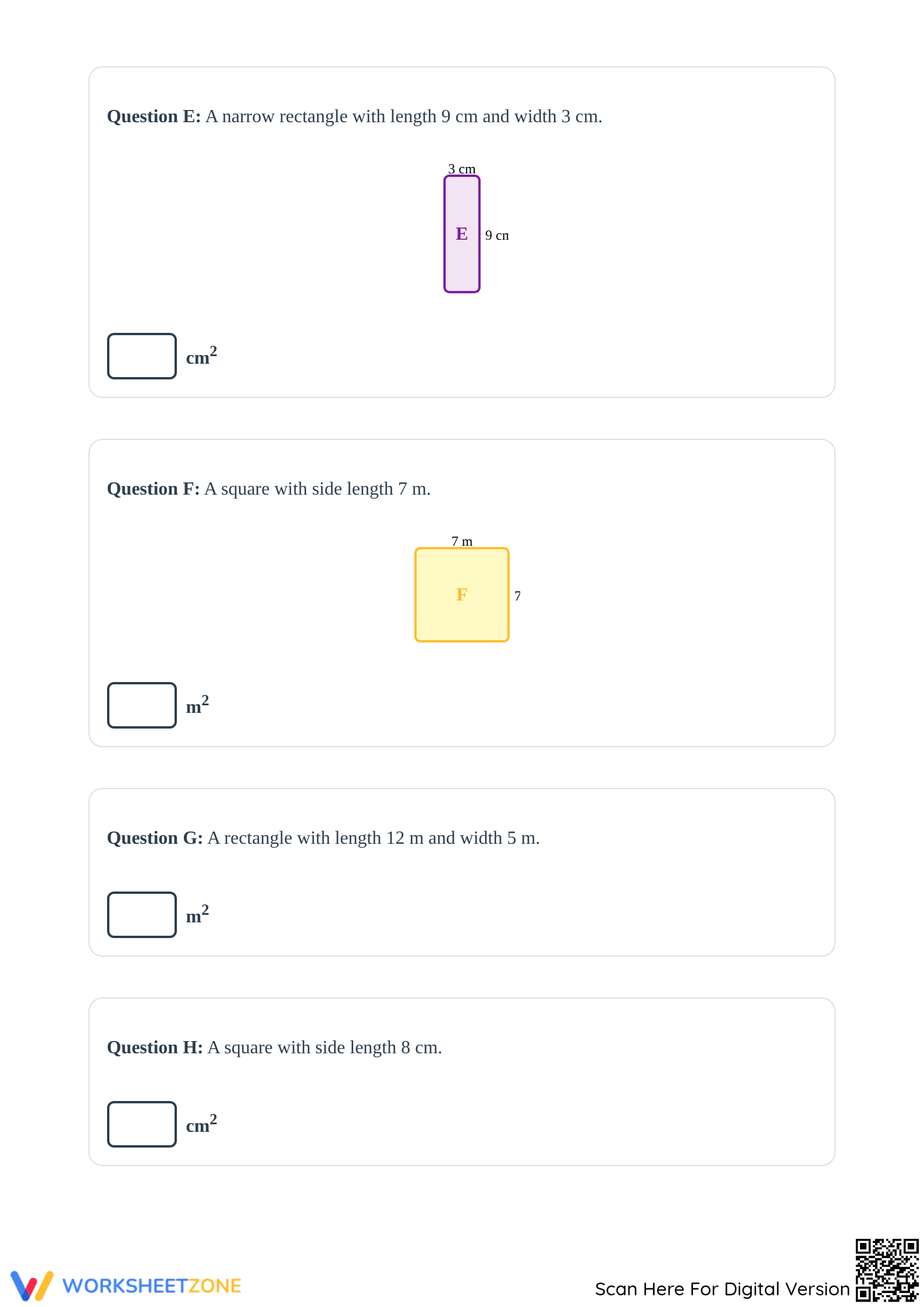
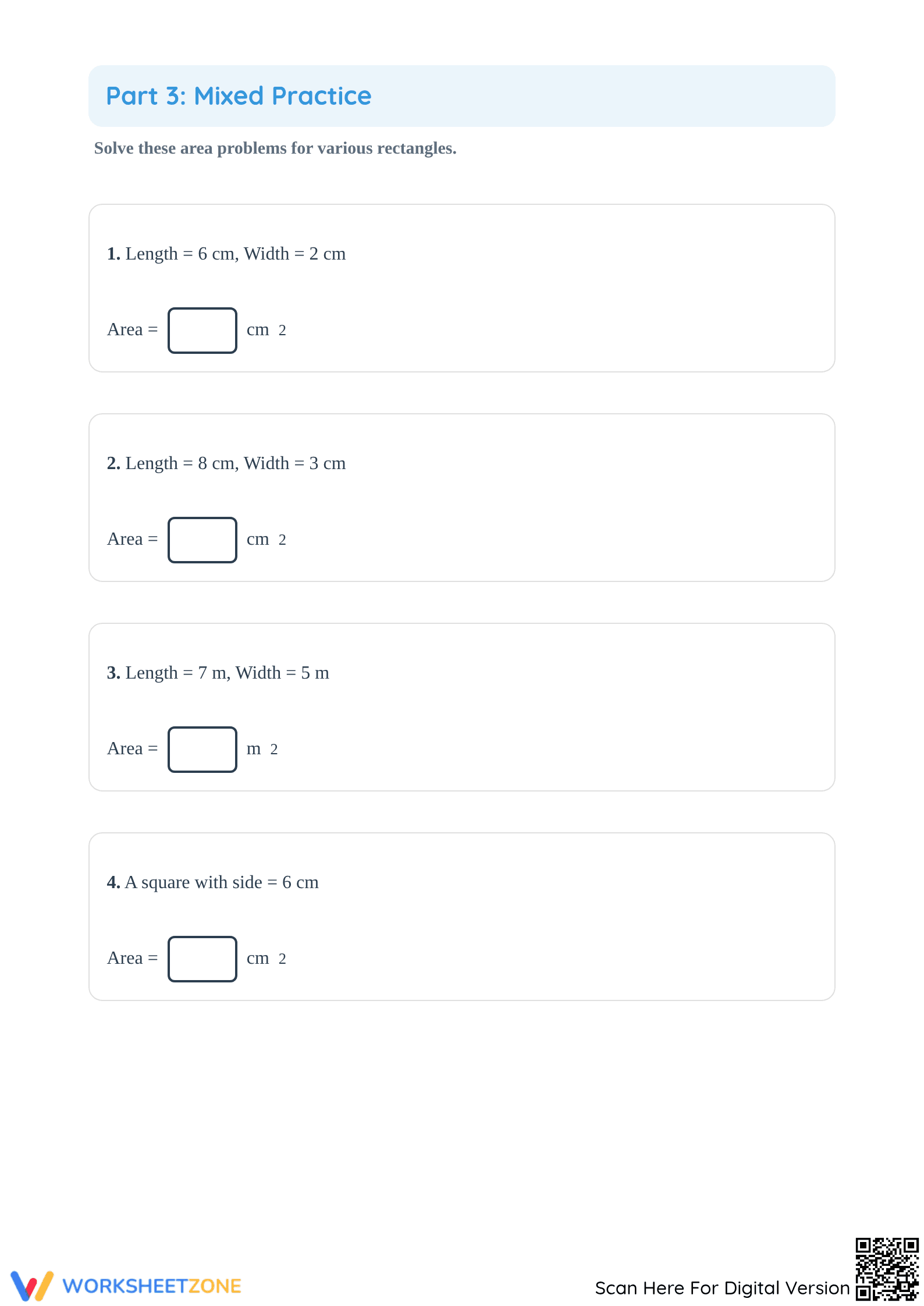
This comprehensive Grade 6 math worksheet guides students through the process of calculating the area of rectangles and squares. By progressing from visual grid counting to abstract formula application and real-world word problems, learners develop a robust understanding of spatial measurements. Students will achieve mastery in area determination, preparing them for more complex geometric concepts in later grades.
At a Glance
- Grade: 6 · Subject: Math
- Standard:
CCSS.MATH.CONTENT.6.G.A.1— Find the area of right triangles, other triangles, special quadrilaterals, and polygons- Skill Focus: Area of rectangles and squares
- Format: 5 pages · 16 problems · Answer key included · PDF
- Best For: Homework, independent practice, or math centers
- Time: 30–45 minutes
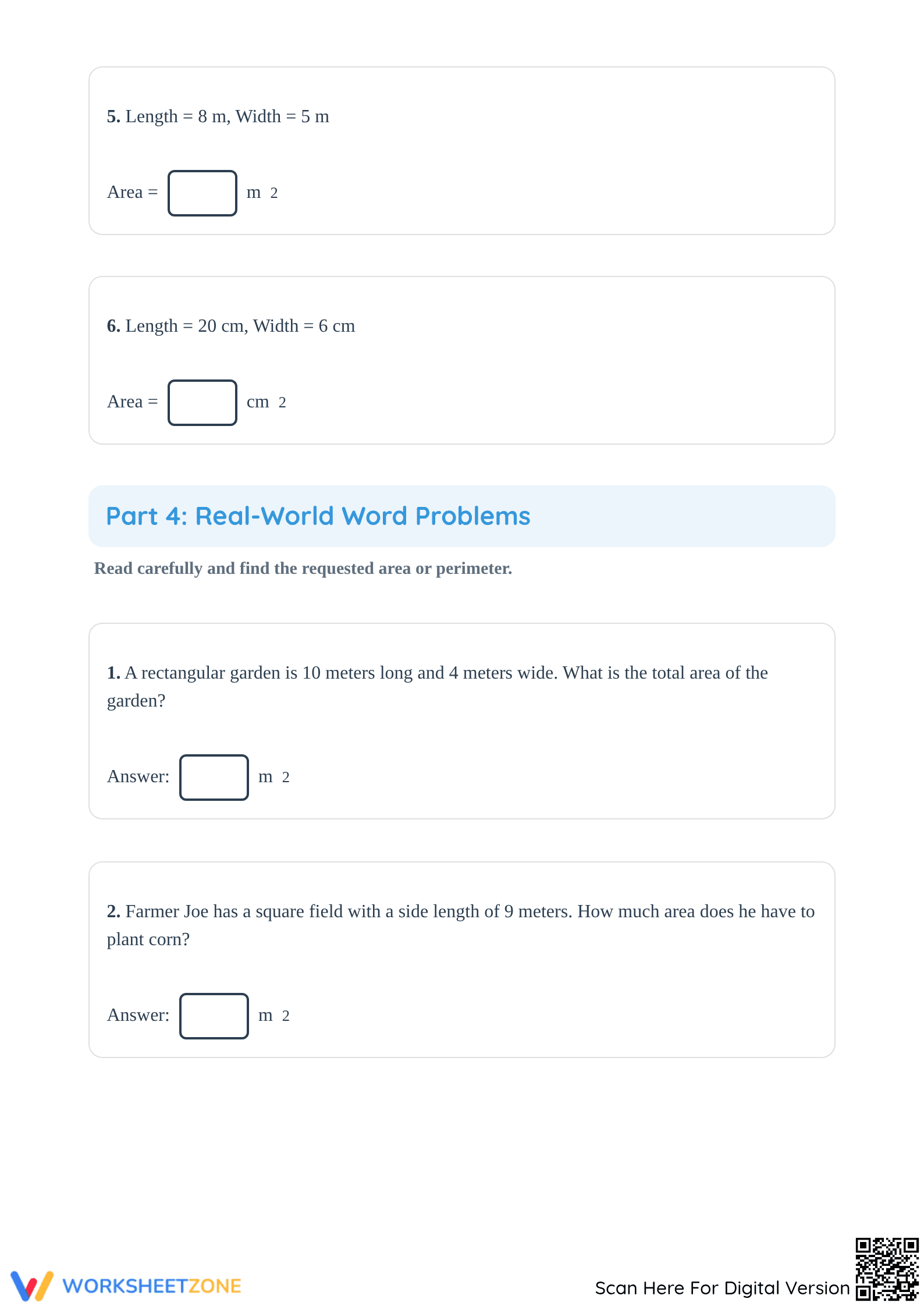
This 5-page resource contains 16 structured tasks divided into four distinct parts. It begins with visual area estimation on grids, moves to direct multiplication using given dimensions for various rectangles and squares, provides mixed numerical practice, and concludes with multi-step real-world word problems involving garden plots and agricultural fields. A complete answer key is provided for immediate grading.
Skill Progression
- Guided Practice: Students use 1cm x 1cm grids to visually count square units, grounding the concept of area in concrete spatial reasoning across three initial problems.
- Supported Practice: Learners apply the A = l x w formula to 11 different geometric shapes and numerical sets, transitioning from visual aids to abstract mathematical computation.
- Independent Practice: Students solve two complex word problems that require extracting dimensions from text and applying area concepts to practical scenarios like rectangular gardens.
This progression follows the gradual-release model, ensuring students build confidence before tackling independent application.
Standards Alignment
Primary Standard: CCSS.MATH.CONTENT.6.G.A.1. This worksheet focuses on finding the area of quadrilaterals by composing into rectangles or decomposing into triangles and other shapes; specifically, it targets the foundational mastery of rectangular area which is central to this standard. Both standard codes can be copied directly into lesson plans, IEP goals, or district curriculum mapping tools.
How to Use It
Assign Part 1 and Part 2 during direct instruction to verify student understanding of the area formula. Use Parts 3 and 4 as a formative assessment to identify students who may struggle with transitioning from numerical problems to word-based applications. A key formative assessment observation tip is to check if students correctly label their final answers with square units (cm² or m²). Expected completion time for the full 5-page set is 35 minutes.
Who It's For
This resource is designed for Grade 6 students but is highly effective for Grade 5 enrichment or Grade 7 remediation. It includes scaffolds like visual grids for ELL students and complex word problems for advanced learners. It pairs naturally with a lesson on perimeter or a 2D geometry anchor chart for a complete unit study.
Standard CCSS.6.G.A.1 requires students to find the area of polygons by composing and decomposing shapes. This worksheet targets the foundational rectangular area skills necessary for this mastery. According to Fisher & Frey (2014), the gradual release of responsibility—moving from grid-based counting to formulaic application as seen here—is essential for long-term retention of geometric concepts. The 16 varied tasks provide the purposeful practice recommended by NAEP for middle-school mathematics. By grounding abstract formulas in concrete grids and then extending them to real-world garden scenarios, this resource bridges the gap between procedural fluency and conceptual understanding. Research from ScienceDirect TpT Analysis (2024) indicates that multi-modal math worksheets (visual, numerical, and verbal) significantly improve student performance on standardized geometry assessments compared to single-mode practice sheets.


