


























Views
Downloads

Essential Friends of 10 Number Bonds Worksheet | Grade 1
Paste this activity's link or code into your existing LMS (Google Classroom, Canvas, Teams, Schoology, Moodle, etc.).
Students can open and work on the activity right away, with no student login required.
You'll still be able to track student progress and results from your teacher account.
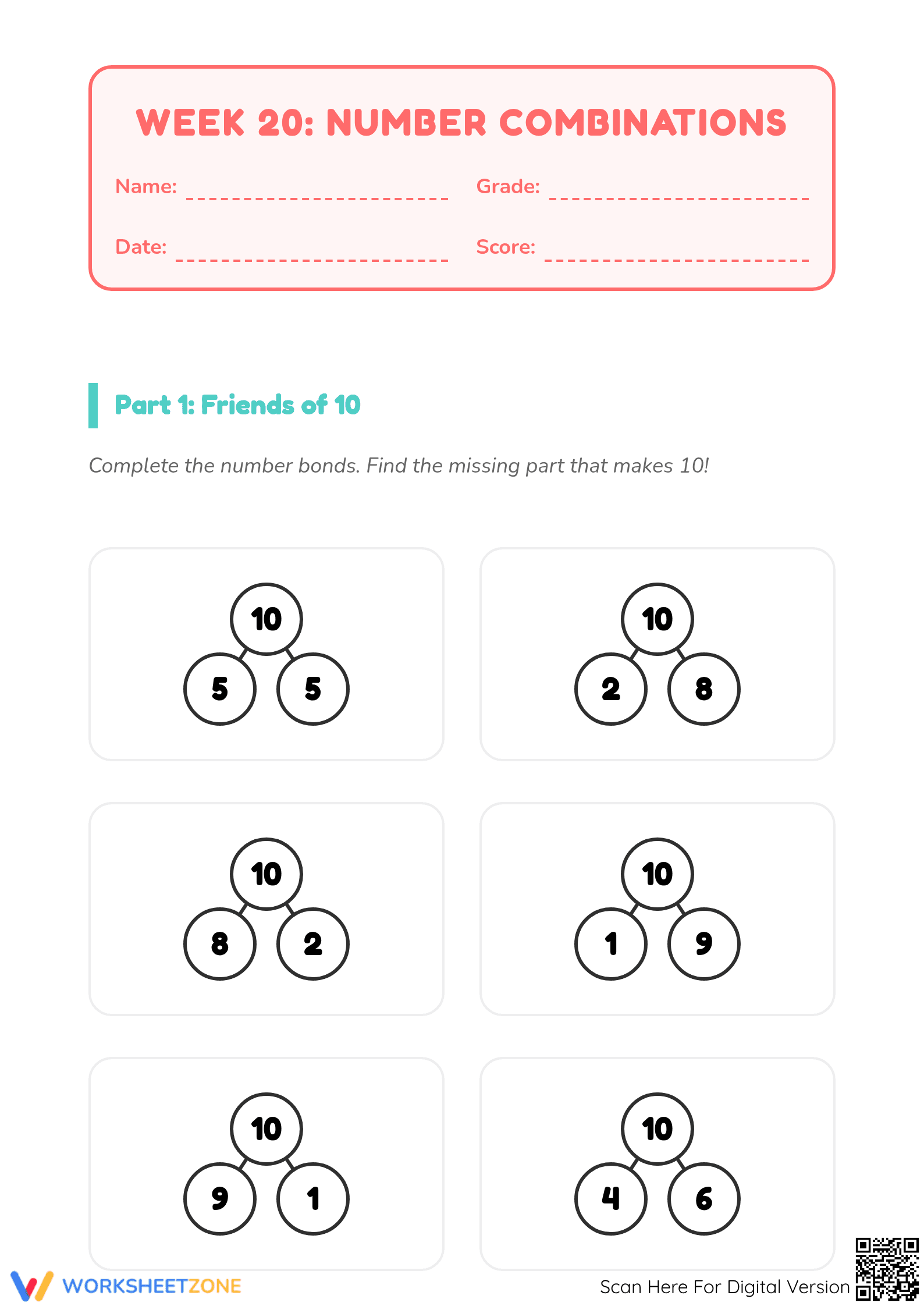
Mastering number combinations is a critical milestone for early mathematicians. This comprehensive 5-page worksheet packet focuses on the 'Friends of 10' strategy, helping Grade 1 students build the mental fluency needed for complex addition and subtraction. By visualizing how numbers pair to make ten, learners establish a rock-solid foundation for base-ten operations.
At a Glance
- Grade: 1 · Subject: Math
- Standard:
1.OA.C.6— Add within 10 fluently using the making-ten strategy to build numerical automaticity- Skill Focus: Number Bonds to 10
- Format: 5 pages · 28 problems · Answer key included · PDF
- Best For: Small group math centers, homework, or morning work review
- Time: 25–35 minutes of focused practice
What's Inside
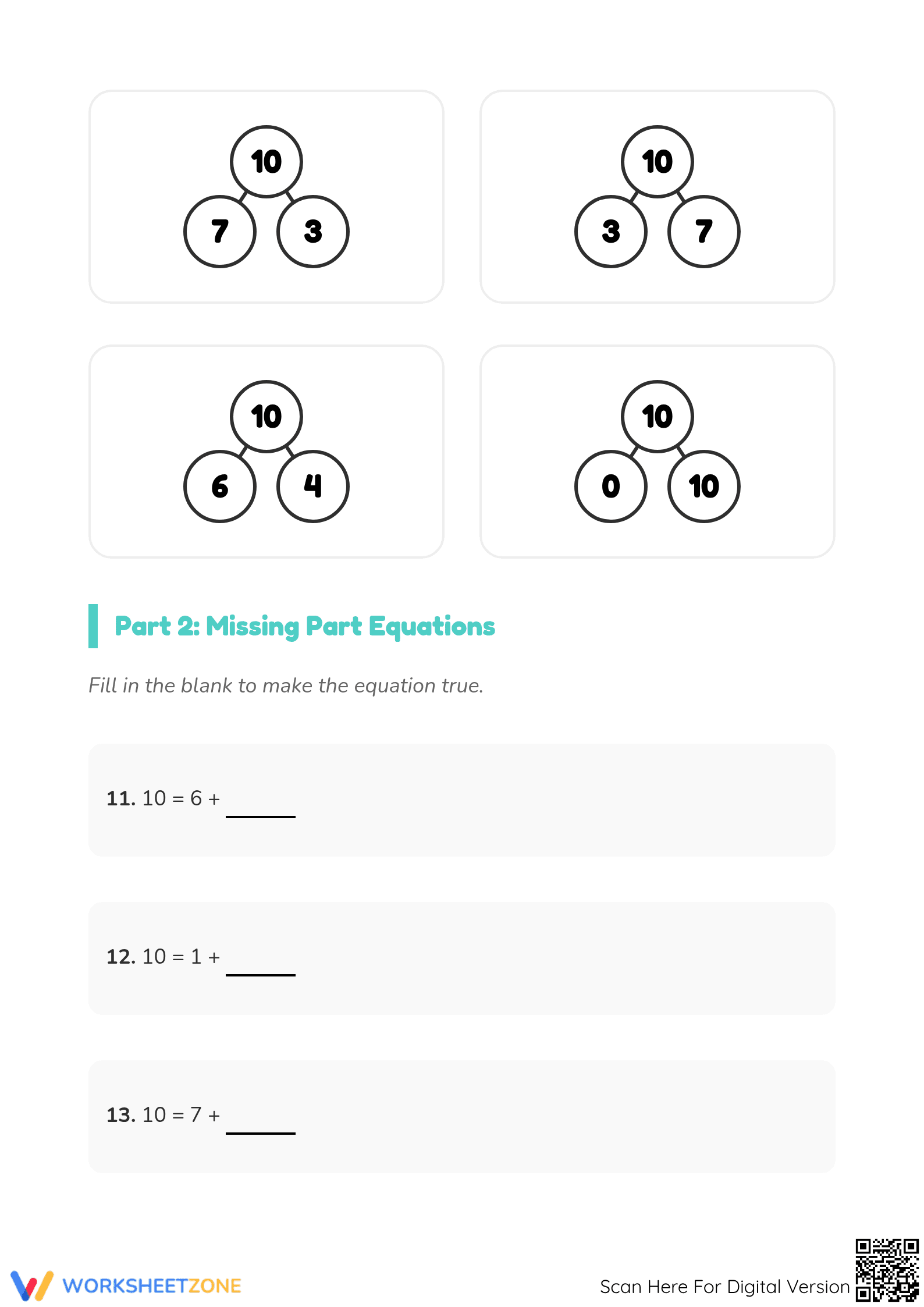
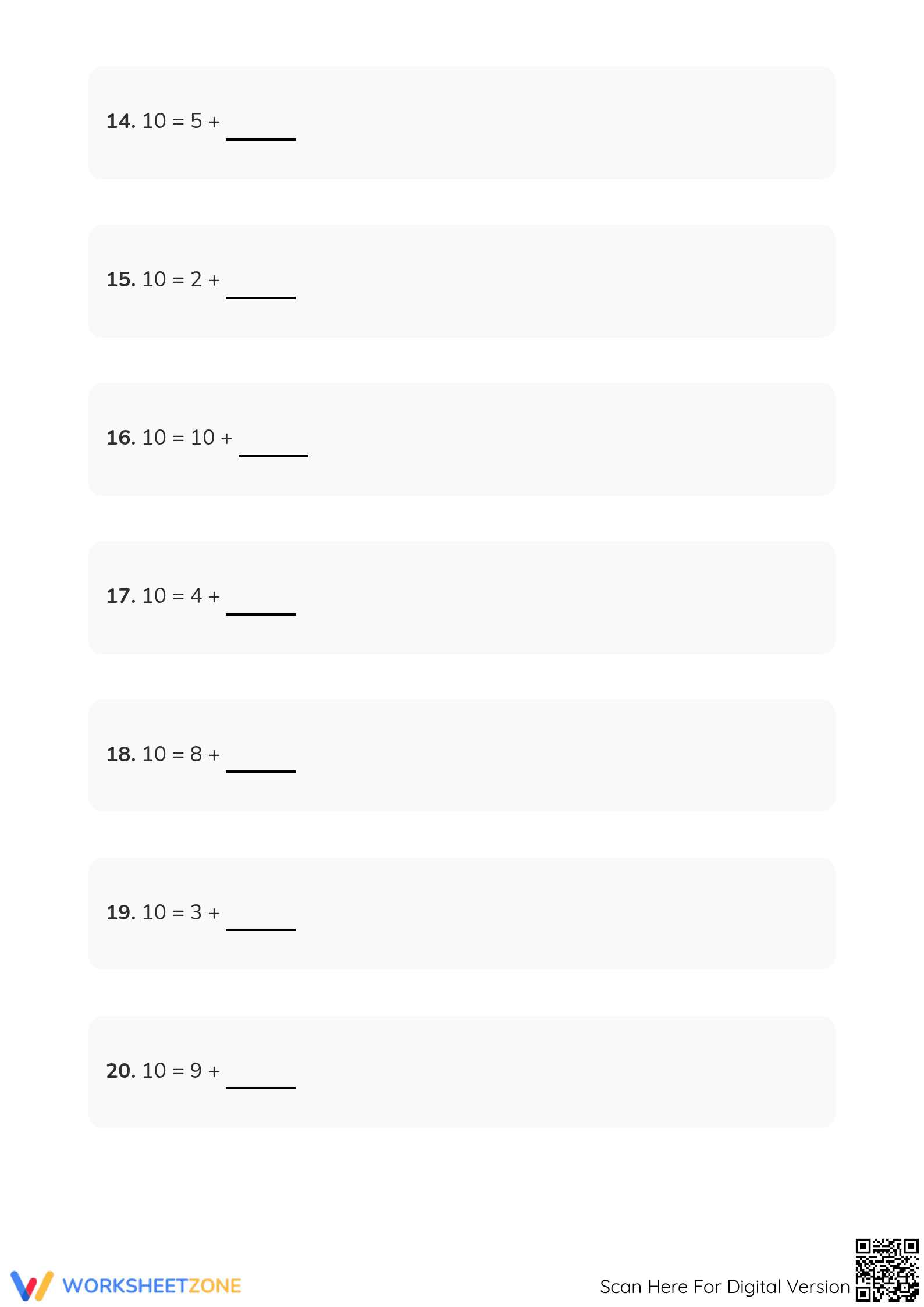
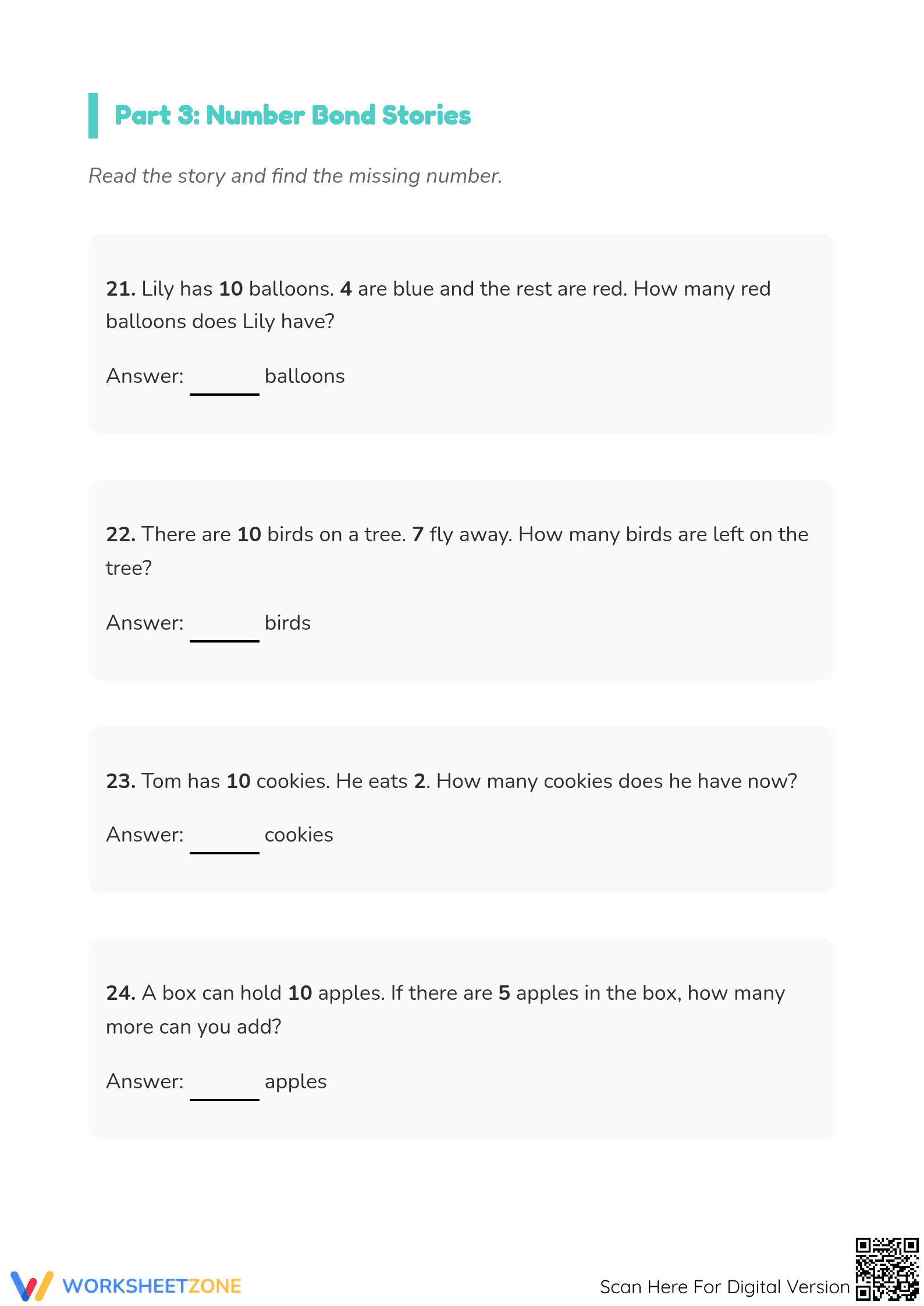
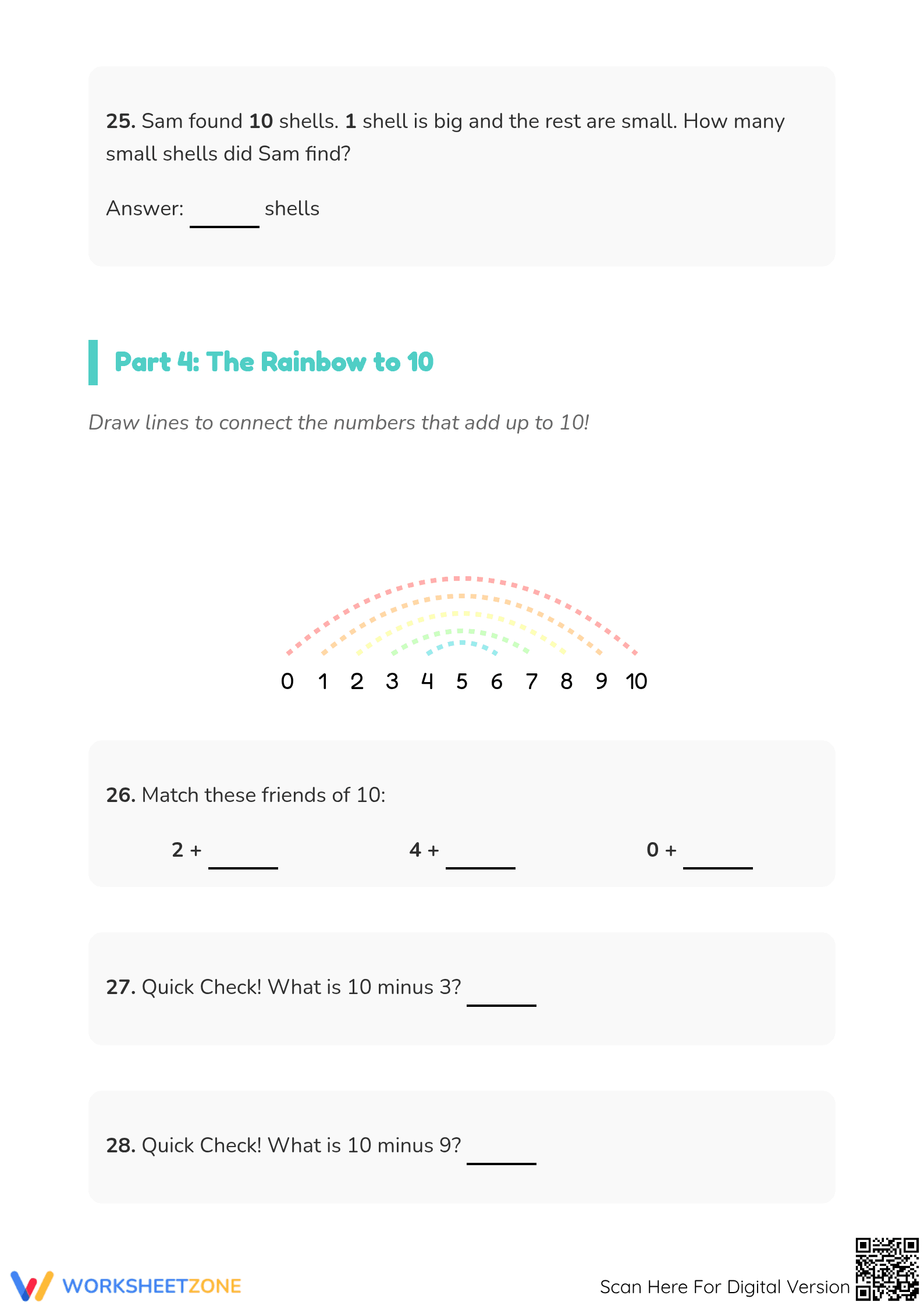
This extensive practice set contains five pages designed to move students from visualization to application. It includes twelve number bond circles, ten missing-addend equations, and five real-world story problems. The final page features a 'Rainbow to 10' matching activity and subtraction quick-checks, ensuring a multi-sensory approach to making ten.
Skill Progression
- Guided practice: 12 number bond circles providing visual anchors for decomposing ten with immediate feedback loops.
- Supported practice: 10 equations that remove visual circles, requiring students to retrieve numerical facts from memory.
- Independent practice: 5 contextualized story problems where students must identify the 'making ten' requirement.
This sequence follows a gradual-release model, shifting from visual aids to independent solving.
Standards Alignment
Primary standard `CCSS.MATH.CONTENT.1.OA.C.6` focuses on adding and subtracting within 20, demonstrating fluency for addition and subtraction within 10. This resource specifically targets the 'making ten' strategy, which is the cornerstone of first-grade algebraic thinking. Supporting standard `K.OA.A.4` is also addressed as students identify missing parts to complete a set of ten. Both standard codes can be copied directly into lesson plans, IEP goals, or district curriculum mapping tools.
How to Use It
Deploy this packet during your 'guided practice' phase after introducing number bonds with physical manipulatives like ten-frames or snap cubes. For a formative assessment, observe students during the 'Number Bond Stories' on page four; notice if they draw pictures or count on their fingers, as this indicates their current level of abstract reasoning. Completion typically takes 30 minutes.
Who It's For
This resource is ideal for Grade 1 students but serves as an excellent challenge for Kindergarteners or a remedial review for Grade 2 learners. It naturally pairs with a large-format classroom anchor chart showing the 'Rainbow to 10' for visual reference during initial attempts.
Mathematical fluency in the early grades is not merely about speed; it is about the flexible use of strategies to solve numerical problems. Research from NAEP indicates that students who possess a strong grasp of number combinations to ten are significantly more likely to succeed in multi-digit addition and place-value concepts in later elementary years. This worksheet applies the `1.OA.C.6` Friends of 10 conceptual framework, which Fisher & Frey (2014) identify as a vital scaffold in the gradual release of responsibility. By explicitly linking visual number bonds (Part 1) to symbolic equations (Part 2) and linguistic story problems (Part 3), this resource addresses multiple cognitive pathways for information encoding. The 28-task repetition count is intentionally designed to move facts from short-term working memory into long-term retrieval, which NAEP studies suggest is the primary driver for arithmetic automaticity in Title I educational settings.


