


























Views
Downloads



Classifying Angles Worksheet | Grade 4-6 Essential
Paste this activity's link or code into your existing LMS (Google Classroom, Canvas, Teams, Schoology, Moodle, etc.).
Students can open and work on the activity right away, with no student login required.
You'll still be able to track student progress and results from your teacher account.
This Grade 4-6 math worksheet provides students with structured practice to identify, classify, and compare different types of angles. By analyzing visual representations, learners develop a concrete understanding of acute, obtuse, and right angles. This resource ensures students can accurately categorize geometric shapes based on their internal properties and angular measurements.
At a Glance
- Grade: 4-6 · Subject: Math
- Standard:
CCSS.MATH.CONTENT.4.G.A.1— Identify right, acute, and obtuse angles in two-dimensional figures- Skill Focus: Angle Classification & Comparison
- Format: 3 pages · 15 problems · Answer key included · PDF
- Best For: Independent practice or formative assessment
- Time: 20–30 minutes
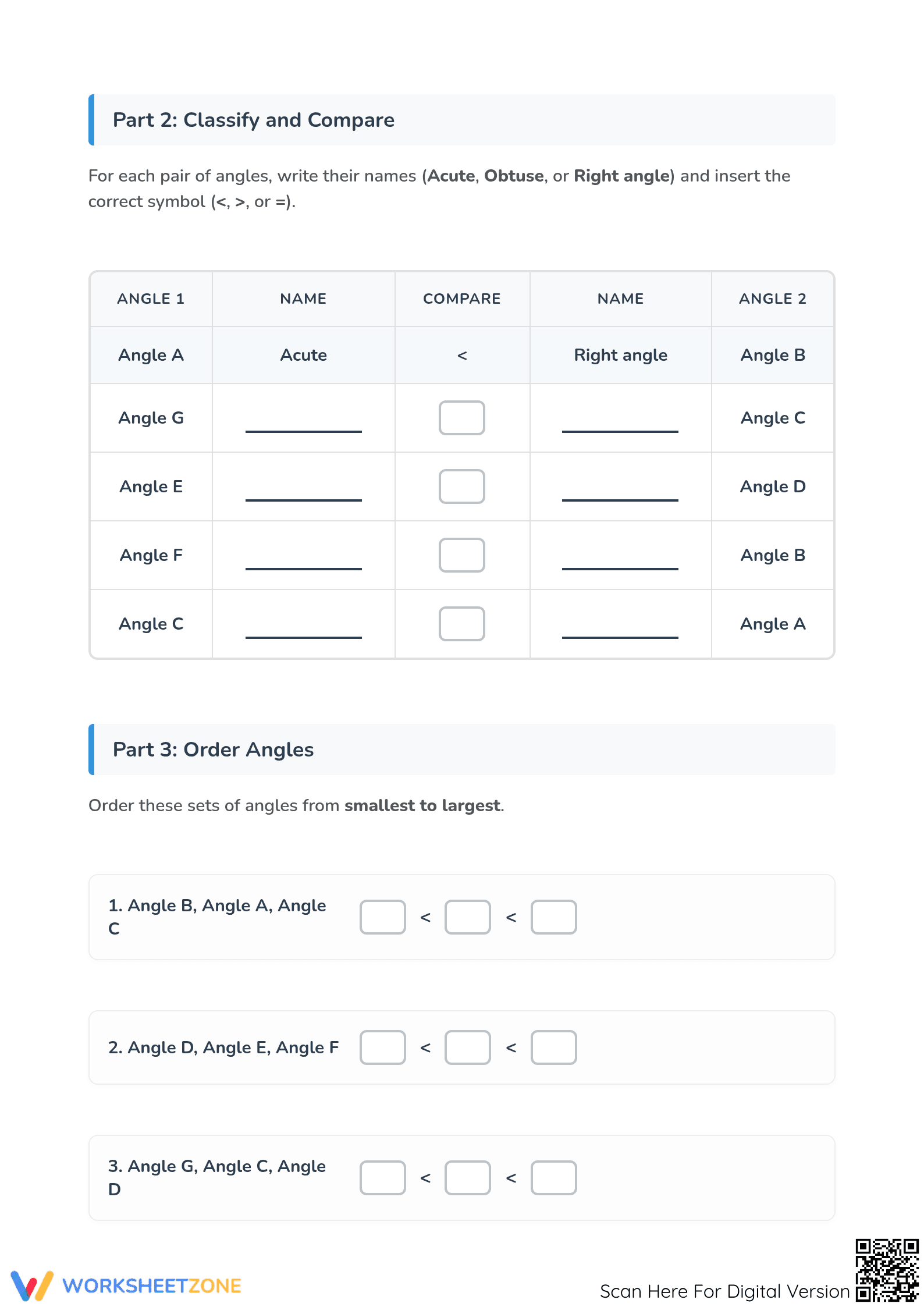
What's Inside: The packet contains three comprehensive pages designed for clarity. It begins with a visual reference guide featuring seven distinct angles (A-G). Students then progress through a classification table, an ordering exercise from smallest to largest, and a final true-or-false conceptual check. A full answer key is provided for immediate feedback and grading.
Skill Progression
- Guided practice: Part 1 provides a visual anchor chart of reference angles to support initial identification and visual discrimination.
- Supported practice: Part 2 and 3 use the reference angles in structured tables and ordering frames to build comparison skills across 9 sub-tasks.
- Independent practice: Part 4 requires students to apply conceptual knowledge to 4 true-or-false statements without direct visual aids.
This sequence follows the gradual-release model to ensure student mastery of geometric terminology.
Standards Alignment
This resource is aligned with `CCSS.MATH.CONTENT.4.G.A.1`, which requires students to draw and identify lines and angles, specifically right, acute, and obtuse angles. It also supports higher-grade geometry foundations by reinforcing the properties of two-dimensional figures. Both standard codes can be copied directly into lesson plans, IEP goals, or district curriculum mapping tools.
How to Use It
Use this worksheet during the independent practice phase of a lesson after introducing angle types with a protractor or square corner. It serves as an excellent formative assessment to check if students can distinguish between angle sizes visually. Expect students to complete the three pages in approximately 25 minutes.
Who It's For
This is designed for 4th, 5th, and 6th-grade students who need to solidify their geometric vocabulary. It is particularly helpful for visual learners who benefit from comparing angles side-by-side. Pair this with an anchor chart showing real-world examples of angles for maximum impact.
According to the Fisher & Frey (2014) framework for intentional scaffolding, providing visual reference points before independent classification significantly improves retention of geometric properties. This worksheet utilizes that research-backed approach by including a dedicated reference section for the 15 included tasks. By aligning with CCSS.MATH.CONTENT.4.G.A.1, the material ensures that students move beyond simple recognition toward the comparative analysis required for middle school geometry. The inclusion of true-or-false conceptual questions mirrors the rigor found in NAEP assessments, challenging students to defend their mathematical reasoning. Educators can rely on this structured progression to bridge the gap between basic identification and the application of geometric definitions in complex figures. This resource provides the necessary repetition and variety to ensure that the distinction between acute, obtuse, and right angles becomes a permanent part of the student's mathematical toolkit.


