


























Views
Downloads


Grade 4 Comparing Angles — Printable No-Prep Worksheet
Paste this activity's link or code into your existing LMS (Google Classroom, Canvas, Teams, Schoology, Moodle, etc.).
Students can open and work on the activity right away, with no student login required.
You'll still be able to track student progress and results from your teacher account.
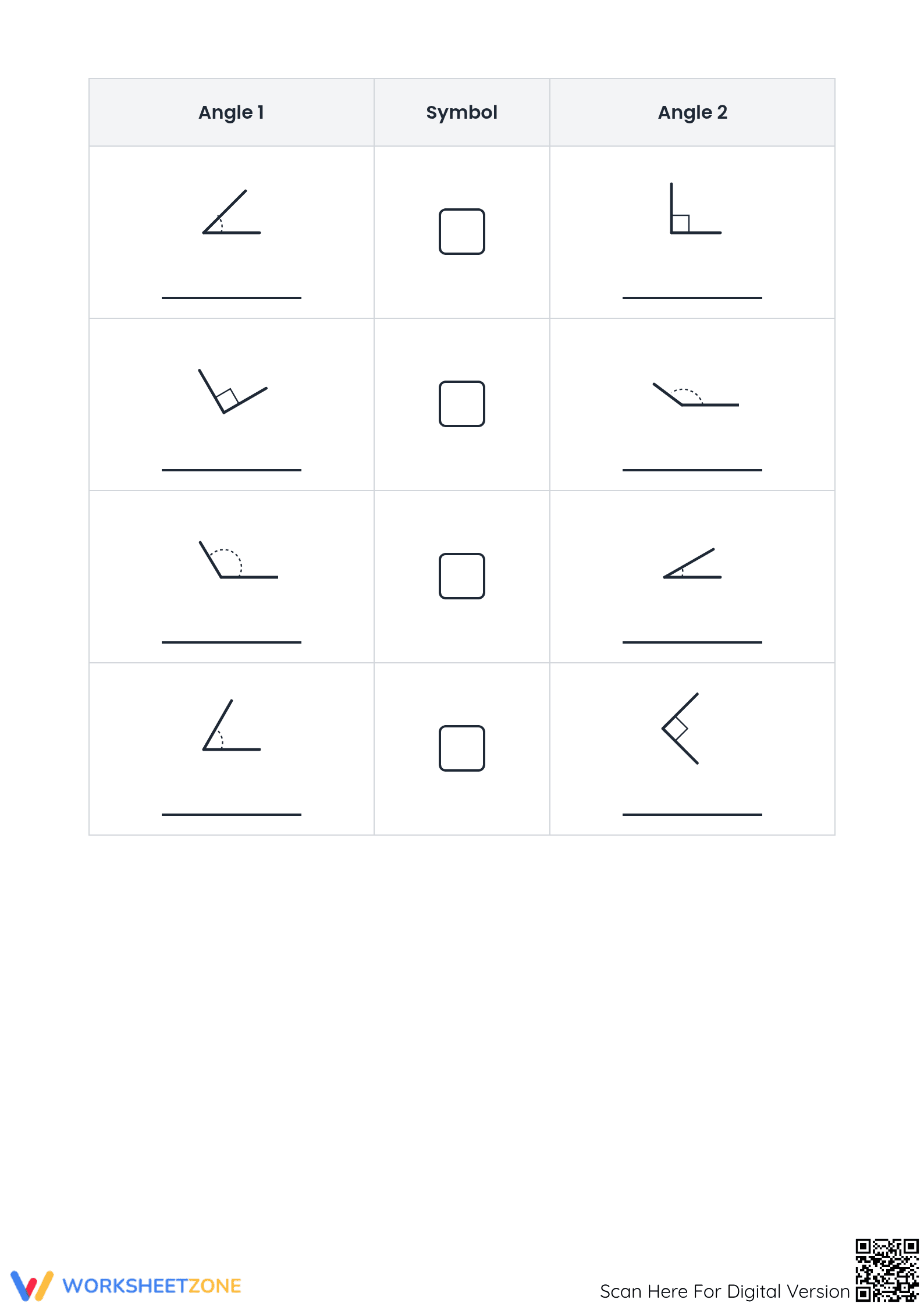
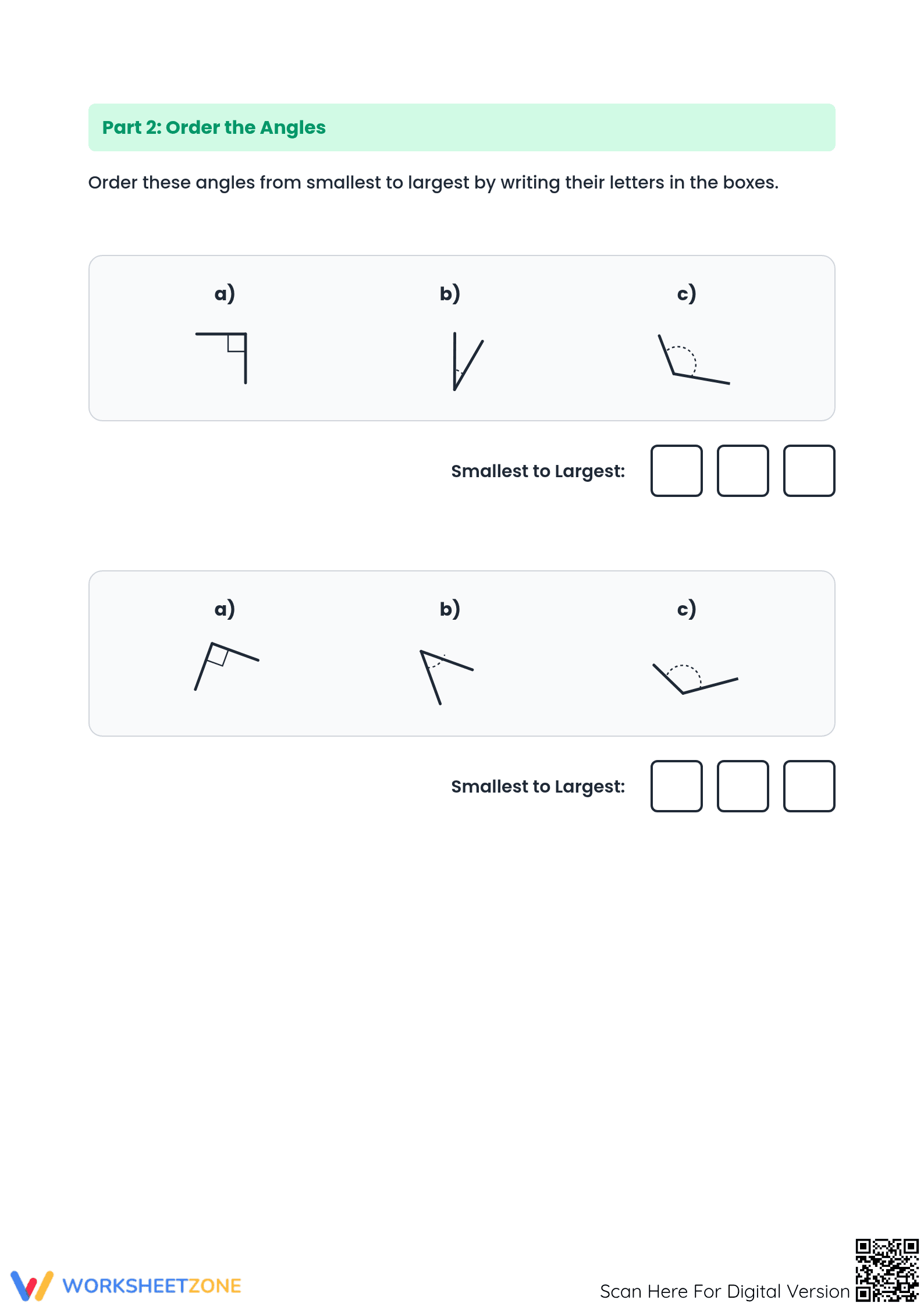
This Grade 4 math worksheet provides students with structured practice in identifying, comparing, and ordering acute, right, and obtuse angles. By visually analyzing geometric shapes, learners develop a concrete understanding of angle magnitude before moving into protractor measurement. It is an essential resource for building spatial reasoning and geometric vocabulary.
At a Glance
- Grade: 4 · Subject: Math
- Standard:
CCSS.MATH.CONTENT.4.G.A.1— Identify right, acute, and obtuse angles in two-dimensional figures- Skill Focus: Comparing and ordering angles
- Format: 3 pages · 14 tasks · Answer key included · PDF
- Best For: Independent practice or quick formative assessment
- Time: 15–20 minutes
The packet contains three high-quality pages designed for immediate classroom use. Part 1 features a comparison table where students must label eight different angles as acute, right, or obtuse while using inequality symbols to compare pairs. Part 2 challenges students to order sets of angles from smallest to largest. A dedicated notes section is included for student observations, and a full answer key ensures quick grading.
This resource is designed for a three-step zero-prep workflow. First, print the three-page PDF (30 seconds). Second, distribute the sheets to students for independent work or as a supplemental sub plan (1 minute). Finally, use the provided answer key for rapid review or peer-grading (1 minute). Total teacher preparation time is under two minutes, making it ideal for busy instructional blocks.
This worksheet is primary aligned to CCSS.MATH.CONTENT.4.G.A.1, which requires students to draw points, lines, line segments, rays, angles, and perpendicular and parallel lines. It specifically targets the identification and classification of angles within two-dimensional figures. Both standard codes can be copied directly into lesson plans, IEP goals, or district curriculum mapping tools.
Use this worksheet during the independent practice phase of a gradual release lesson after students have been introduced to angle types. It also serves as an excellent formative assessment tool to check for misconceptions between acute and obtuse classifications. Expect students to complete the tasks within 15 to 20 minutes depending on their familiarity with geometric symbols.
This resource is tailored for Grade 4 students but provides valuable review for Grade 5 and 6 learners who need to reinforce geometric properties. It is particularly effective for visual learners who benefit from comparing side-by-side illustrations. Pair this with an anchor chart showing 90-degree benchmarks for the best instructional results.
According to the Fisher & Frey (2014) framework for intentional instruction, providing students with opportunities to categorize and order mathematical concepts is vital for long-term retention. This worksheet facilitates that process by requiring students to apply the CCSS.MATH.CONTENT.4.G.A.1 standard through active comparison of acute, right, and obtuse angles. Research from the RAND AIRS 2024 report suggests that high-quality, standards-aligned supplemental materials significantly reduce teacher burnout by streamlining the planning process. By focusing on the plain-English skill of identifying angle types in 2D figures, this resource ensures that 100% of the tasks are directly relevant to grade-level mastery. The inclusion of 14 distinct tasks allows for sufficient repetition to move students from surface-level recognition to deeper conceptual understanding of geometric relationships.


