


























Views
Plays

Essential Waves: Wavelength, Frequency, Amplitude
Paste this activity's link or code into your existing LMS (Google Classroom, Canvas, Teams, Schoology, Moodle, etc.).
Students can open and work on the activity right away, with no student login required.
You'll still be able to track student progress and results from your teacher account.
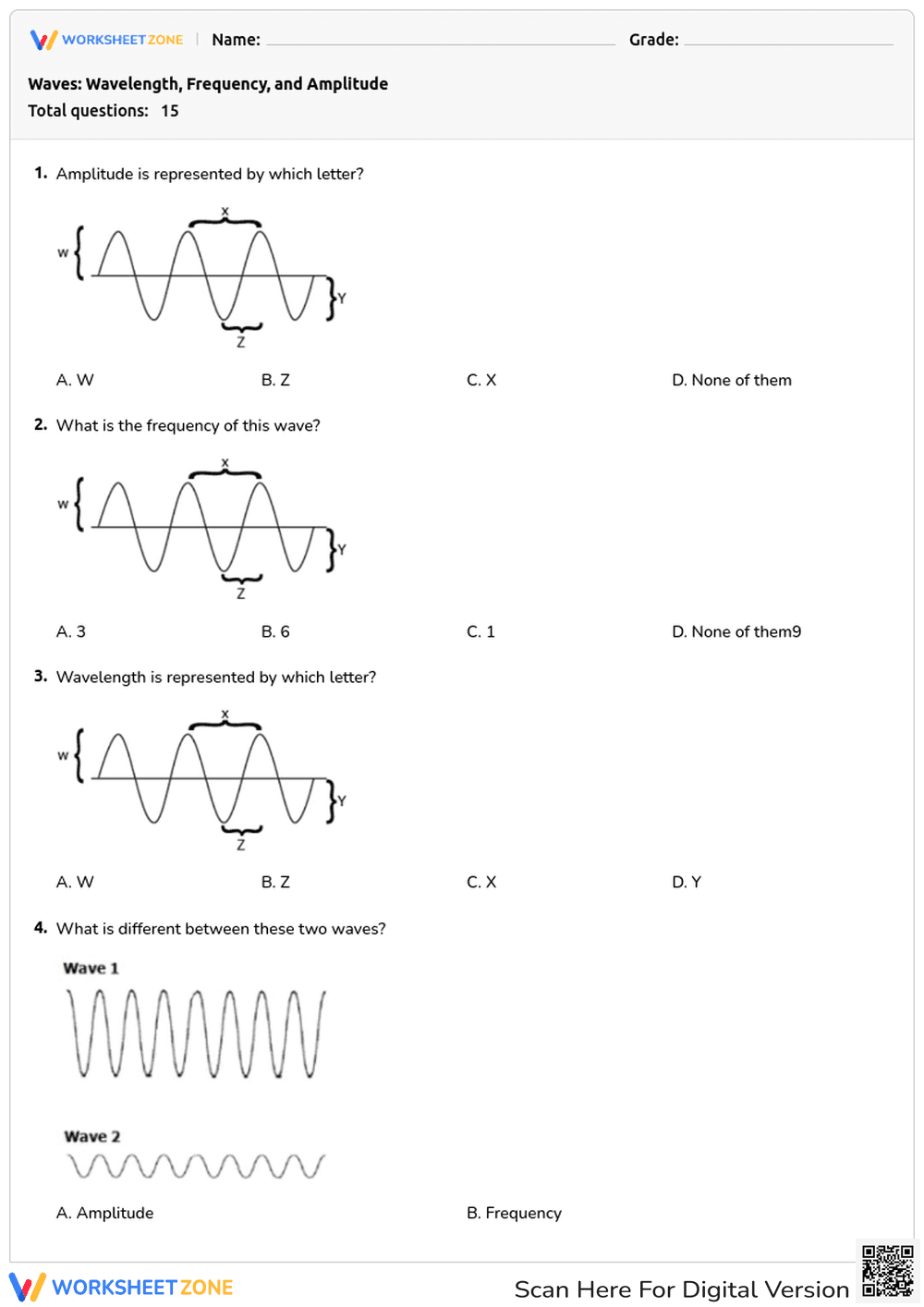
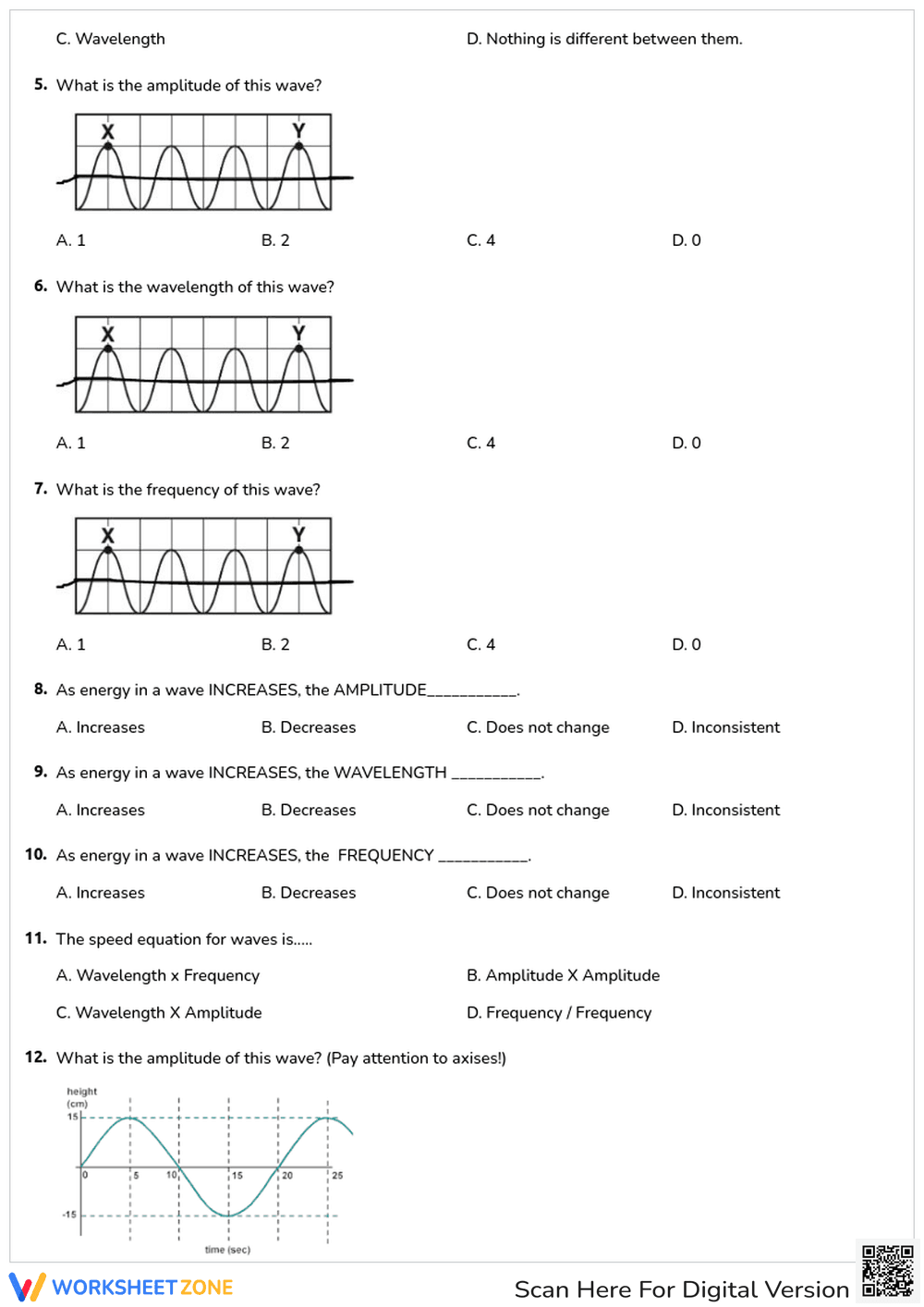
This Grade 9-11 physics worksheet provides students with 15 targeted problems to master the fundamental properties of waves. Students will identify wavelength, frequency, and amplitude from diagrams and apply the wave speed equation to solve quantitative problems. It ensures students can visualize and calculate wave behavior accurately.
At a Glance
- Grade: 9-11 · Subject: Physics
- Standard:
HS-PS4-1— Use mathematical representations to describe relationships between frequency, wavelength, and wave speed- Skill Focus: Wave Property Identification
- Format: 3 pages · 15 problems · Answer key included · PDF
- Best For: Independent practice or formative assessment
- Time: 25–35 minutes
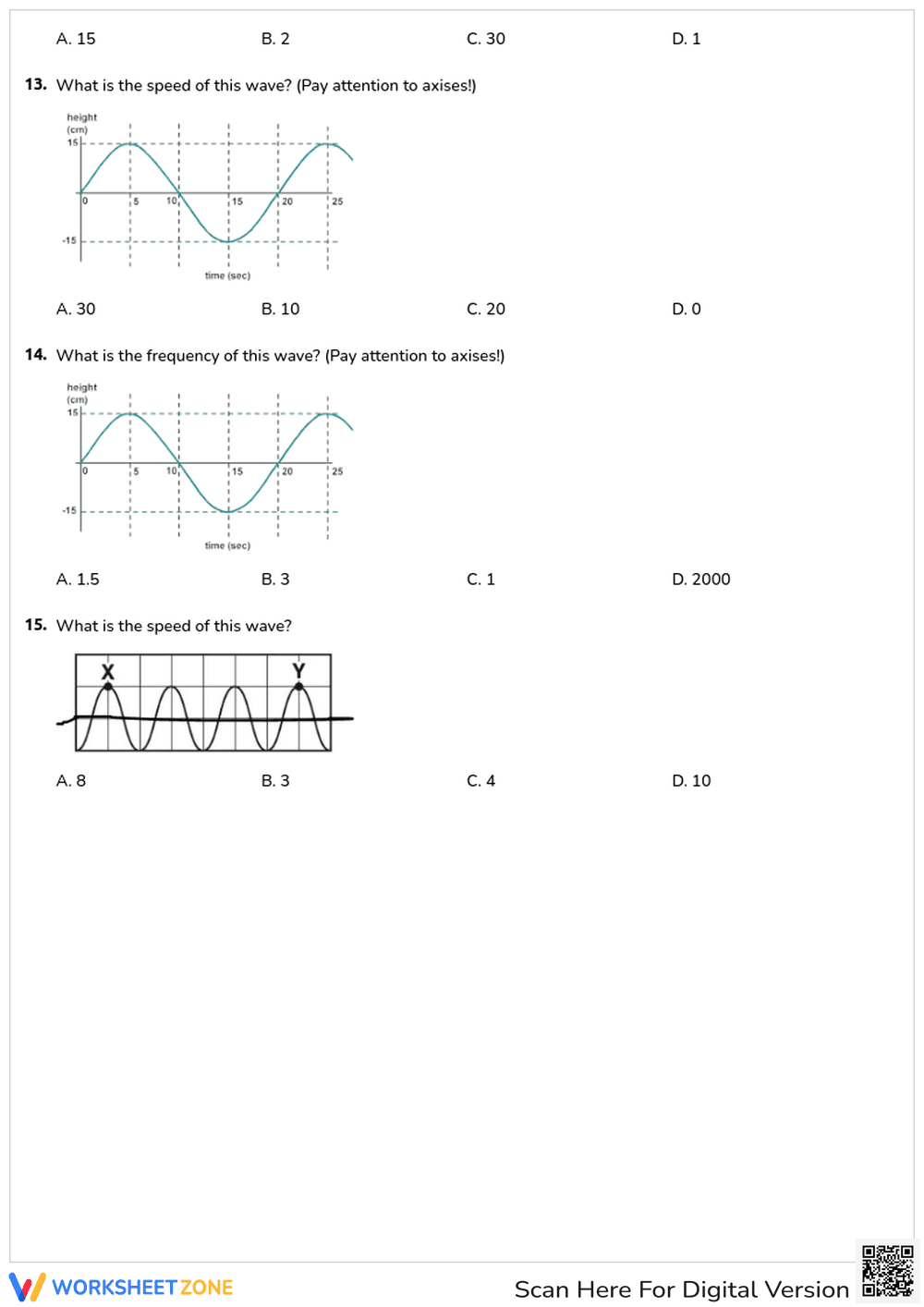
The 3-page PDF features 15 multiple-choice questions supported by high-quality wave diagrams. It includes visual identification tasks, conceptual energy relationship questions, and mathematical applications using the wave speed equation (Wavelength x Frequency). A full answer key is provided for rapid grading and immediate student feedback.
Skill Progression
- Guided practice: Questions 1-7 use labeled diagrams to help students identify amplitude and wavelength visually with clear letter markers.
- Supported practice: Questions 8-11 transition to conceptual relationships, exploring how energy changes affect wave characteristics like frequency.
- Independent practice: Questions 12-15 require students to interpret axes and calculate wave speed independently using the provided formula.
This gradual-release model ensures students build confidence before tackling complex calculations involving multiple variables.
Standards Alignment: Primary standard HS-PS4-1: "Use mathematical representations to support a claim regarding relationships among the frequency, wavelength, and speed of waves traveling in various media." This resource also supports algebraic manipulation skills required in high school physics. Both standard codes can be copied directly into lesson plans, IEP goals, or district curriculum mapping tools.
How to Use It: Use this worksheet as a mid-unit formative assessment after introducing the wave equation. It is also effective as a structured review before a summative exam. Teachers should observe students during questions 12-14 to ensure they are correctly reading the grid units on the axes. Completion typically takes 30 minutes.
Who It's For: Designed for Grade 9-11 students in Physics or Physical Science courses. It provides excellent support for visual learners through clear diagrams and is a natural pairing for a direct instruction lesson on electromagnetic or mechanical waves.
This resource aligns with the HS-PS4-1 standard, focusing on the mathematical and visual representation of wave properties. According to the RAND AIRS 2024 report, structured practice with visual-to-mathematical translation is critical for long-term retention in secondary science. By requiring students to identify amplitude, frequency, and wavelength across 15 distinct tasks, the worksheet reinforces the cognitive pathways necessary for mastery of wave mechanics. The inclusion of the wave speed equation ensures that students meet the quantitative demands of the NGSS framework. Research from Fisher & Frey (2014) emphasizes that such scaffolded practice—moving from simple identification to complex calculation—supports the gradual release of responsibility. This worksheet serves as a reliable tool for both classroom instruction and independent study, providing the necessary repetition to solidify student understanding of how energy relates to wave physical characteristics.


