


























Views
Downloads
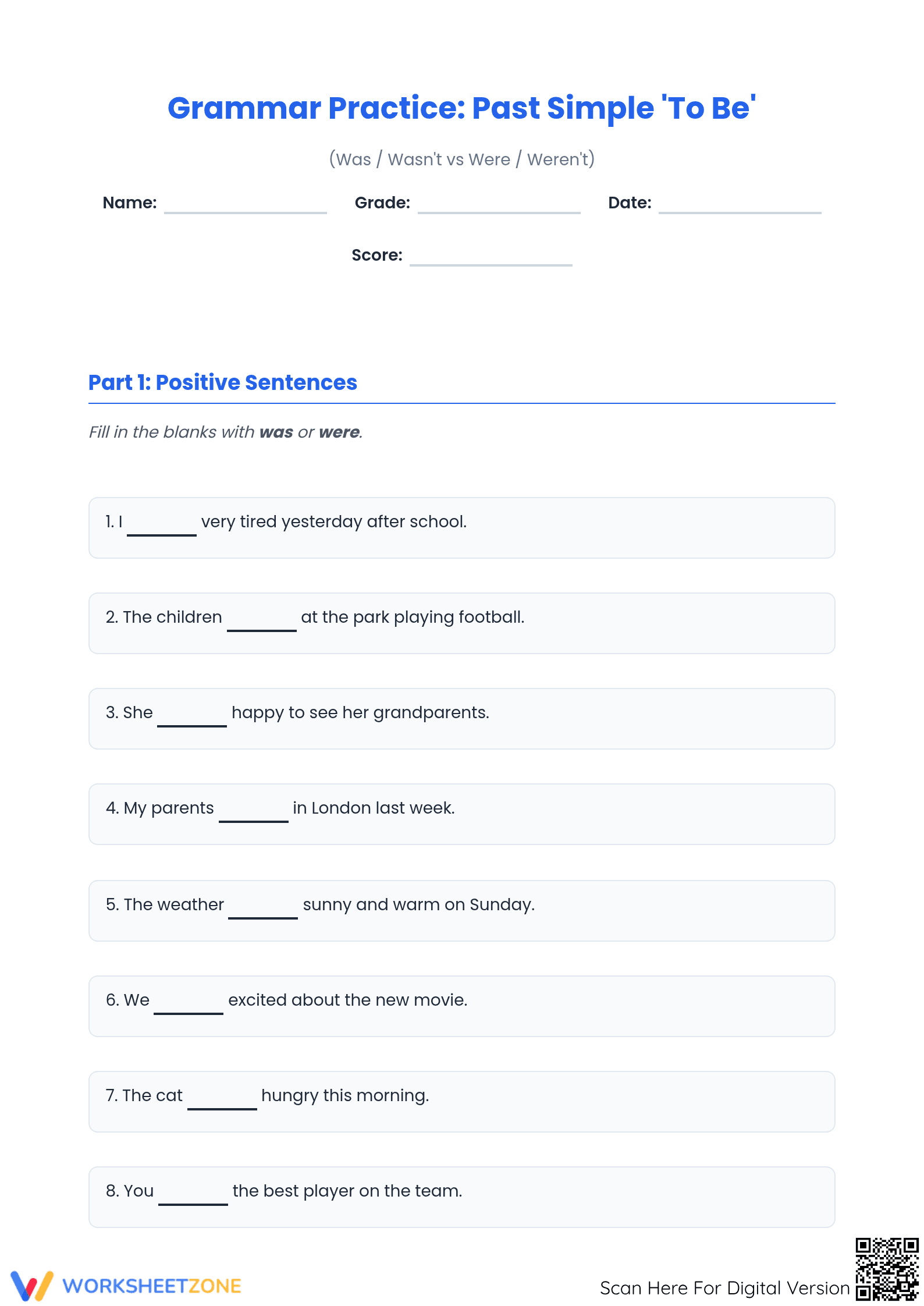


Printable Was vs Were Worksheet | Grade 4 Grammar
Paste this activity's link or code into your existing LMS (Google Classroom, Canvas, Teams, Schoology, Moodle, etc.).
Students can open and work on the activity right away, with no student login required.
You'll still be able to track student progress and results from your teacher account.
This Grade 4 grammar worksheet provides focused practice on the past simple tense of the verb "to be." Students master subject-verb agreement by correctly applying was, were, wasn't, and weren't across various sentence structures, building essential foundational writing skills for clear communication.
At a Glance
- Grade: 4 · Subject: ELA
- Standard:
CCSS.ELA-LITERACY.L.4.1— Use standard English grammar when writing- Skill Focus: Past Tense Verbs (Was/Were)
- Format: 4 pages · 28 problems · Answer key included · PDF
- Best For: Independent practice and review
- Time: 20–30 minutes
This comprehensive resource features four distinct sections to build grammatical fluency. Students begin with positive sentences, move to negative constructions, tackle multiple-choice questions, and finish by writing short answers. The four-page layout provides ample space for writing, while the included answer key ensures quick and accurate grading.
- Guided practice: The first 16 problems focus on isolated positive and negative sentence completion, allowing students to establish basic subject-verb agreement rules.
- Supported practice: The next 7 multiple-choice questions require students to evaluate complete sentences and select the correct verb form.
- Independent practice: The final 5 questions challenge students to generate their own short answers using the target verbs.
This gradual-release approach ensures students build confidence before applying the skill independently.
Aligned to primary standard CCSS.ELA-LITERACY.L.4.1, this resource requires students to demonstrate command of the conventions of standard English grammar and usage when writing. It specifically targets verb tense and agreement. Both standard codes can be copied directly into lesson plans, IEP goals, or district curriculum mapping tools.
Use this worksheet during independent practice after direct instruction on past tense verbs. It also serves as an excellent morning work assignment or homework task. Teachers can use the final short-answer section as a quick formative assessment to check for individual mastery of subject-verb agreement. Expect students to complete the full packet in 20 to 30 minutes.
Designed for fourth-grade general education students, this resource also supports English Language Learners needing explicit verb tense practice. Pair this worksheet with an anchor chart detailing singular and plural pronouns to provide additional scaffolding for struggling learners.
Explicit grammar instruction remains a critical component of effective literacy education. According to Fisher & Frey (2014), targeted practice with foundational language conventions directly improves students' overall writing clarity and reading comprehension. This worksheet aligns with CCSS.ELA-LITERACY.L.4.1, requiring students to use standard English grammar when writing. By isolating the past simple forms of "to be," educators can address common subject-verb agreement errors before they become ingrained habits. Structured repetition across multiple contexts—such as fill-in-the-blank and short-answer formats—helps solidify these grammatical rules in long-term memory. Providing students with 28 distinct opportunities to apply these concepts ensures they develop the automaticity needed for more complex writing tasks. This targeted approach supports broader literacy goals and builds essential communication skills.


