


























Views
Downloads
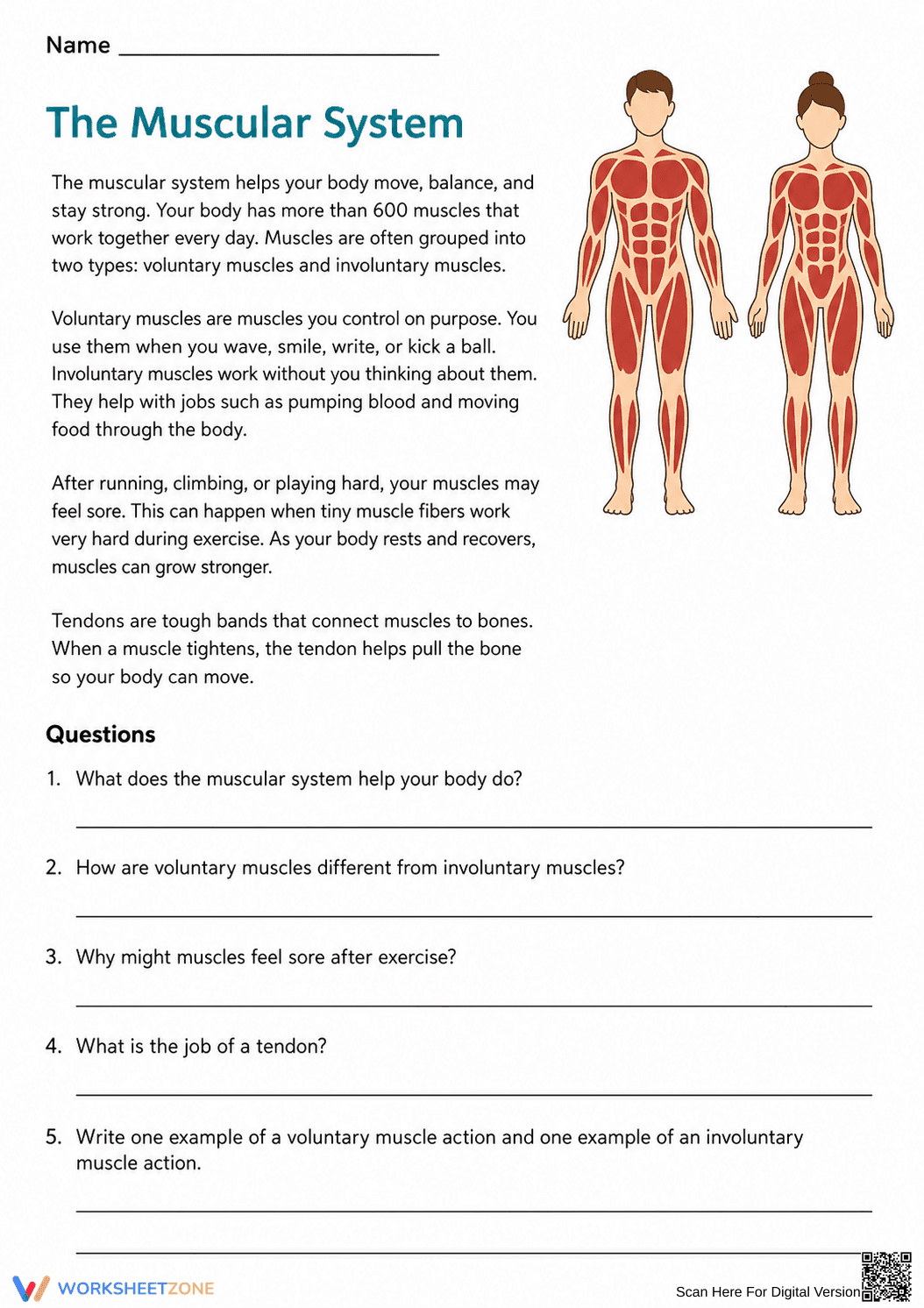

Grade 8 Muscular System — Printable No-Prep Worksheet
Paste this activity's link or code into your existing LMS (Google Classroom, Canvas, Teams, Schoology, Moodle, etc.).
Students can open and work on the activity right away, with no student login required.
You'll still be able to track student progress and results from your teacher account.
This Grade 8 science worksheet builds foundational knowledge of the human muscular system while strengthening reading comprehension skills. Students read a short informational text and answer targeted questions to demonstrate their understanding of voluntary and involuntary muscles, tendons, and muscle recovery, ensuring they grasp how these subsystems interact.
At a Glance
- Grade: 8 · Subject: Science
- Standard:
MS-LS1-3— Understand how body subsystems interact to function- Skill Focus: Reading Comprehension & Body Systems
- Format: 1 page · 5 problems · Answer key included · PDF
- Best For: Independent practice or sub plans
- Time: 15–20 minutes
This resource features a concise, easy-to-read informational passage detailing the core functions of the muscular system, accompanied by clear anatomical diagrams. Following the text, students will find five short-answer comprehension questions that require them to recall facts, differentiate between muscle types, and apply their knowledge to real-world examples. A complete answer key is provided for quick grading.
Designed for maximum efficiency, this worksheet requires zero teacher setup.
- Print (1 minute): The single-page layout is optimized for quick photocopying and immediate distribution.
- Distribute (1 minute): Hand out the reading passage and question set as a unified packet. No extra materials or textbooks are needed.
- Review (3 minutes): Use the included answer key to quickly check student responses or facilitate a brief whole-class discussion.
Because it is entirely self-contained, this activity is an excellent choice for emergency sub plans or quiet independent work.
This material is aligned to MS-LS1-3, requiring students to use evidence to explain how the body is a system of interacting subsystems composed of groups of cells. By reading about how tendons connect muscles to bones and how voluntary and involuntary muscles operate, students see direct examples of these interactions. Both standard codes can be copied directly into lesson plans, IEP goals, or district curriculum mapping tools.
This worksheet is highly versatile in the middle school science classroom. Use it as an introductory activity before a broader lecture on human anatomy to build background knowledge, or assign it as a quick formative assessment after direct instruction. While students work, teachers can circulate and observe how well they locate specific textual evidence to support their answers, particularly on the final question requiring original examples. Expect students to complete the reading and questions within 15 to 20 minutes.
This resource is ideal for Grade 8 general science or biology students learning about human body systems. The straightforward text and clear diagrams provide built-in scaffolding, making it accessible for diverse learners who might struggle with dense textbook chapters. It pairs perfectly with a hands-on lab about heart rate or a broader unit on the skeletal system.
Integrating literacy into science instruction is critical for developing students' ability to process technical information. This worksheet aligns with MS-LS1-3 by having students understand how body subsystems interact to function. According to Fisher & Frey (2014), embedding targeted reading comprehension tasks within content-area instruction significantly improves students' retention of complex academic vocabulary and core concepts. By requiring learners to read an informational text about the muscular system and immediately apply that knowledge to answer specific questions, this resource reinforces both scientific understanding and literacy skills. The structured format ensures that students actively engage with the material rather than passively scanning it. This dual-focus approach not only prepares students for standardized science assessments but also builds the critical thinking habits necessary for advanced high school coursework.


