


























Views
Downloads

Printable Volume of Spheres Worksheet | Grade 8 Math
Paste this activity's link or code into your existing LMS (Google Classroom, Canvas, Teams, Schoology, Moodle, etc.).
Students can open and work on the activity right away, with no student login required.
You'll still be able to track student progress and results from your teacher account.
This comprehensive geometry worksheet provides students with targeted practice for calculating the volume of spheres using the standard formula. By moving from basic visual identification to complex real-world applications, learners develop a deep conceptual understanding of three-dimensional space. Students will successfully master the relationship between radius, diameter, and total volume in various mathematical contexts.
At a Glance
- Grade: 8 · Subject: Math
- Standard:
CCSS.MATH.CONTENT.8.G.C.9— Use formulas to calculate the volumes of cylinders, cones, and spheres- Skill Focus: Volume of Spheres calculation and formula manipulation
- Format: 3 pages · 10 problems · Answer key included · PDF
- Best For: Geometry unit practice and formative assessment
- Time: 30–45 minutes
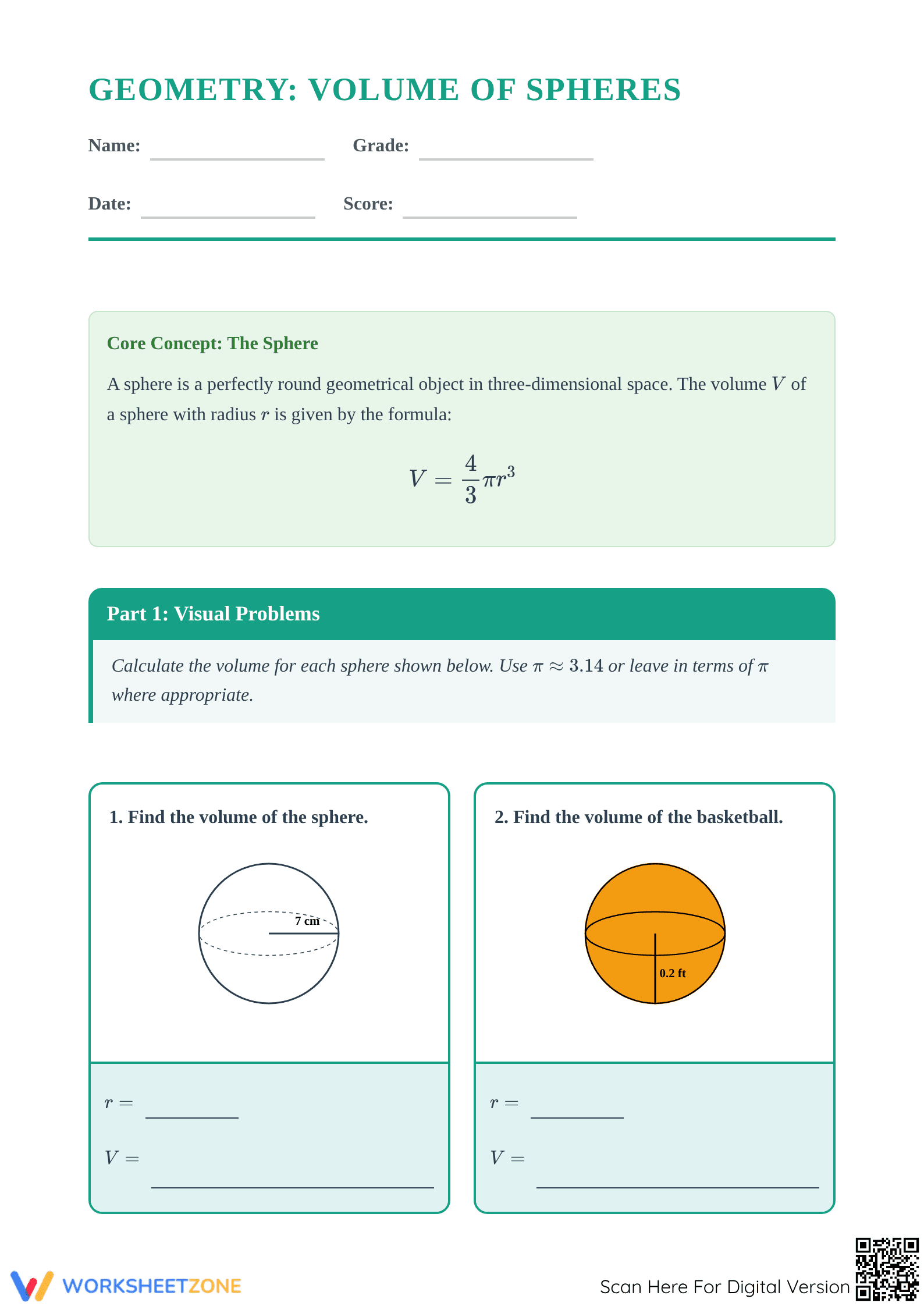
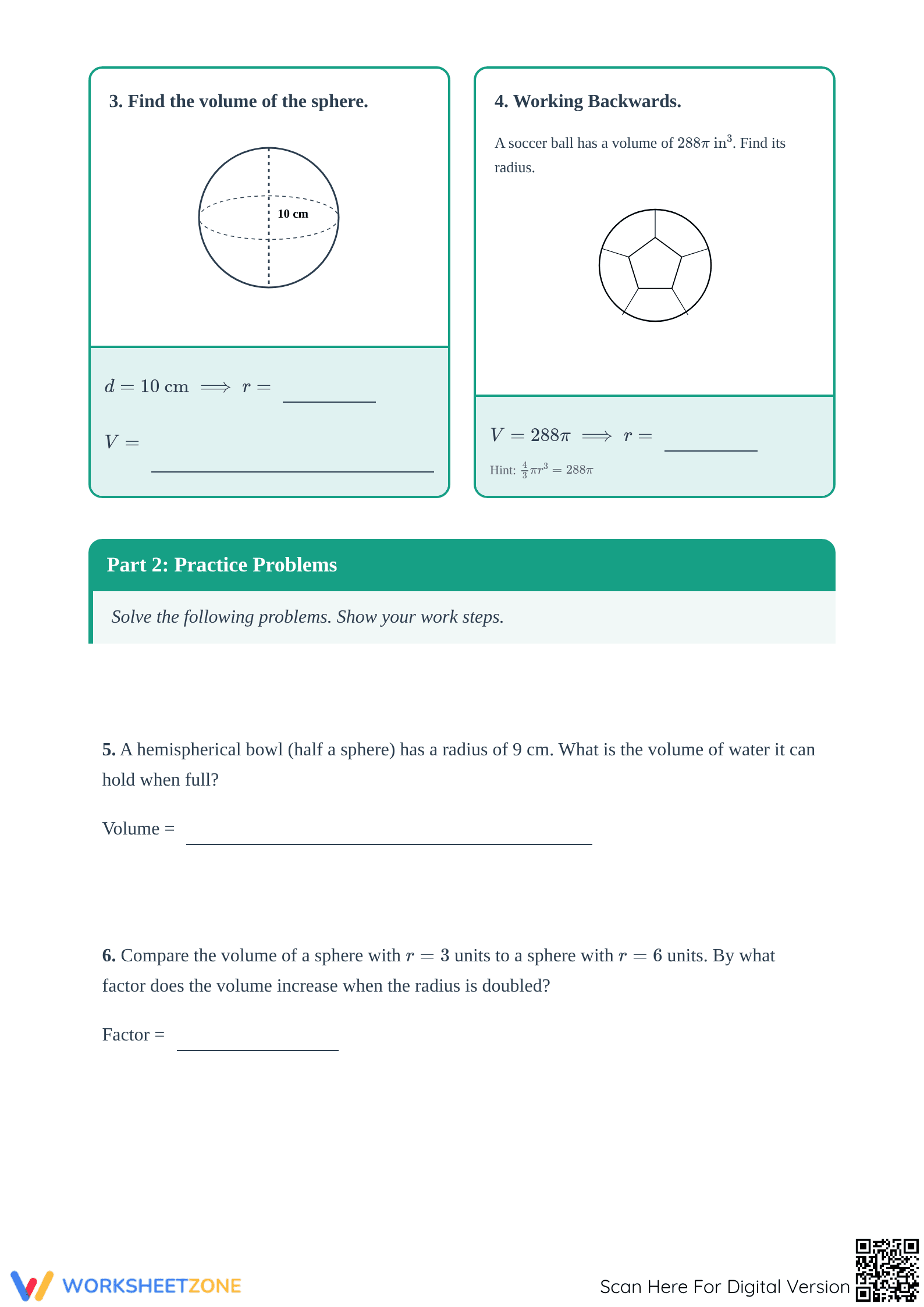
The three-page PDF contains 10 rigorous problems designed to build fluency. The resource begins with a clear "Core Concept" section defining the sphere and the volume formula. Tasks include finding volume from radius or diameter, working backward to find the radius from a given volume, and calculating hemispherical volume. A complete answer key is provided to facilitate quick grading.
- Guided Practice: Problems 1-3 provide visual representations of spheres with labeled dimensions, requiring direct application of the volume formula with minimal scaffolding.
- Supported Practice: Problems 4-6 introduce variable manipulation, including working backward from a known volume and exploring the volumetric effects of doubling a sphere's radius.
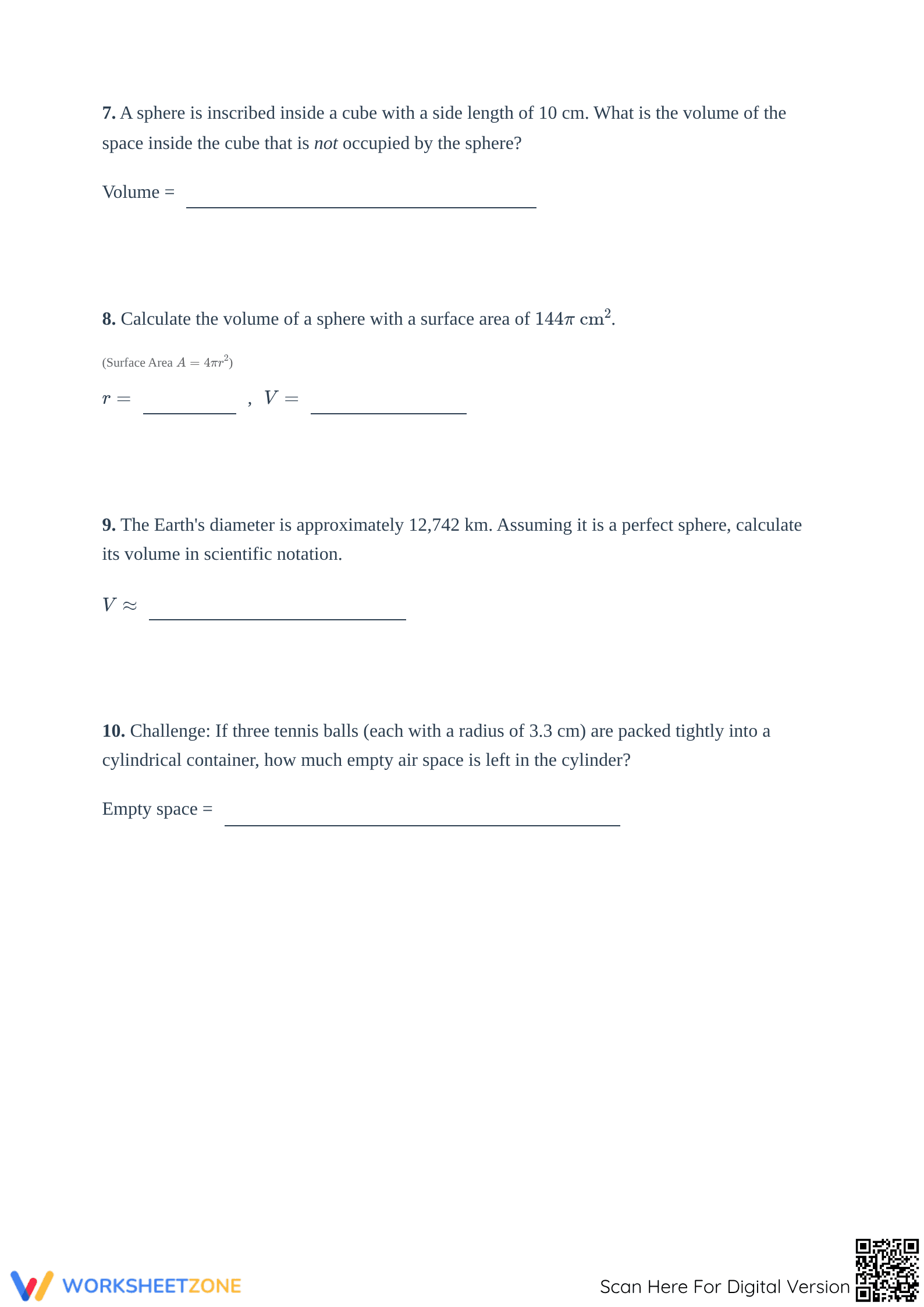
- Independent Practice: Problems 7-10 demand high-level application, including spheres inscribed in cubes, scientific notation for planetary volume, and a complex challenge involving packing efficiency.
This "I Do, We Do, You Do" structure ensures students build confidence before attempting complex geometric proofs and ensures that all core competencies are addressed within a single instructional block.
The primary alignment is CCSS.MATH.CONTENT.8.G.C.9: "Know the formulas for the volumes of cones, cylinders, and spheres and use them to solve real-world and mathematical problems." This resource also supports higher-level geometry standards regarding surface area and volume relationships. Both standard codes can be copied directly into lesson plans, IEP goals, or district curriculum mapping tools.
Use this resource during the "independent practice" phase of a geometry lesson after introducing the volume formula. It serves as an excellent bridge between basic computation and complex word problems. For formative assessment, observe students during Problem 4; their ability to isolate the variable r reveals their algebraic readiness for high school geometry. The expected completion time is 40 minutes.
This resource is designed for Grade 8 students but is highly appropriate for high school geometry review or advanced Grade 7 learners. The inclusion of a hemispherical problem and a packing challenge makes it an ideal differentiation tool for mixed-ability classrooms. It pairs naturally with a short video lecture or a physical demonstration using water and geometric solids.
Rigorous geometric instruction requires a balance between procedural fluency and conceptual application. According to the EdReports 2024 analysis of middle school mathematics, effective curricula must emphasize the coherence between geometric measurement and algebraic reasoning. This worksheet directly addresses this need by requiring students to solve for volume while simultaneously manipulating formulas to find missing radii. By utilizing standard CCSS.MATH.CONTENT.8.G.C.9, students engage in high-order thinking that transcends rote memorization. The inclusion of problems involving scientific notation and inscribed figures provides the cognitive depth necessary for college and career readiness. This resource offers 10 structured tasks that systematically remove scaffolds, leading to student independence in solving complex three-dimensional problems. Such structured practice is essential for internalizing the spatial relationships inherent in the volume of spheres, ensuring that learners are prepared for advanced trigonometry and calculus in subsequent academic years.


