


























Views
Downloads
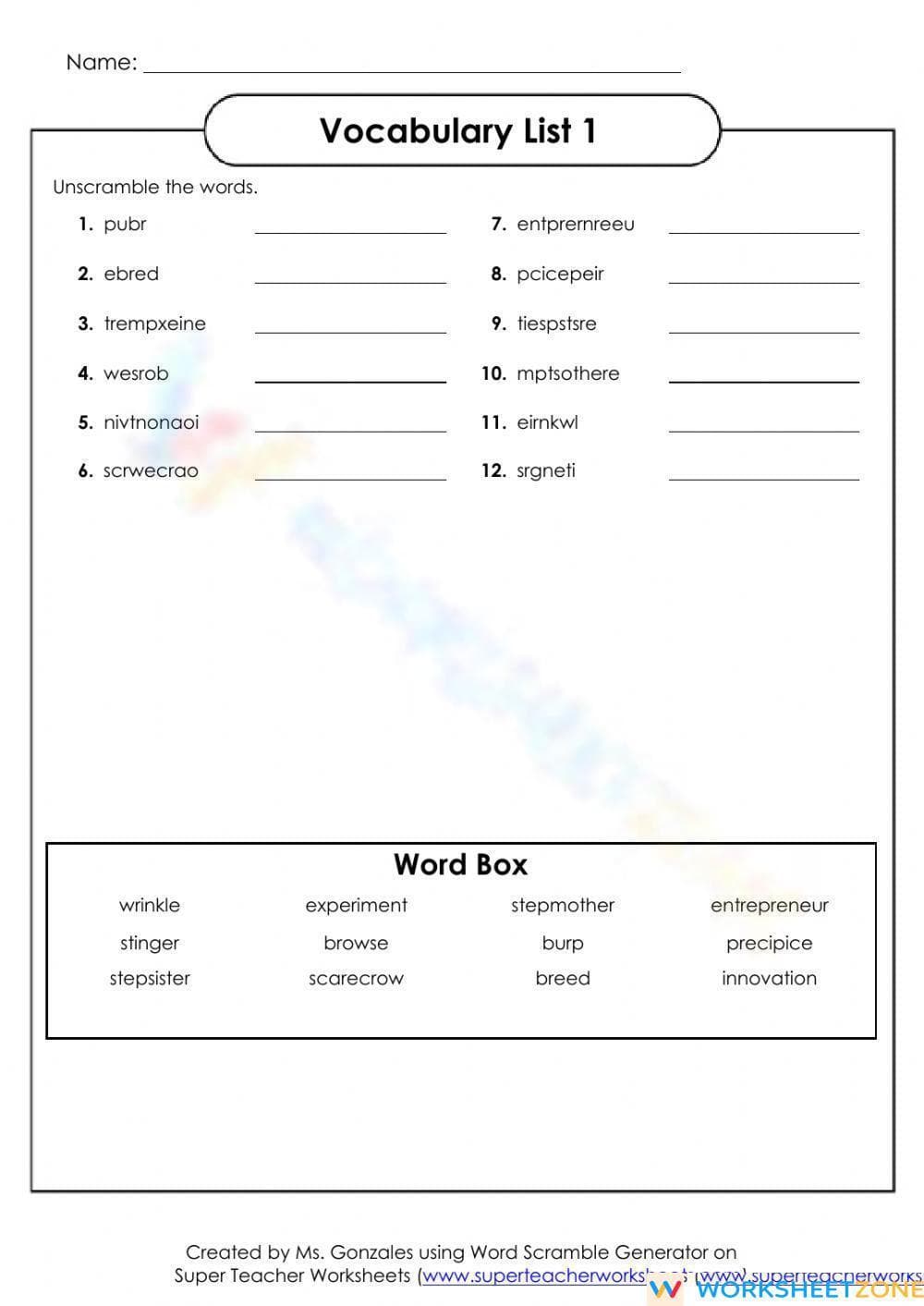


Printable Vocabulary List 1 Word Scramble | Grade 5 ELA
Paste this activity's link or code into your existing LMS (Google Classroom, Canvas, Teams, Schoology, Moodle, etc.).
Students can open and work on the activity right away, with no student login required.
You'll still be able to track student progress and results from your teacher account.
This Grade 5 vocabulary worksheet engages students in active word recognition by challenging them to unscramble twelve essential academic terms. By manipulating letters to form words like "innovation" and "entrepreneur," learners deepen their orthographic awareness and strengthen spelling accuracy. This focused practice ensures complex vocabulary becomes a permanent part of the student's functional lexicon.
At a Glance
- Grade: 5 · Subject: English Language Arts (ELA)
- Standard:
CCSS.ELA-LITERACY.L.5.6— Acquire and use accurately grade-appropriate general academic and domain-specific words and phrases- Skill Focus: Vocabulary Recognition & Spelling
- Format: 1 page · 12 problems · Answer key included · PDF
- Best For: Morning work or quick sub plans
- Time: 15–20 minutes
What's Inside
This single-page PDF features 12 scrambled words ranging from common terms to advanced academic vocabulary. A "Word Box" serves as a scaffold, providing the correct spellings for all items. This allows students to focus on letter patterns while ensuring they have the support needed for accuracy. The document includes clear response lines and a name field for easy grading.
Zero-Prep Workflow
Teachers can integrate this resource with virtually no setup:
- Print (30 seconds): Print the required copies for your group.
- Distribute (1 minute): Hand out sheets during transitions or as students enter.
- Review (30 seconds): Use the word box to check progress or facilitate peer-review.
Total teacher preparation time is under two minutes, making it ideal for busy classroom environments.
Standards Alignment
This worksheet is directly aligned with CCSS.ELA-LITERACY.L.5.6, requiring students to acquire and use grade-appropriate general academic and domain-specific words. By engaging with terms like "precipice" and "experiment," students process complex vocabulary foundational to late-elementary success. Standard codes can be copied directly into lesson plans, IEP goals, or district curriculum mapping tools for seamless documentation.
How to Use It
Assign this worksheet as a "Bell Ringer" at the start of an ELA block. As students work independently, teachers can make formative assessments, observing which learners struggle with specific letter clusters. Alternatively, use it as a timed challenge during a center rotation to build engagement. Most students will complete the tasks within a fifteen-minute window, providing focused academic activity.
Who It's For
Designed for Grade 5 and 6 students, this resource is effective for learners who benefit from tactile-visual word play. It provides excellent support for English Language Learners (ELLs) by pairing a word bank with scrambled versions. This worksheet pairs naturally with a weekly vocabulary log or an anchor chart featuring Greek and Latin roots to help identify structural components.
Research indicates that active manipulation of word parts, such as unscrambling exercises, significantly enhances retention compared to passive reading. According to Fisher & Frey (2014), the "gradual release of responsibility" is supported when students move from scaffolded word recognition using the provided Word Box to independent orthographic retrieval. This worksheet addresses the CCSS.ELA-LITERACY.L.5.6 mandate for vocabulary acquisition by exposing learners to high-frequency academic terms in a structured format. By focusing on twelve specific lexical targets, the resource prevents cognitive overload while providing enough repetition for mastery. Educational analyses from ScienceDirect TpT Analysis suggest that such "plug-and-play" resources are vital for maintaining instructional consistency during unforeseen absences or tight scheduling windows. This combination of standard-aligned content and research-backed methodology makes this vocabulary list an essential component of the modern ELA curriculum, supporting long-term literacy goals and overall fluency.


