


























Views
Downloads

Printable Body Parts Vocabulary Worksheet | Grade K
Paste this activity's link or code into your existing LMS (Google Classroom, Canvas, Teams, Schoology, Moodle, etc.).
Students can open and work on the activity right away, with no student login required.
You'll still be able to track student progress and results from your teacher account.
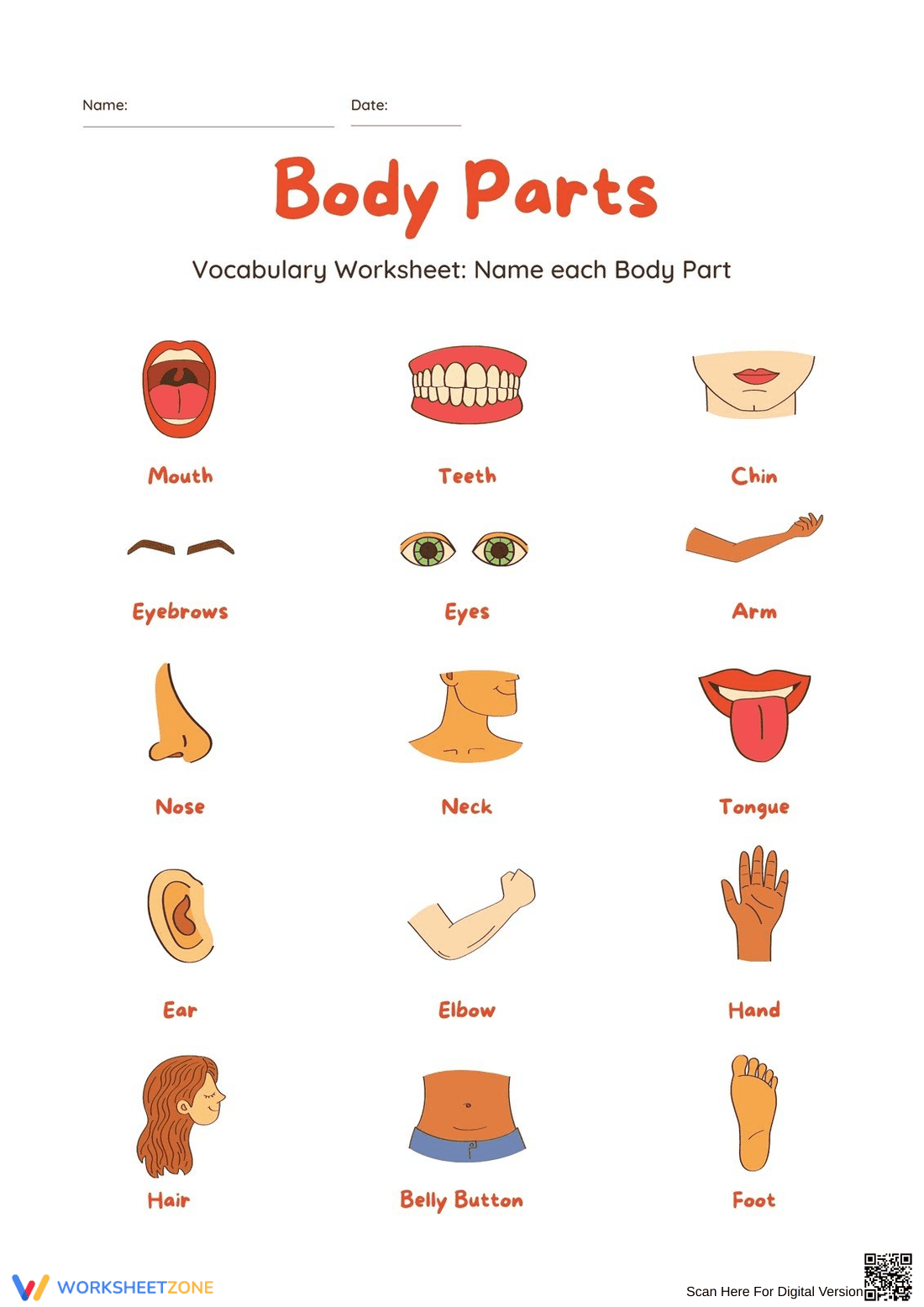
This foundational vocabulary worksheet helps early learners identify and read the names of basic human body parts. By connecting clear illustrations with written words, kindergarten students build essential sight word recognition and life science vocabulary, setting the stage for stronger reading comprehension and descriptive communication.
At a Glance
- Grade: K · Subject: ELA
- Standard:
CCSS.ELA-LITERACY.L.K.6— Use acquired words and phrases- Skill Focus: Body parts vocabulary
- Format: 1 page · 15 vocabulary words · No answer key needed · PDF
- Best For: Independent reading practice
- Time: 10–15 minutes
This single-page resource features fifteen distinct body parts, each paired with a colorful, easy-to-understand illustration and clearly printed text. The layout includes common terms like mouth, eyes, and hands, alongside slightly more specific vocabulary such as eyebrows and belly button. The straightforward design acts as both a reading practice sheet and a visual reference guide, requiring no additional answer key or complex instructions for students to begin learning immediately.
Designed for immediate classroom implementation, this resource follows a simple zero-prep workflow:
- Print (1 minute): Generate the PDF and print a class set or display it on a smartboard.
- Distribute (1 minute): Hand out the sheets to students during morning work or literacy centers.
- Review (3 minutes): Read the words aloud together, pointing to the corresponding body parts.
Total teacher preparation time is under two minutes, making this an excellent addition to emergency sub plans or quick transition activities.
This material aligns with CCSS.ELA-LITERACY.L.K.6: Use words and phrases acquired through conversations, reading and being read to, and responding to texts. It also supports early life science concepts by familiarizing students with human anatomy. Both standard codes can be copied directly into lesson plans, IEP goals, or district curriculum mapping tools.
Teachers can utilize this visual guide before direct instruction as an introductory anchor chart to activate prior knowledge about the human body. Alternatively, it serves well during independent literacy centers where students can practice reading the words to a partner while pointing to their own features. For a quick formative assessment, observe students as they attempt to read the words without looking at the pictures, noting which initial consonant sounds they successfully decode. Expected completion time ranges from ten to fifteen minutes.
This resource is primarily designed for kindergarten students, though it is equally effective for preschool learners and early elementary English Language Learners (ELLs) building basic vocabulary. To differentiate, teachers can cover the text and ask advanced students to write the words independently, or provide the sheet as a reference for struggling readers. It pairs naturally with interactive read-alouds about health or introductory science lessons on the five senses.
Developing early domain-specific vocabulary is a critical component of reading comprehension and overall academic readiness. According to Fisher & Frey (2014), explicit vocabulary instruction combined with visual scaffolds significantly improves word retention and conceptual understanding in early childhood education. This resource directly supports CCSS.ELA-LITERACY.L.K.6 by requiring students to use acquired words and phrases in context. By linking the visual representation of human anatomy to printed text, young learners establish the neural pathways necessary for fluent reading and effective communication. The integration of familiar concepts, such as body parts, provides a low-barrier entry point for students to practice decoding skills and phonemic awareness. Utilizing structured, visually supported materials ensures that foundational literacy skills are developed systematically, providing a robust framework for future academic achievement across multiple disciplines.


