


























Views
Downloads

Printable Visualizing Shapes Worksheet | Grade 1 Math
Paste this activity's link or code into your existing LMS (Google Classroom, Canvas, Teams, Schoology, Moodle, etc.).
Students can open and work on the activity right away, with no student login required.
You'll still be able to track student progress and results from your teacher account.
This printable geometry worksheet helps students master shape recognition and attribute analysis. By identifying names, counting sides, and connecting geometry to real-world objects, learners build a concrete foundation for spatial reasoning. It is a complete resource for transitioning from basic recognition to understanding the defining properties of two-dimensional shapes.
At a Glance
- Grade: Kindergarten & Grade 1 · Subject: Math
- Standard:
CCSS.MATH.CONTENT.1.G.A.1— Distinguish between defining attributes like sides and corners versus non-defining attributes.- Skill Focus: 2D Geometry & Attribute Counting
- Format: 3 pages · 11 problems · Answer key included · PDF
- Best For: Initial geometry instruction and formative assessment
- Time: 15–25 minutes
What's Inside
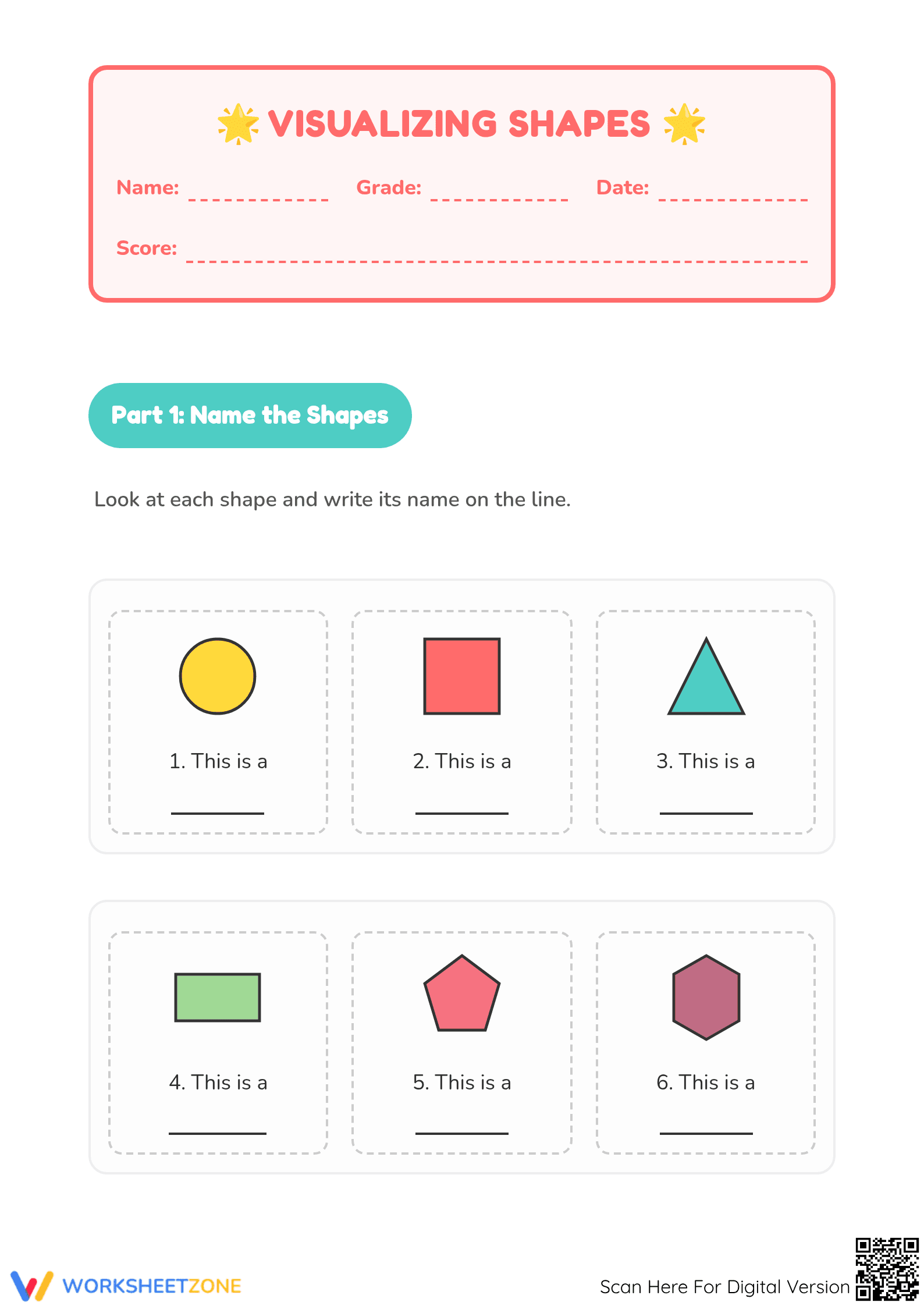
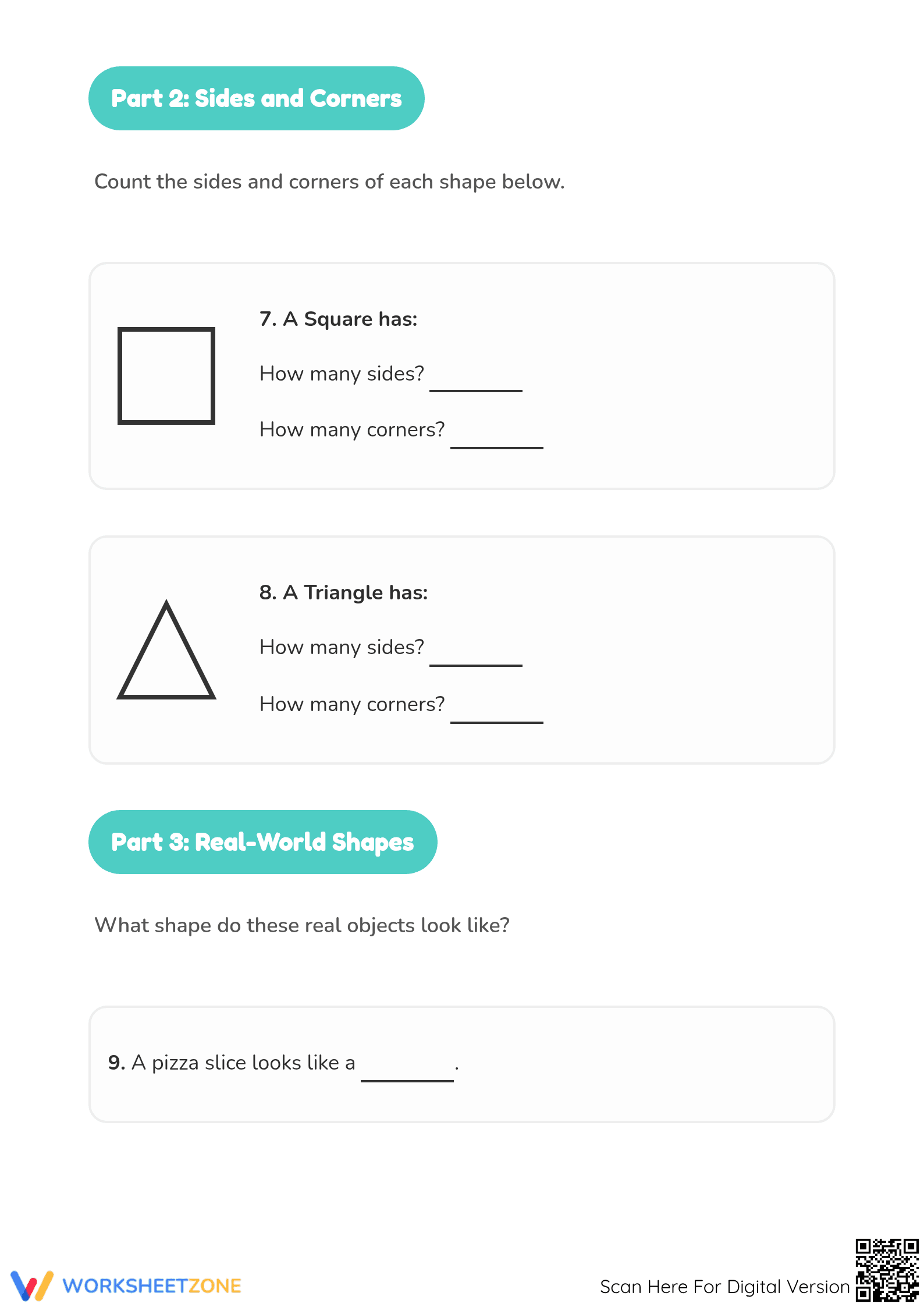
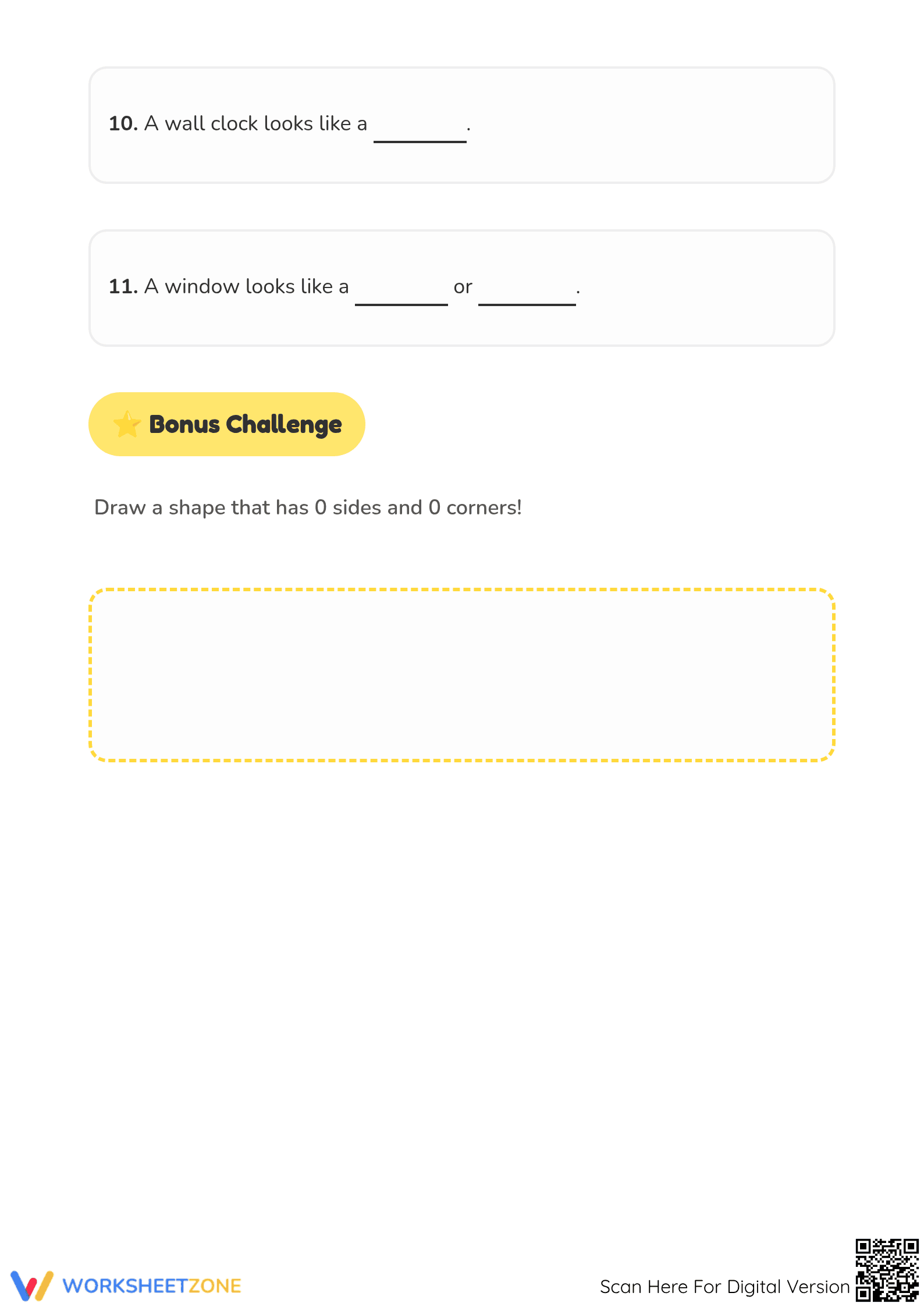
This three-page PDF packet offers a comprehensive look at basic 2D geometry. The first page presents six distinct shapes—including hexagons and pentagons—for identification. The second page shifts focus to attribute counting, requiring students to quantify sides and corners. Finally, the third page bridges the gap between abstract geometry and the real world by asking students to categorize common household objects.
Skill Progression
- Guided Recognition: Students begin with six high-contrast shapes, using a visual word bank approach to name circles, squares, triangles, and polygons.
- Supported Attribute Analysis: The second section provides specific prompts for counting sides and corners, reinforcing the mathematical vocabulary needed to describe geometric figures.
- Independent Application: Students apply their knowledge to real-world scenarios and a creative bonus challenge, demonstrating mastery through transfer of skills.
This gradual-release model ensures students move confidently from simple identification to conceptual understanding.
Standards Alignment
This resource is primarily aligned with CCSS.MATH.CONTENT.1.G.A.1, which covers distinguishing defining attributes. It also supports CCSS.MATH.CONTENT.K.G.B.4. Both standard codes can be copied directly into lesson plans, IEP goals, or district curriculum mapping tools.
How to Use It
Use this worksheet during the 'We Do' phase of a lesson on polygons. Have students use highlighters to trace the sides as they count them in Part 2. For a quick formative assessment, observe student responses in the Bonus Challenge to see if they can conceptualize a circle as having zero sides. Most students complete the entire packet in approximately 20 minutes.
Who It's For
This worksheet is designed for Grade 1 and Kindergarten students. It provides excellent support for English Language Learners (ELLs) through its heavy visual scaffolding and clear labeling tasks. It pairs naturally with a classroom 'Shape Hunt' activity or a geometry anchor chart displayed on an interactive whiteboard.
Research from NAEP indicates that early mastery of geometric attributes is a significant predictor of later success in spatial reasoning. This worksheet specifically targets CCSS.MATH.CONTENT.1.G.A.1 by isolating defining attributes like sides and corners from non-defining attributes such as color. According to ScienceDirect TpT Analysis, high-quality visual aids in geometry instruction reduce cognitive load, allowing younger learners to focus on the linguistic bridge between 'shape' and 'name.' By identifying 11 distinct tasks and providing a real-world application layer, this resource ensures that students are not merely memorizing names but are analyzing the structural properties of 2D figures. The inclusion of a bonus challenge encourages higher-order thinking, prompting students to visualize the unique properties of a circle. This approach aligns with best practices for early childhood numeracy development, providing the structured practice necessary for long-term retention of geometric concepts.


