




























Views
Downloads

Grade 9 Virus Replication — Printable No-Prep Worksheet

Paste this activity's link or code into your existing LMS (Google Classroom, Canvas, Teams, Schoology, Moodle, etc.).
Students can open and work on the activity right away, with no student login required.
You'll still be able to track student progress and results from your teacher account.
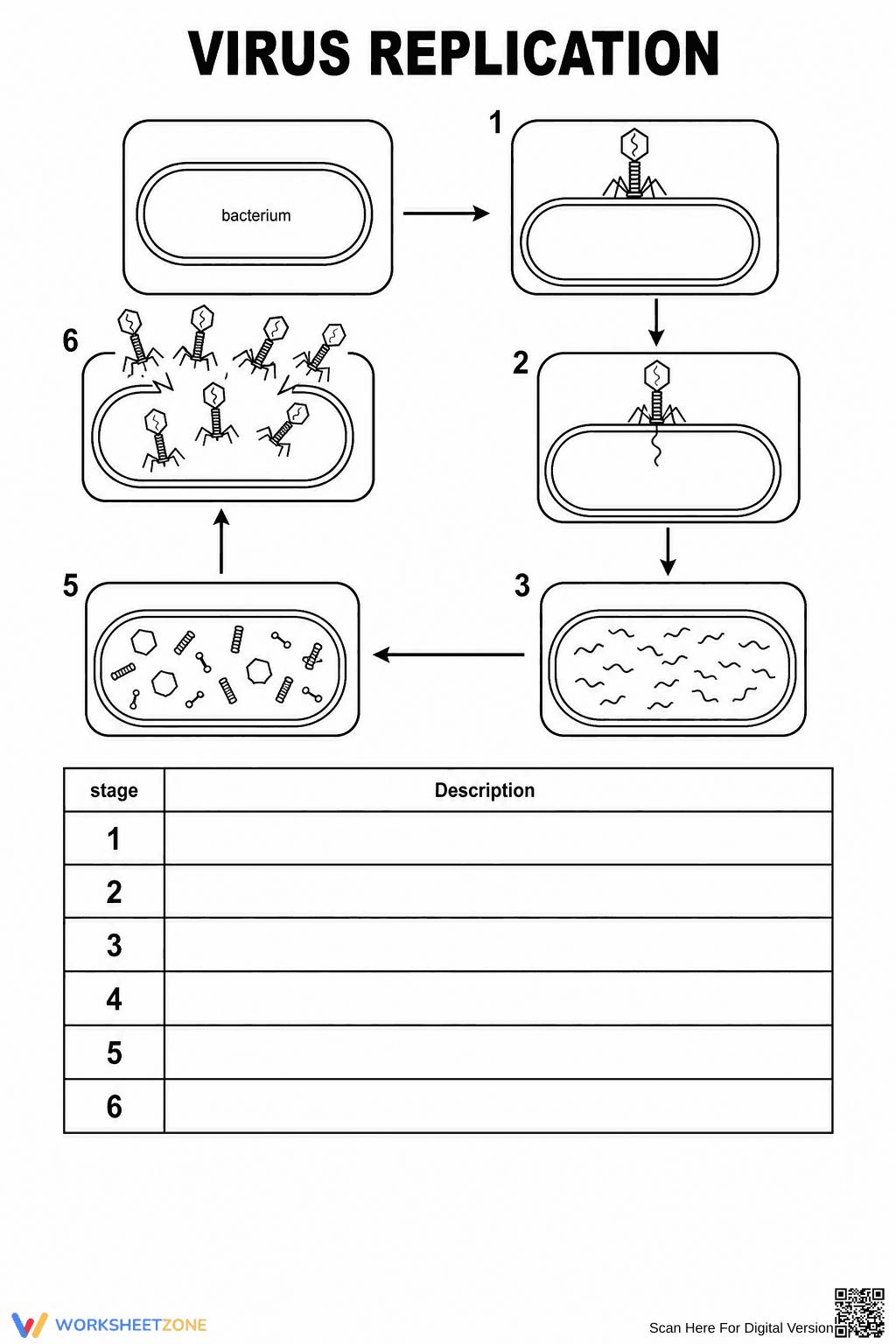
This Grade 9 biology worksheet helps students visualize and explain the lytic cycle of a bacteriophage. By examining a clear, six-step diagram, learners will construct their own written descriptions of how a virus attaches, injects genetic material, synthesizes new parts, assembles, and ultimately lyses the host cell.
At a Glance
- Grade: 9 · Subject: Science
- Standard:
HS-LS1-2— Develop and use a model to illustrate biological processes- Skill Focus: Describing the virus replication cycle
- Format: 1 page · 6 problems · PDF
- Best For: Independent practice or homework
- Time: 15–20 minutes
This single-page resource features a detailed, sequential diagram of a bacteriophage infecting a bacterium. The visual model is broken down into six distinct, numbered stages. Below the diagram, a structured table provides space for students to write a comprehensive description for each corresponding stage. The clear layout ensures students can easily map the visual data to their written explanations without feeling overwhelmed by complex text.
Zero-Prep Workflow
Designed for immediate implementation:
- Print (1 minute): Simply print the single-page PDF.
- Distribute (1 minute): Hand out the worksheet as a warm-up, in-class activity, or homework assignment.
- Review (3 minutes): Quickly review the correct descriptions using the visual diagram.
With a total teacher prep time of under two minutes, this resource is highly effective for busy educators and makes an excellent, self-explanatory addition to any substitute teacher plan.
Standards Alignment
This resource is aligned to HS-LS1-2, requiring students to develop and use a model to illustrate biological processes. By translating a visual model into written descriptions, students demonstrate a clear understanding of biological mechanisms. Both standard codes can be copied directly into lesson plans, IEP goals, or district curriculum mapping tools.
How to Use It
This worksheet is highly versatile. Use it during direct instruction as a guided note-taking tool. Alternatively, assign it after a lesson as an independent practice activity to consolidate their understanding. As a formative assessment tip, walk around the room and observe how students describe stage 2 (penetration) and stage 6 (lysis); this will quickly reveal if they grasp how viral genetic material enters the host and how new virions exit. Expected completion time is 15 to 20 minutes.
Who It's For
This resource is primarily designed for Grade 9 biology students, though it is easily adaptable for middle school life science or introductory high school virology units. To support learners who need extra scaffolding, consider providing a word bank containing key terms like capsid, genetic material, synthesis, and lysis. This worksheet pairs perfectly with a 3D modeling activity or a direct instruction lesson on the differences between the lytic and lysogenic cycles.
Aligning instructional materials with rigorous science standards like HS-LS1-2 ensures that students can effectively develop and use a model to illustrate biological processes. According to a ScienceDirect TpT Analysis, providing students with clear visual models alongside structured writing tasks significantly improves their retention of complex biological cycles. When learners are required to translate a visual diagram of virus replication into their own written descriptions, they engage in deeper cognitive processing than they would through passive reading alone. This dual-coding approach—combining imagery with text—helps solidify the sequential nature of the lytic cycle, from initial attachment to the final release of new virions. By integrating these evidence-based strategies into daily practice, educators can foster stronger scientific literacy and better prepare students for advanced topics in microbiology and genetics.


