


























Views
Downloads

Essential Printable Verb Agreement Worksheet | Grade 1-2
Paste this activity's link or code into your existing LMS (Google Classroom, Canvas, Teams, Schoology, Moodle, etc.).
Students can open and work on the activity right away, with no student login required.
You'll still be able to track student progress and results from your teacher account.
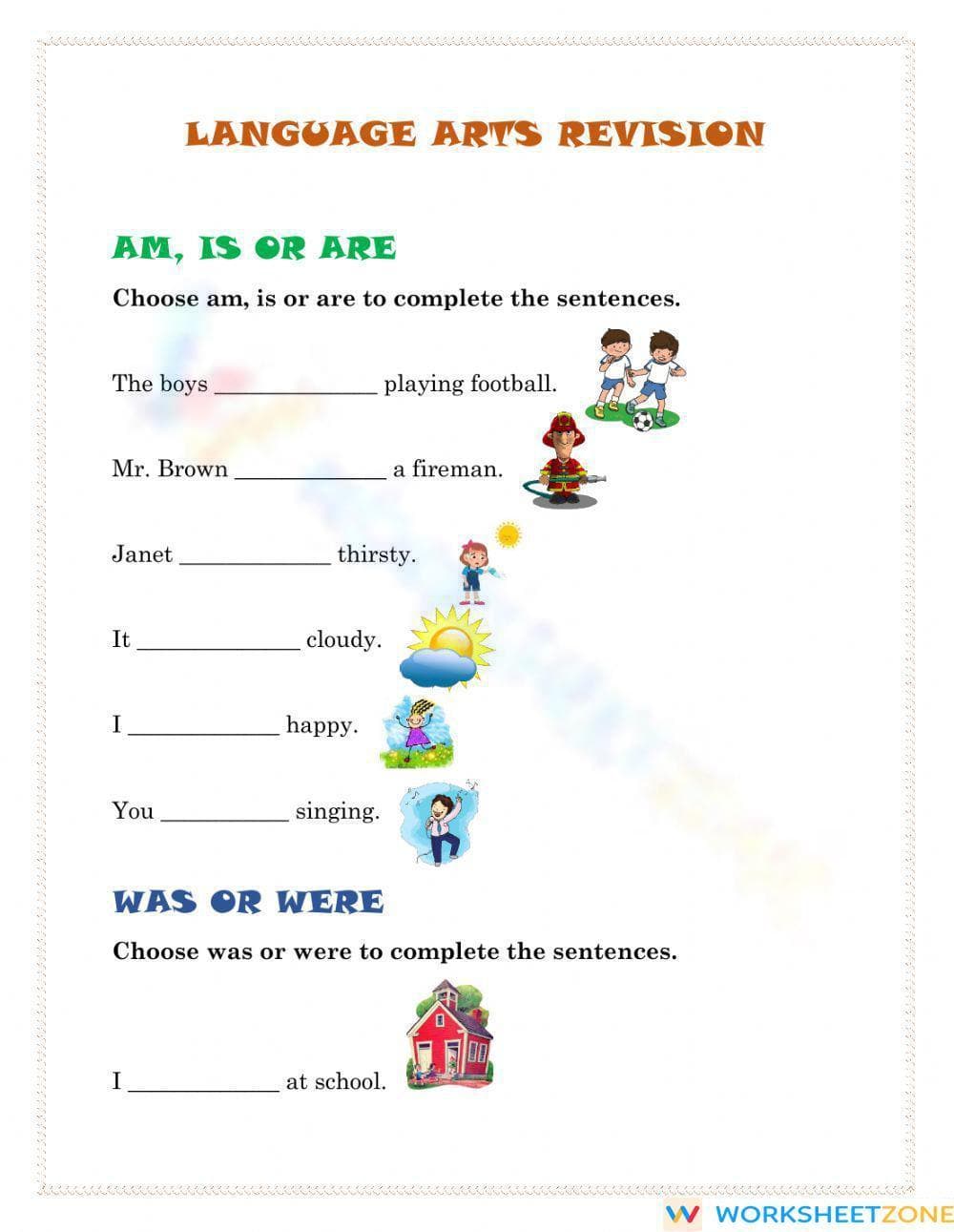
This Language Arts Revision worksheet focuses on essential subject-verb agreement for early elementary students. By practicing with am, is, are, was, were, do, does, has, and have, learners develop the grammar skills necessary for accurate sentence construction. This printable resource ensures students master matching subjects with correct verb forms.
At a Glance
- Grade: 1–2 · Subject: ELA
- Standard:
CCSS.ELA-LITERACY.L.1.1.C— Use singular and plural nouns with matching verbs in basic sentences- Skill Focus: Subject-verb agreement with auxiliary verbs
- Format: 3 pages · 24 problems · Answer key included · PDF
- Best For: Grammar review and formative assessment
- Time: 20–30 minutes
What's Inside
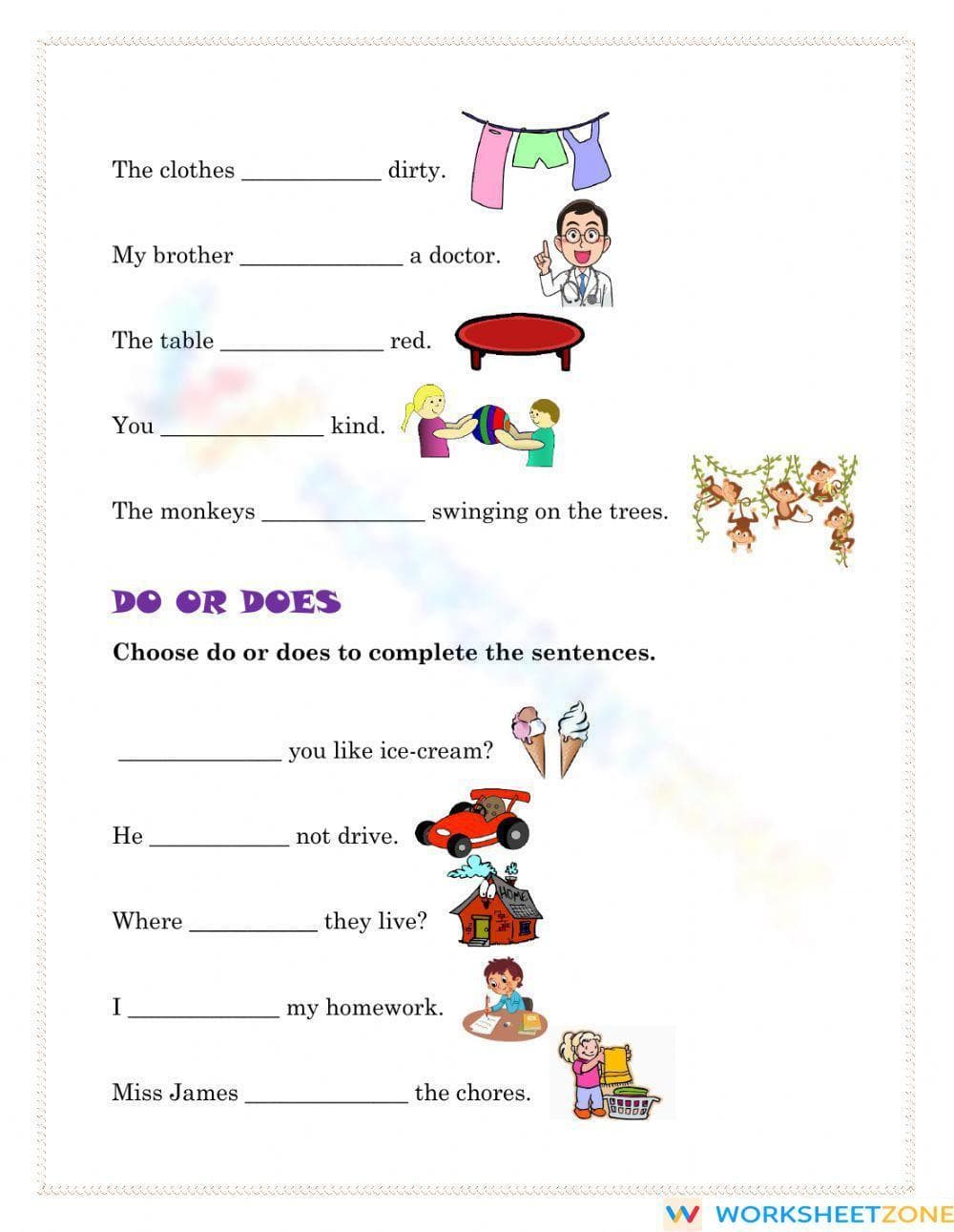
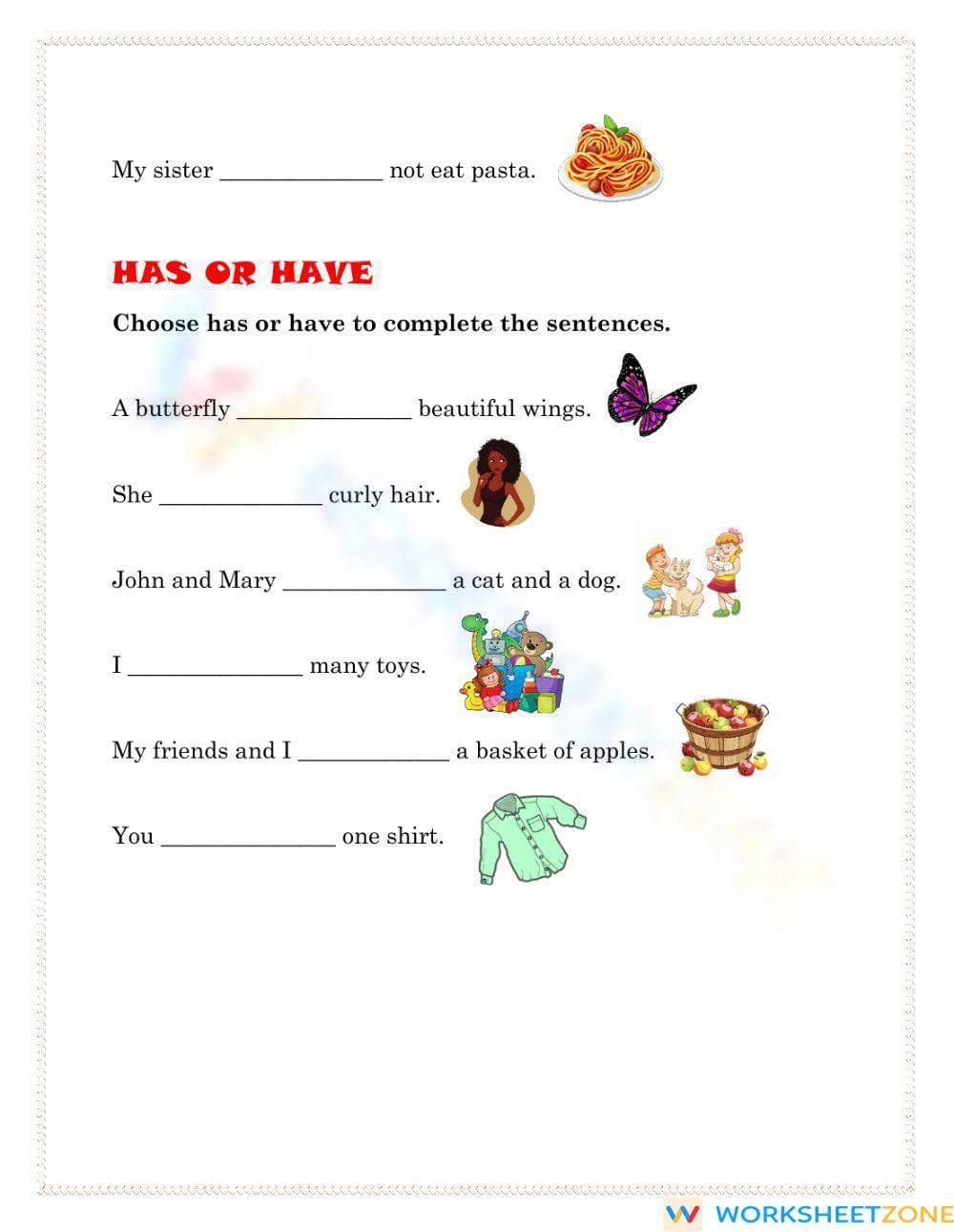
This three-page PDF package provides 24 targeted sentence-completion tasks. The worksheet covers present-tense linking verbs, past-tense agreement, and auxiliary forms like "do/does" and "has/have." Each task is accompanied by a colorful illustration to provide context. The structure includes a clear answer-key-ready format for quick teacher review or student self-correction.
Skill Progression
- Guided practice: Students begin with present-tense linking verbs (am, is, are), establishing core patterns through 6 initial tasks.
- Supported practice: The worksheet transitions into past-tense forms and "do/does" distinctions across 11 problems.
- Independent practice: The final 7 tasks focus on "has" and "have" agreement in possessive auxiliary structures.
This progression follows a scaffolded approach to grammar mastery, ensuring students build confidence before moving to more complex verb pairs.
Standards Alignment
The primary focus is CCSS.ELA-LITERACY.L.1.1.C: "Use singular and plural nouns with matching verbs in basic sentences." The inclusion of interrogative structures also supports CCSS.ELA-LITERACY.L.1.1.J. Both standard codes can be copied directly into lesson plans, IEP goals, or district curriculum mapping tools to track student progress toward foundational literacy benchmarks.
How to Use It
Use this worksheet as a summative review after instruction. It is ideal for guided practice where the teacher models the first problem. For a formative tip, observe if students correctly identify plural subjects like "The monkeys." Expect completion within 25 minutes. This format works well for independent desk work or literacy centers.
Who It's For
This resource is designed for Grade 1 and Grade 2 students, serving as excellent remediation or enrichment. It pairs naturally with a classroom anchor chart. The visual cues make it effective for English Language Learners (ELLs). The simple layout ensures that the focus remains on grammatical accuracy rather than complex navigation.
The mastery of subject-verb agreement, specifically with auxiliary and linking verbs like am, is, are, was, were, do, does, has, and have, is a critical milestone in early literacy development. According to Fisher & Frey (2014), the gradual release of responsibility model—moving from teacher-led modeling to independent student application—is most effective when grammar concepts are reinforced through high-frequency practice. This worksheet provides 24 distinct opportunities for students to internalize the relationship between subjects and verbs, which is essential for achieving the requirements of CCSS.ELA-LITERACY.L.1.1.C. Research suggests that integrating visual scaffolding with grammatical tasks helps young learners bridge the gap between abstract rules and concrete application. By isolating these specific verb sets, educators can pinpoint exactly where agreement errors occur, allowing for targeted intervention. This evidence-based approach to grammar instruction ensures that students develop the syntactical precision required for successful academic writing and reading comprehension across the elementary curriculum.


