


























Views
Downloads

Printable Periodic Table Worksheet | Grade 8 Science
Paste this activity's link or code into your existing LMS (Google Classroom, Canvas, Teams, Schoology, Moodle, etc.).
Students can open and work on the activity right away, with no student login required.
You'll still be able to track student progress and results from your teacher account.
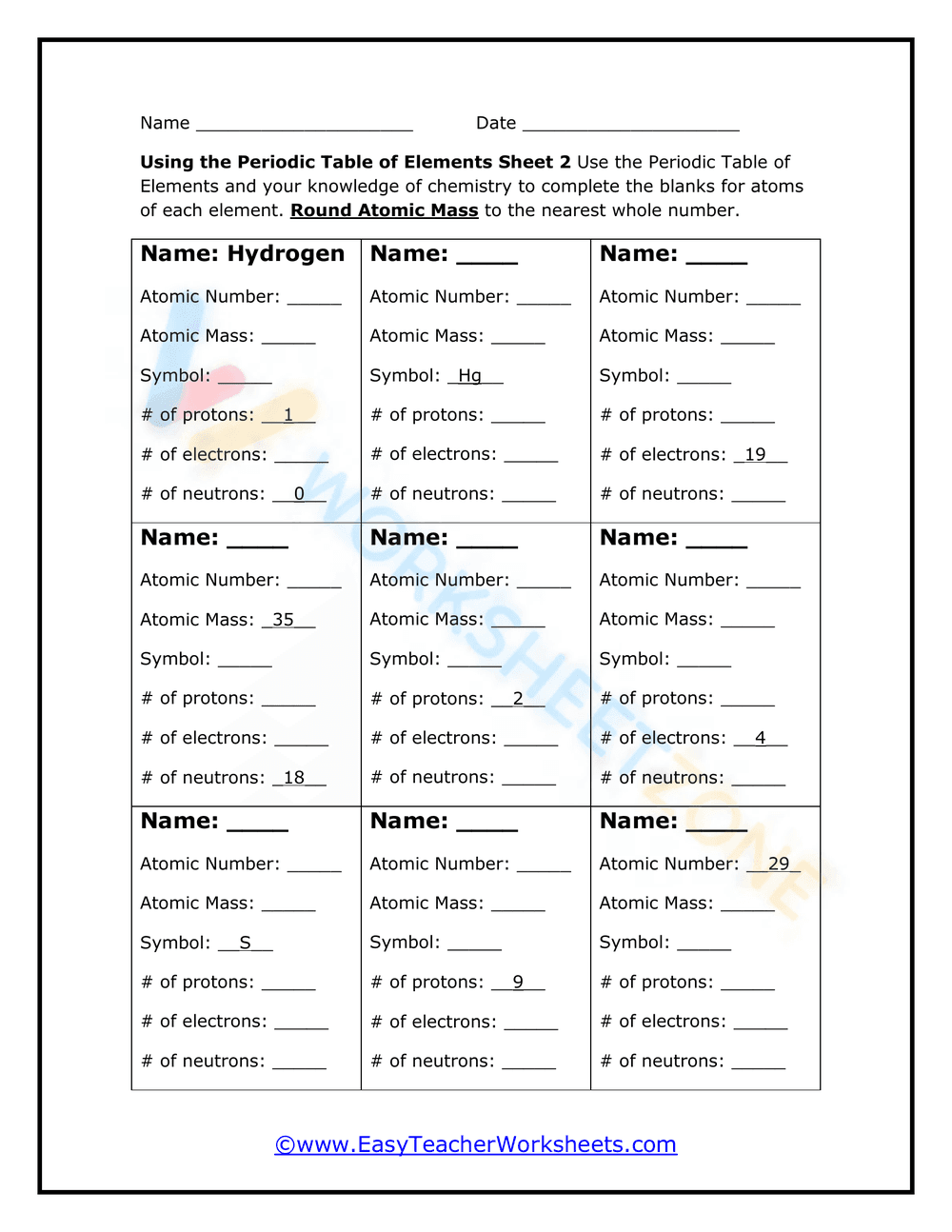
This Grade 8 science worksheet provides students with targeted practice using the periodic table to determine atomic structure. By analyzing given clues like atomic mass or proton count, learners will calculate the number of subatomic particles for various elements, reinforcing their foundational chemistry skills.
At a Glance
- Grade: 8 · Subject: Science
- Standard:
MS-PS1-1— Describe the atomic composition of simple molecules- Skill Focus: Calculating protons, neutrons, and electrons
- Format: 1 page · 9 problems · Answer key included · PDF
- Best For: Independent practice or review
- Time: 15–20 minutes
This single-page resource features a structured grid containing nine distinct element profiles. Each profile provides starting clues, such as the element's symbol or specific subatomic particle count. Students use a standard periodic table to fill in the missing data, including the element name, atomic mass, and the exact number of protons, neutrons, and electrons. A complete answer key is provided.
Zero-Prep Workflow
This resource requires under two minutes of total teacher preparation time.
- Print (1 minute): Download the PDF and print copies.
- Distribute (1 minute): Hand out the sheets with a periodic table. No complex instructions are necessary.
- Review: Use the included answer key to quickly check student work.
Because it is self-explanatory, this worksheet is an excellent option for a substitute teacher plan.
Standards Alignment
This practice aligns with MS-PS1-1, which requires students to develop models to describe the atomic composition of simple molecules and extended structures. By calculating subatomic particles, students build the foundational understanding of atomic structure necessary to master this standard. Both standard codes can be copied directly into lesson plans, IEP goals, or district curriculum mapping tools.
How to Use It
Deploy this worksheet immediately following direct instruction on reading the periodic table. It works perfectly as an independent classwork assignment. As a formative assessment tip, observe students as they calculate neutrons; if they forget to subtract the atomic number from the atomic mass, provide a quick correction. Students will complete the nine profiles within 15 to 20 minutes.
Who It's For
This resource is primarily designed for eighth-grade physical science students, though it also serves as an effective review for high school chemistry classes. For students requiring differentiation, teachers can provide a partially completed version or allow the use of a calculator for the subtraction steps. It pairs naturally with an introductory lesson on atomic structure or a classroom anchor chart detailing how to find protons, neutrons, and electrons.
Mastering the layout and data provided by the periodic table is a critical step in secondary science education. When students practice extracting specific information, such as atomic mass and atomic number, they develop the analytical skills required to understand complex chemical interactions. This worksheet directly supports MS-PS1-1 by helping learners describe the atomic composition of simple molecules through the calculation of protons, neutrons, and electrons. According to a ScienceDirect TpT Analysis, providing structured, repetitive practice with immediate feedback significantly improves student retention of abstract scientific concepts like atomic structure. By engaging with these nine targeted element profiles, students transition from rote memorization to active application. This foundational knowledge is essential for their future success in advanced chemistry courses, ensuring they can confidently interpret and utilize the periodic table in various scientific contexts.


