


























Views
Downloads




Essential Number Line Patterns Worksheet | Grades 2-4
Paste this activity's link or code into your existing LMS (Google Classroom, Canvas, Teams, Schoology, Moodle, etc.).
Students can open and work on the activity right away, with no student login required.
You'll still be able to track student progress and results from your teacher account.
1. Skill Focus and Outcomes
Students often struggle to visualize relationships between numbers when presented in isolation. This Grade 3 number line patterns worksheet provides visual scaffolding to help learners identify sequences and complete numerical strings. By focusing on constant intervals, students develop a robust understanding of skip-counting and linear growth, leading to increased computational fluency across all math domains.
At a Glance
- Grade: 3 · Subject: Math
- Standard:
3.OA.D.9— Identify and complete numerical patterns on a number line using constant intervals- Skill Focus: Number pattern identification on linear scales
- Format: 5 pages · 20 problems · Full answer key included · PDF
- Best For: Targeted small group intervention and morning work practice
- Time: 15–20 total minutes
3. What's Inside
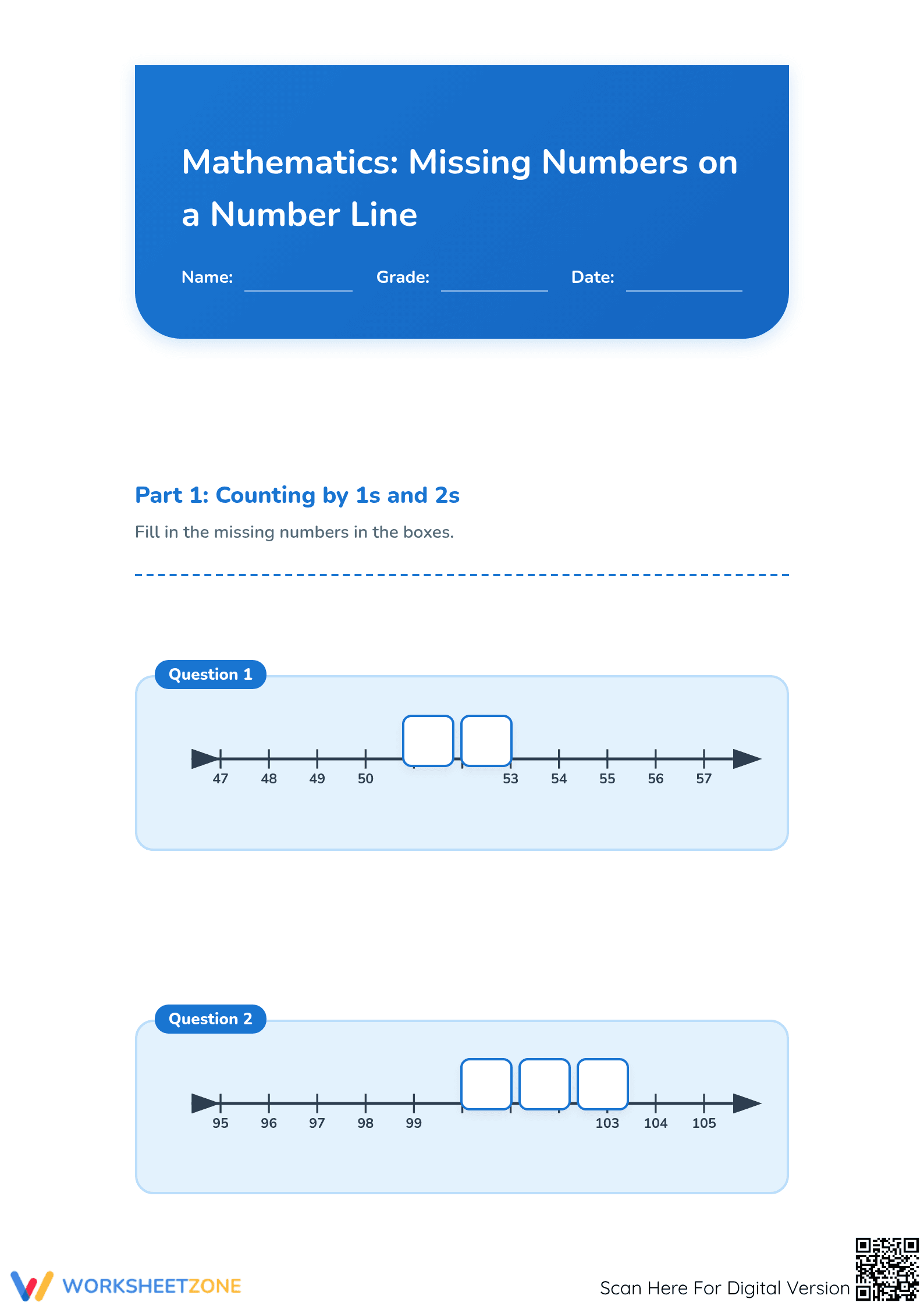
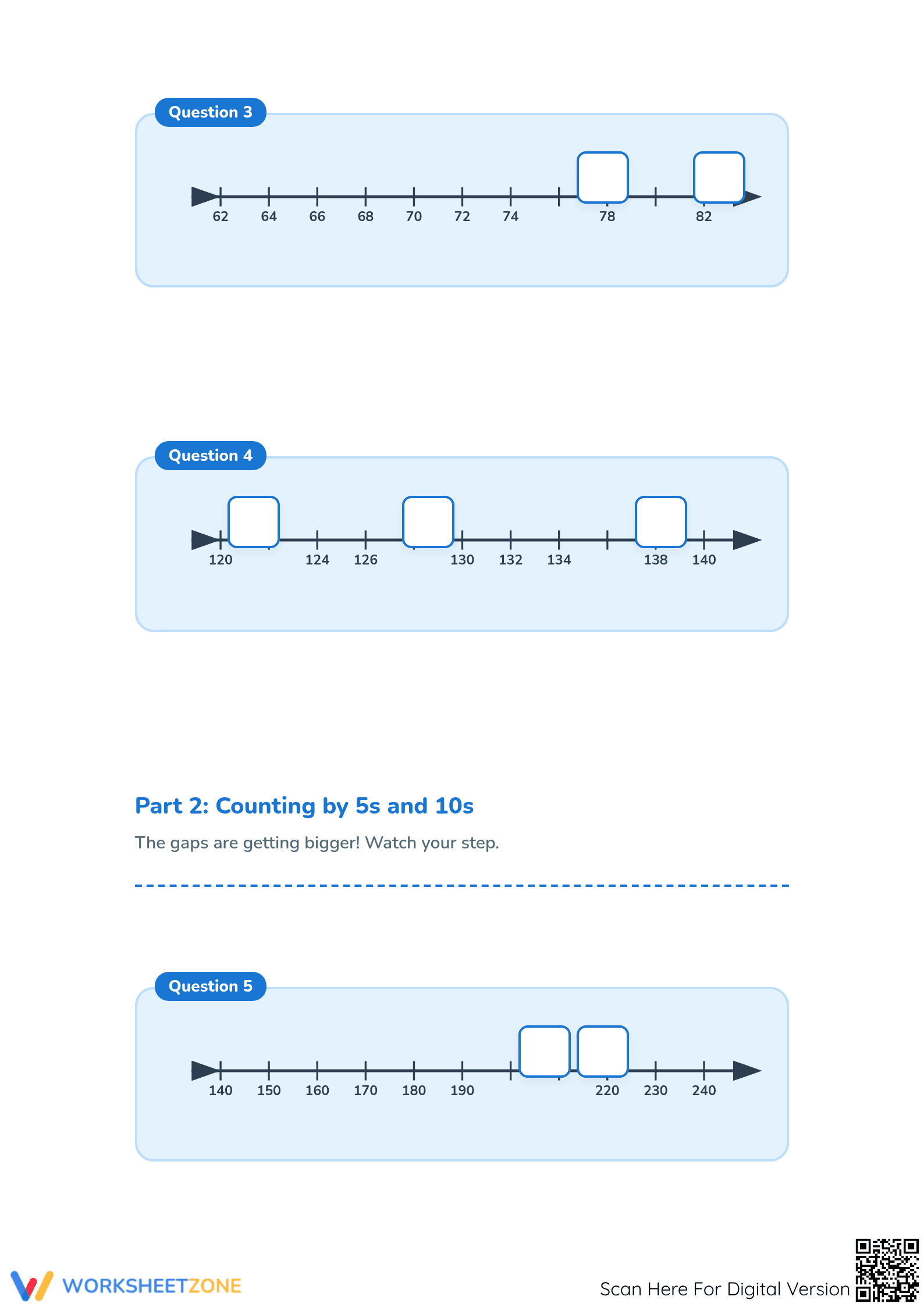
This comprehensive five-page resource contains twenty unique number line problems designed to challenge and support Grade 2-4 learners. Each page features four high-contrast number lines with missing values that require students to deduce the underlying arithmetic pattern. The package includes a full-sized answer key for quick grading or student self-check, ensuring that teachers can implement this resource with zero additional preparation time.
4. Skill Progression
- Guided Practice: The first page features four problems with common intervals like twos and fives, providing a high level of scaffolded success for all learners.
- Supported Practice: Middle sections introduce eight problems with larger intervals, requiring students to intentionally calculate the distance between provided points.
- Independent Practice: The final eight problems present mixed intervals that demand students independently apply pattern-identification strategies without repeated visual cues.
This "I Do, We Do, You Do" approach builds student confidence through a gradual release of responsibility.
5. Standards Alignment
The primary focus of this worksheet is `CCSS.MATH.CONTENT.3.OA.D.9`: "Identify arithmetic patterns (including patterns in the addition table or multiplication table), and explain them using properties of operations." It also supports `CCSS.MATH.CONTENT.2.NBT.A.2` regarding skip-counting by various denominations. Both standard codes can be copied directly into lesson plans, IEP goals, or district curriculum mapping tools.
6. How to Use It
Use this during independent practice on patterns. Assign one page as an exit ticket to gauge understanding of intervals before introducing more complex algebraic concepts. Alternatively, use it as a scaffolded warm-up for small-group intervention where educators observe specific student strategies. Expected completion time is roughly four minutes per page.
7. Who It's For
Designed for third-grade students mastering patterns, it also serves as enrichment for second-graders or remediation for fourth-graders. It is particularly effective for English Language Learners who benefit from visual representations of number relationships. Pair this with a desktop number line or physical manipulatives for maximum instructional impact.
According to the RAND AIRS 2024 report on mathematics education, visual number lines are critical scaffolds for developing early algebraic thinking and number sense. This worksheet addresses these foundational needs by requiring students to identify constant intervals and predict subsequent values, a core component of CCSS.MATH.CONTENT.3.OA.D.9. By transitioning from concrete counting to abstract pattern recognition, students build the cognitive flexibility required for higher-order multiplication and mental arithmetic. Fisher & Frey (2014) emphasize that such structured practice provides the necessary repetition to move skills from short-term working memory to long-term procedural mastery. This resource serves as a vital bridge in the gradual release of responsibility model, moving students from guided observation of patterns to independent completion of complex arithmetic sequences. Educators can utilize these twenty targeted problems to gather precise formative data on student mastery of skip-counting and linear relationship identification, ensuring all learners meet proficiency benchmarks.


