


























Views
Downloads

Grade 1 Nouns — Printable No-Prep Worksheet
Paste this activity's link or code into your existing LMS (Google Classroom, Canvas, Teams, Schoology, Moodle, etc.).
Students can open and work on the activity right away, with no student login required.
You'll still be able to track student progress and results from your teacher account.
This Grade 1 grammar worksheet helps students master the fundamental concept of nouns through identification and practical application. By distinguishing nouns from other word classes and using them to complete sentences, learners build a strong foundation for sentence structure and reading comprehension. This resource ensures students can confidently define and use nouns for people, places, and things.
At a Glance
- Grade: 1 · Subject: ELA
- Standard:
CCSS.ELA-LITERACY.L.1.1.B— Use common, proper, and possessive nouns in sentences- Skill Focus: Noun identification and application
- Format: 2 pages · 17 problems · Answer key included · PDF
- Best For: Independent grammar practice or morning work
- Time: 15–20 minutes
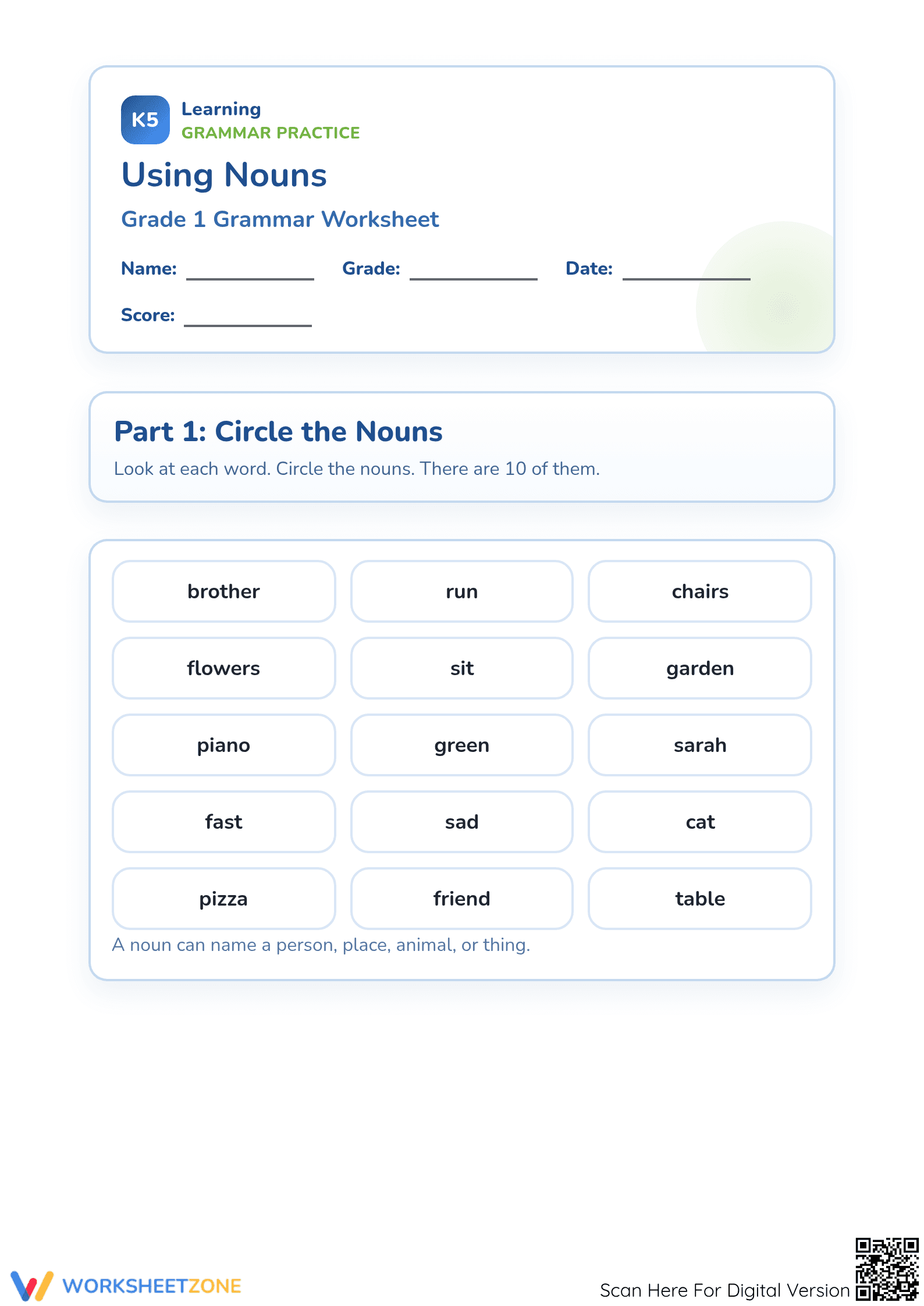
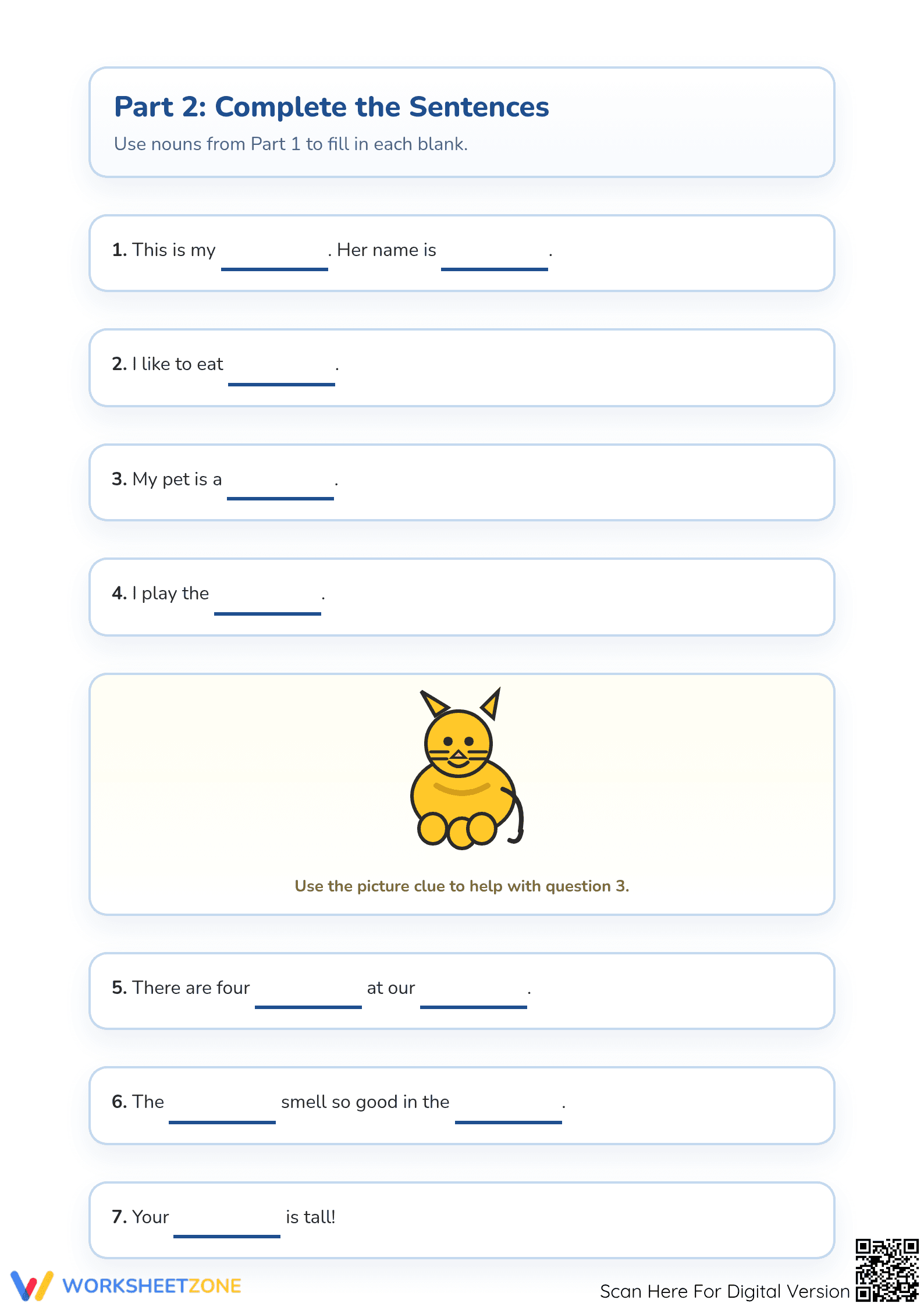
The worksheet consists of two structured pages designed for clarity. Part 1 features a word bank of 15 terms where students identify 10 nouns. Part 2 transitions to application, offering 7 fill-in-the-blank sentences using nouns from the previous section. A picture clue supports visual learners, and a clear definition is provided for quick reference.
Zero-Prep Workflow
The zero-prep workflow is designed for maximum efficiency. First, print the two-page PDF (30 seconds). Next, distribute the sheets to students as a standalone activity or part of a literacy center (1 minute). Finally, use the included answer key to review student work (30 seconds). Total teacher preparation time is under two minutes, making this an ideal solution for sub plans.
Standards Alignment
This resource is directly aligned with `CCSS.ELA-LITERACY.L.1.1.B`, which requires students to use common, proper, and possessive nouns. By focusing on the identification of nouns representing people, places, and things, the worksheet provides the scaffolding necessary for Grade 1 mastery. Both standard codes can be copied directly into lesson plans, IEP goals, or district curriculum mapping tools.
How to Use It
Use this worksheet during the independent practice phase of a grammar lesson after introducing the definition of a noun. It also serves as an excellent formative assessment tool; observe which students struggle to distinguish nouns from verbs to identify who needs targeted intervention. Most first-grade students will complete both pages within 15 to 20 minutes.
Who It's For
This resource is tailored for first-grade students but also suits kindergarteners ready for a challenge or second graders needing review. It pairs naturally with a classroom anchor chart or a shared reading passage. The clear layout supports English Language Learners by providing a limited word set and visual aids.
According to the RAND AIRS 2024 report on foundational literacy, explicit instruction in lexical categories like nouns is essential for early syntactic development. This Grade 1 worksheet targets CCSS.ELA-LITERACY.L.1.1.B by requiring students to distinguish between parts of speech and apply them within context-rich sentences. Research from Fisher & Frey (2014) emphasizes the importance of the gradual release of responsibility, which this resource mirrors through its two-part structure: first identifying nouns in isolation and then applying them to complete meaningful sentences. By engaging with 17 distinct tasks, students reinforce their understanding of nouns as names for people, places, animals, and things. This systematic approach ensures that learners build the necessary grammatical stamina for more complex writing tasks in later primary grades. The inclusion of visual cues and word banks supports vocabulary acquisition while reducing cognitive load during the initial phases of grammar mastery.


