


























Views
Downloads

Printable Addition Worksheet | Grade 1 Math
Paste this activity's link or code into your existing LMS (Google Classroom, Canvas, Teams, Schoology, Moodle, etc.).
Students can open and work on the activity right away, with no student login required.
You'll still be able to track student progress and results from your teacher account.
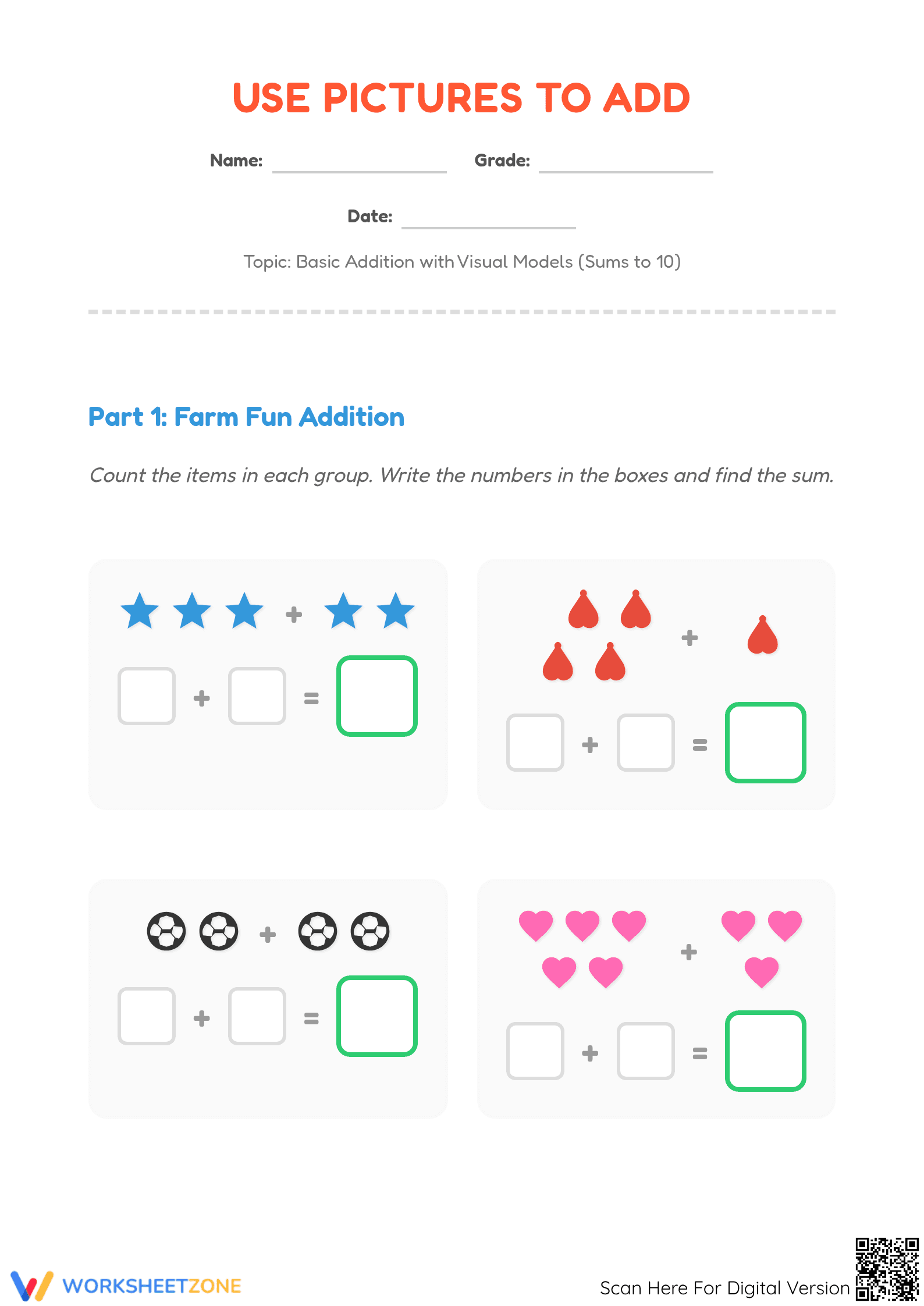
This foundational math worksheet helps first-grade students master basic addition by using clear visual models. Learners will count objects, write corresponding addition sentences, and solve for the sum in a structured, engaging format. It's designed to build a concrete understanding of how addition works before moving to more abstract problems.
At a Glance
- Grade: 1 · Subject: Math
- Standard:
CCSS.MATH.CONTENT.1.OA.A.1— Use addition to solve problems with objects and drawings.- Skill Focus: Addition with Visual Models (Sums to 10)
- Format: 3 pages · 12 problems · Answer key included · PDF
- Best For: Guided practice, math centers, homework
- Time: 15–25 minutes
What's Inside
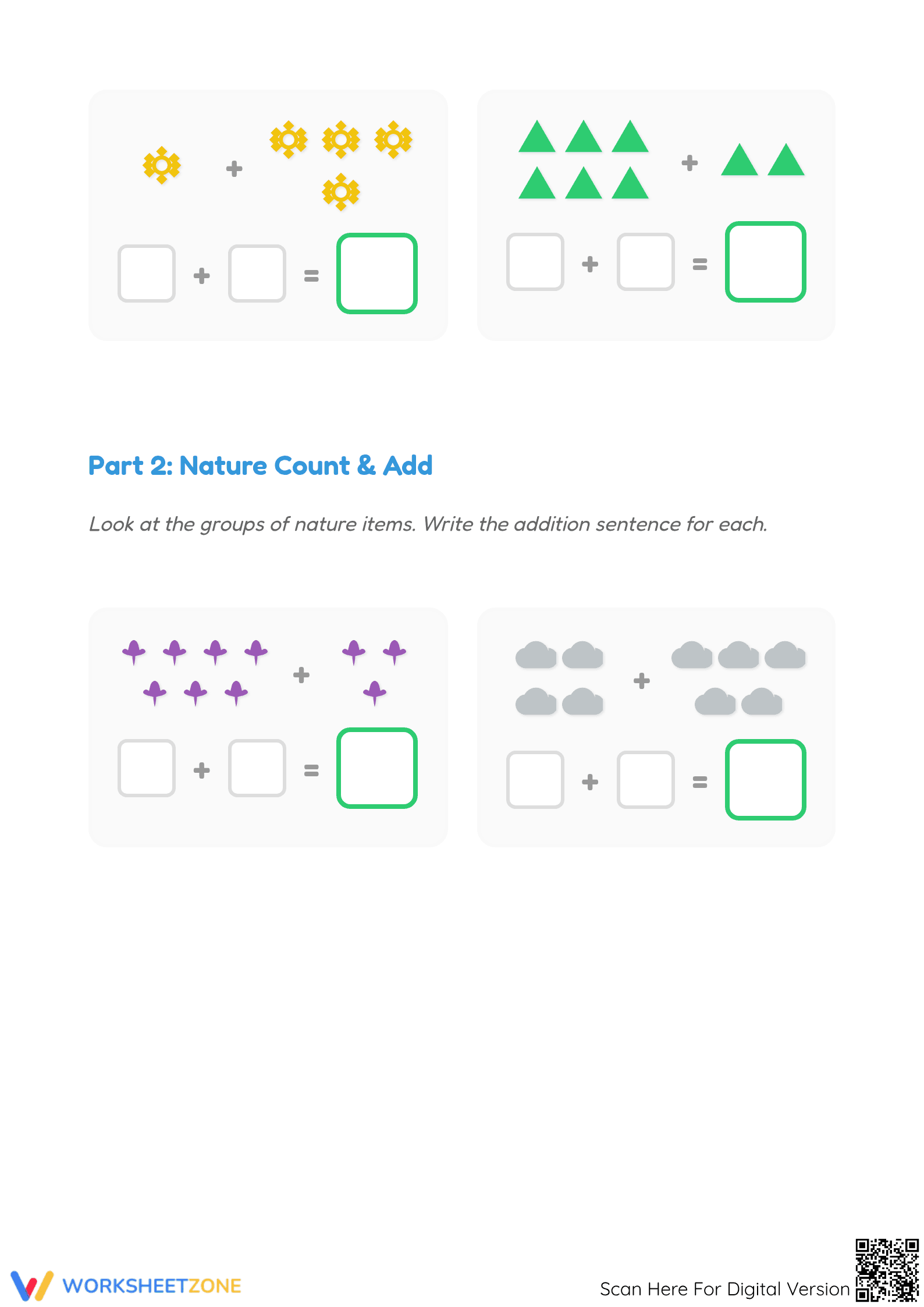
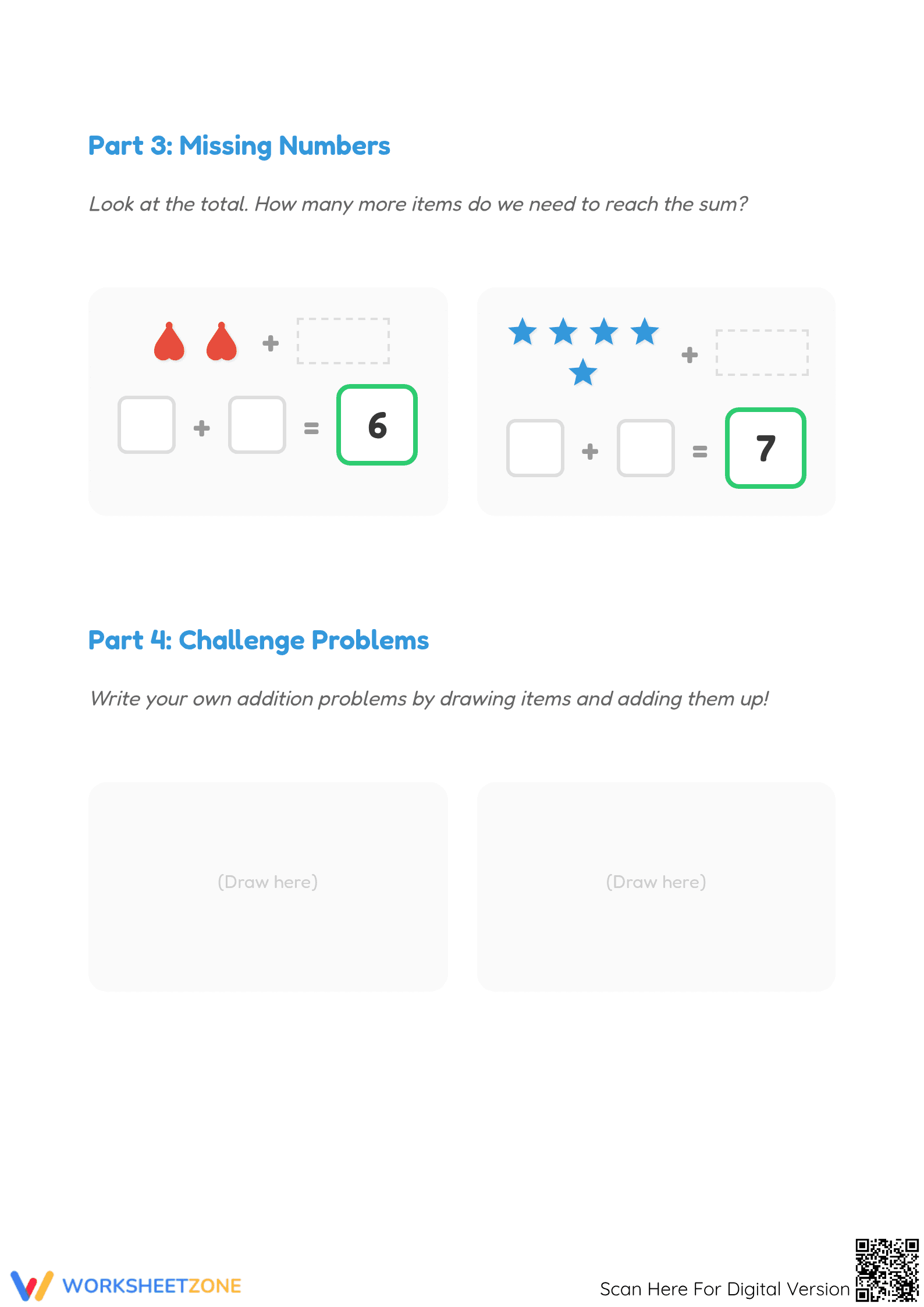
This three-page PDF includes 12 total addition problems broken into four distinct parts. The first two sections provide images for students to count and add. The third section challenges students with missing number problems, and the final section provides space for students to create their own visual addition problems. A complete answer key is included for easy grading.
A Progression to Build Confidence
The worksheet follows a clear gradual-release model to support student learning:
- Guided Practice: The first 8 problems (Parts 1 and 2) provide the most direct practice, where students simply count two groups of objects and write the full addition sentence.
- Supported Practice: In Part 3, the task shifts to finding a missing addend to reach a given sum, requiring a deeper understanding of part-whole relationships.
- Independent Practice: Part 4 serves as a performance task where students demonstrate their understanding by drawing and solving their own addition problems from scratch.
This "I Do, We Do, You Do" structure ensures students build confidence as they move from concrete representation to more abstract application.
Standards-Aligned for Your Classroom
This worksheet is directly aligned with Common Core standard CCSS.MATH.CONTENT.1.OA.A.1, which requires students to use addition and subtraction within 20 to solve word problems by using objects and drawings. It provides targeted practice on the foundational skill of representing "adding to" situations with visual models. Both standard codes can be copied directly into lesson plans, IEP goals, or district curriculum mapping tools.
How to Use This Worksheet
This resource is flexible for various instructional moments. Use it during a math center rotation after a direct instruction lesson on addition. Or, assign it as homework to reinforce concepts taught in class. For formative assessment, observe how students approach the "Challenge Problems" in Part 4. Their ability to create a valid problem demonstrates a strong grasp of the concept. Most students will complete the worksheet in 15 to 25 minutes.
Who It's For
This worksheet is ideal for first-grade students beginning their journey with addition. It's also suitable for advanced kindergarteners ready for a challenge or second graders needing a review of foundational concepts. Pair this activity with a physical set of counting manipulatives or an anchor chart of addition strategies.
This resource provides targeted practice for CCSS.MATH.CONTENT.1.OA.A.1, helping students develop a concrete understanding of addition through visual representation. Building this foundation is critical for future success in mathematics, as students must first grasp the part-whole relationship inherent in addition before they can fluently solve abstract equations. According to research on early math instruction summarized by Fisher & Frey (2014), the use of visual models and a gradual release of responsibility are proven strategies for helping young learners internalize complex concepts. This worksheet's progression from counting concrete objects to solving for missing addends and finally creating original problems aligns with these best practices, ensuring students build a durable and flexible understanding of addition. This method is crucial for developing the operational sense needed for higher-level math.


