




























Views
Downloads
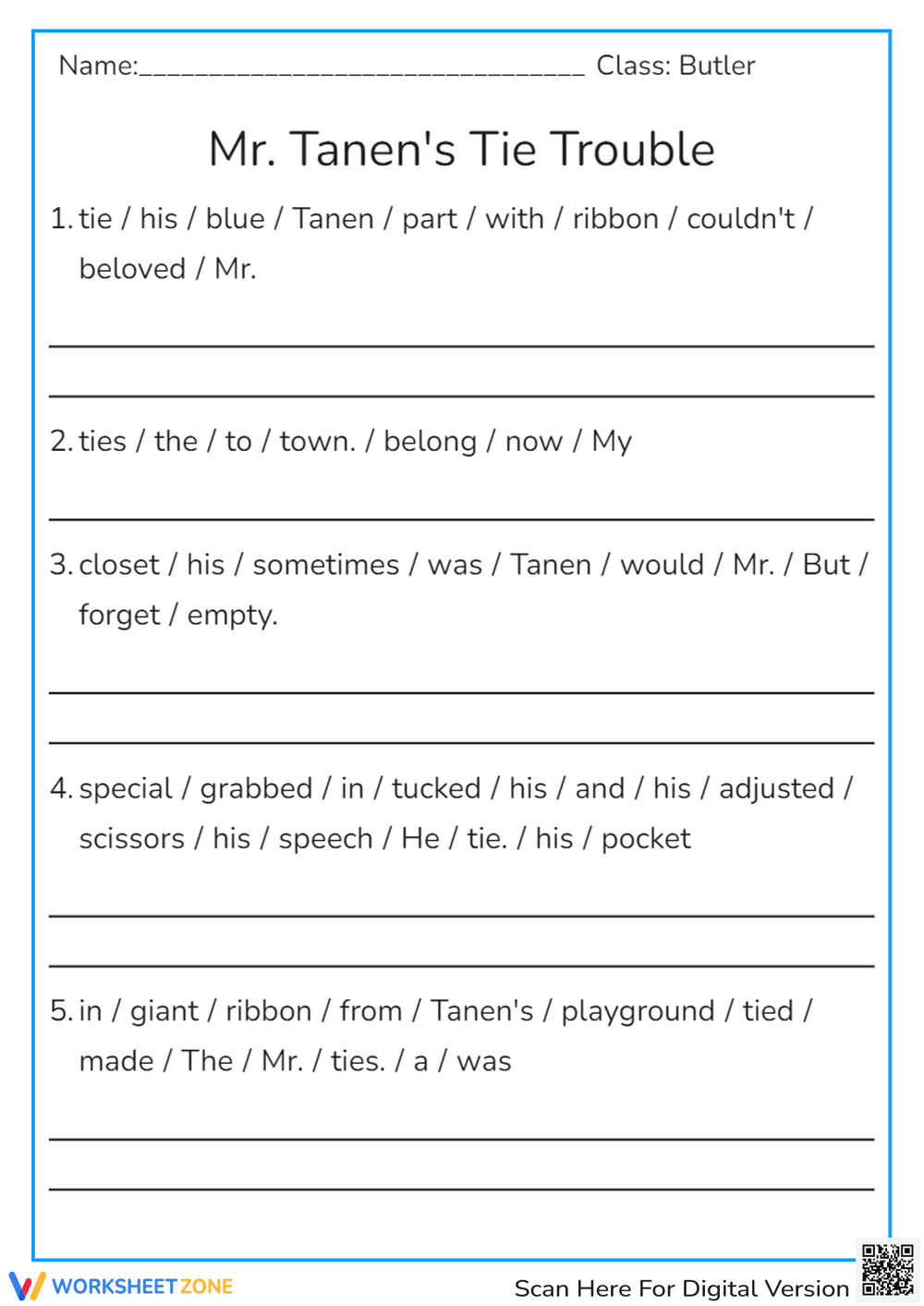

Essential Grade 2 Sentence Scramble — Printable Worksheet

Paste this activity's link or code into your existing LMS (Google Classroom, Canvas, Teams, Schoology, Moodle, etc.).
Students can open and work on the activity right away, with no student login required.
You'll still be able to track student progress and results from your teacher account.
This Grade 2 ELA worksheet provides targeted practice in syntax and sentence construction using themes from the popular story 'Mr. Tanen's Tie Trouble.' Students rearrange scrambled word banks to form coherent, grammatically correct sentences, reinforcing their understanding of subject-verb agreement and word order. It is an effective tool for building foundational writing fluency.
At a Glance
At a Glance
- Grade: 2 · Subject: ELA
- Standard:
CCSS.ELA-LITERACY.L.2.1.f— Produce, expand, and rearrange complete simple and compound sentences to demonstrate grammar mastery- Skill Focus: Sentence structure, syntax, and story-based grammar
- Format: 1 page · 5 problems · Answer key included · PDF
- Best For: Literacy centers, morning work, and early finishers
- Time: 10–15 minutes
What's Inside
Inside this resource, you will find a single-page layout featuring 5 distinct sentence-scrambling tasks. Each task presents a set of words separated by slashes, requiring students to decode the intended meaning and rewrite the sentence on the provided lines. The worksheet includes a clear title and space for student identification, making it easy to collect and grade.
Zero-Prep Workflow
The zero-prep workflow for this resource is designed for maximum efficiency. First, print the single-page PDF (30 seconds). Second, distribute the copies to your students during your ELA block or as a transition activity (1 minute). Third, review the completed sentences as a whole group to provide immediate feedback on capitalization and punctuation (5 minutes). Total teacher preparation time is under 2 minutes.
Standards Alignment
This worksheet is aligned with `CCSS.ELA-LITERACY.L.2.1.f`, which requires students to produce, expand, and rearrange complete simple and compound sentences. By manipulating word order to create meaning, students demonstrate mastery of standard English conventions. Both standard codes can be copied directly into lesson plans, IEP goals, or district curriculum mapping tools.
How to Use It
Use this worksheet as a formative assessment after reading 'Mr. Tanen's Tie Trouble' to check for both comprehension and syntactic awareness. It also serves as an excellent 'early finisher' task or a quick sub-plan addition. Observe whether students correctly capitalize the first word and include the terminal punctuation provided in the word bank. Completion typically takes 10 to 15 minutes.
Who It's For
This resource is ideal for Grade 2 students, particularly those who benefit from kinesthetic-style mental manipulation of language. It is also highly effective for English Language Learners (ELLs) who are developing an understanding of English word order. Pair this worksheet with the original picture book or a sentence-building anchor chart for a comprehensive literacy lesson.
According to Fisher & Frey (2014), the gradual release of responsibility model is supported by tasks that allow students to manipulate language structures before independent writing. This worksheet facilitates that transition by providing the necessary vocabulary while requiring the student to supply the logic of the syntax. By focusing on CCSS.ELA-LITERACY.L.2.1.f, the activity ensures that 2nd-grade students are not just memorizing words but are actively constructing meaning through sentence architecture. Research from the NAEP indicates that early mastery of sentence-level mechanics is a strong predictor of later narrative and informational writing success. This 5-task practice set offers a low-stakes environment for students to experiment with word placement, ensuring they understand how modifiers and subjects interact within a complete thought. It is a reliable addition to any evidence-based literacy curriculum that prioritizes syntactic development alongside reading comprehension.


