


























Views
Downloads
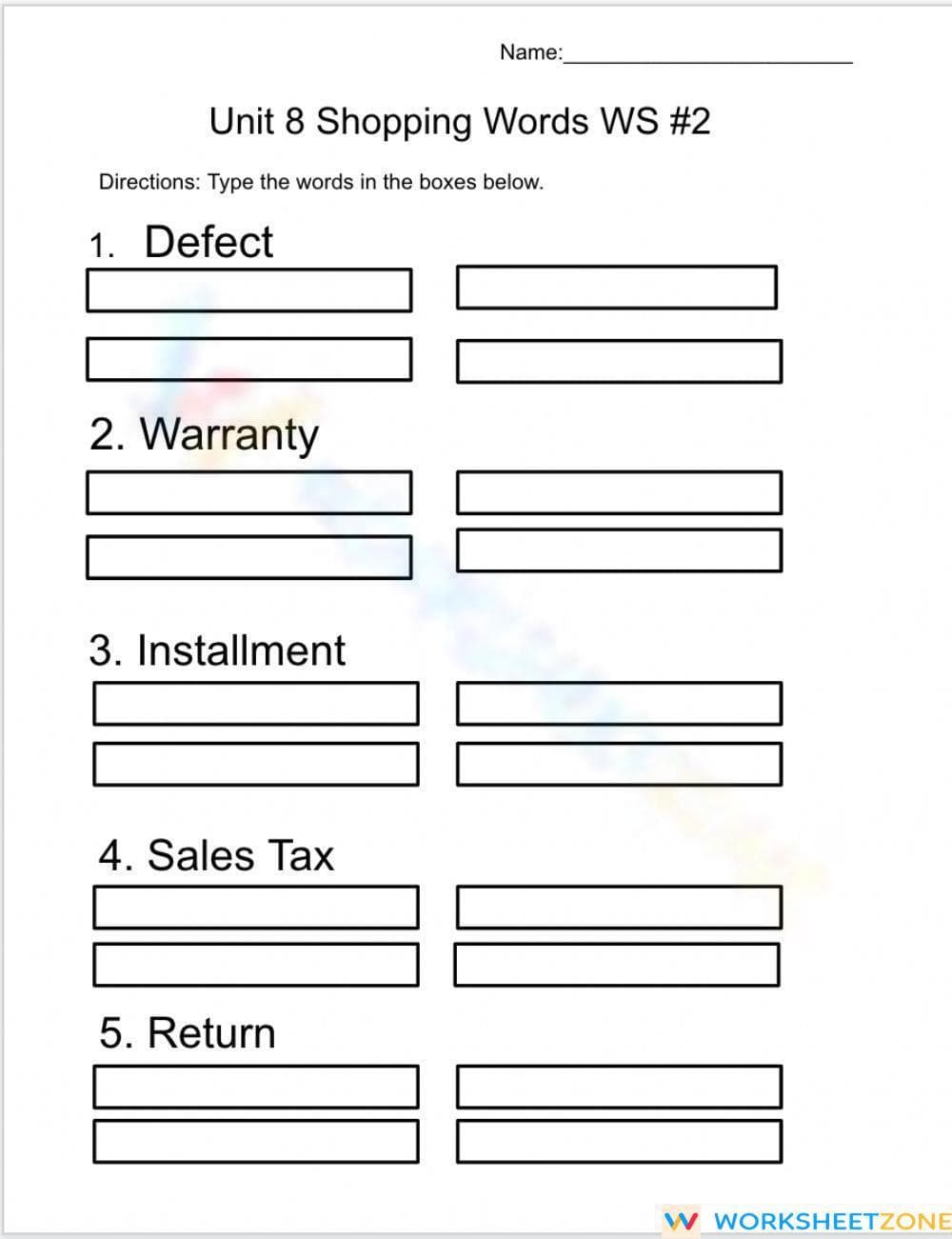

Essential Shopping Vocabulary Worksheet | Grade 3-6 ELA
Paste this activity's link or code into your existing LMS (Google Classroom, Canvas, Teams, Schoology, Moodle, etc.).
Students can open and work on the activity right away, with no student login required.
You'll still be able to track student progress and results from your teacher account.
This Grade 3-6 vocabulary worksheet provides students with targeted practice in identifying and spelling essential retail and commerce terms. By interacting with domain-specific words multiple times, learners build the orthographic mapping necessary for long-term retention. This printable resource ensures students master common shopping vocabulary used in real-world financial literacy and consumer education contexts.
At a Glance
- Grade: 3-6 · Subject: English Language Arts (ELA)
- Standard:
CCSS.ELA-LITERACY.L.3.6— Acquire and use accurately grade-appropriate general academic and domain-specific words- Skill Focus: Retail Vocabulary and Spelling
- Format: 1 page · 20 problems · Answer key included · PDF
- Best For: Independent vocabulary reinforcement and spelling practice
- Time: 10–15 minutes
What's Inside
The worksheet features five primary vocabulary terms: defect, warranty, installment, sales tax, and return. Students are provided with four boxes per word to reinforce spelling through repetition. This single-page layout is distraction-free, making it ideal for students requiring structured motor practice. The repetitive nature ensures that the visual form of the word is firmly established in the student's lexicon.
Skill Progression
Practice follows a structured path toward mastery.
- Guided Practice: Students read the target word, serving as a visual anchor and immediate model for the task.
- Supported Practice: Learners copy the word into the first boxes, focusing on letter formation and correct character sequencing.
- Independent Practice: By the final boxes, students internalize the spelling, moving toward independent recall.
This approach utilizes gradual-release principles, providing a model as students build confidence in their spelling accuracy.
Standards Alignment
Aligned with CCSS.ELA-LITERACY.L.3.6, this resource helps students acquire and use grade-appropriate conversational and domain-specific words. The focus on shopping-related terms provides vocabulary necessary for both academic discussion and practical life skills. Both standard codes can be copied directly into lesson plans, IEP goals, or district curriculum mapping tools.
How to Use It
Best used during independent practice. After introducing terms, assign this sheet to reinforce spelling. Teachers should observe students during the task to identify any persistent letter reversals. This formative assessment allows for immediate correction. Completion typically takes 10 to 15 minutes, making it a perfect exit ticket or bell-ringer activity to ensure students have mastered the day's focal vocabulary and spelling patterns.
Who It's For
Designed for Grade 3-6 students, this is particularly effective for ELL and Special Education programs benefiting from high-repetition tasks. It pairs naturally with a retail-themed reading passage or commerce definitions anchor chart. The clear font and spacious layout provide necessary accommodations for students with fine motor challenges or visual processing needs who require a focused and clean environment.
Research by Fisher & Frey (2014) emphasizes that vocabulary acquisition is most effective when students interact with new words multiple times. This worksheet addresses the orthographic component of word mastery by requiring four repetitions of five domain-specific retail terms, including "warranty" and "installment." Aligned to the CCSS.ELA-LITERACY.L.3.6 standard, the resource facilitates the acquisition of academic words essential for consumer literacy. A 2024 ScienceDirect analysis underscores that structured repetition is a critical intervention for students in special education, as it strengthens the neural pathways associated with word recognition. By providing a clear visual model and repetitive practice, this printable resource bridges the gap between initial exposure and spelling fluency. This summary provides the evidence-based rationale required for lesson plan citations and district-level curriculum audits.


