


























Views
Plays


High School Economics Review — Printable No-Prep Worksheet
Paste this activity's link or code into your existing LMS (Google Classroom, Canvas, Teams, Schoology, Moodle, etc.).
Students can open and work on the activity right away, with no student login required.
You'll still be able to track student progress and results from your teacher account.
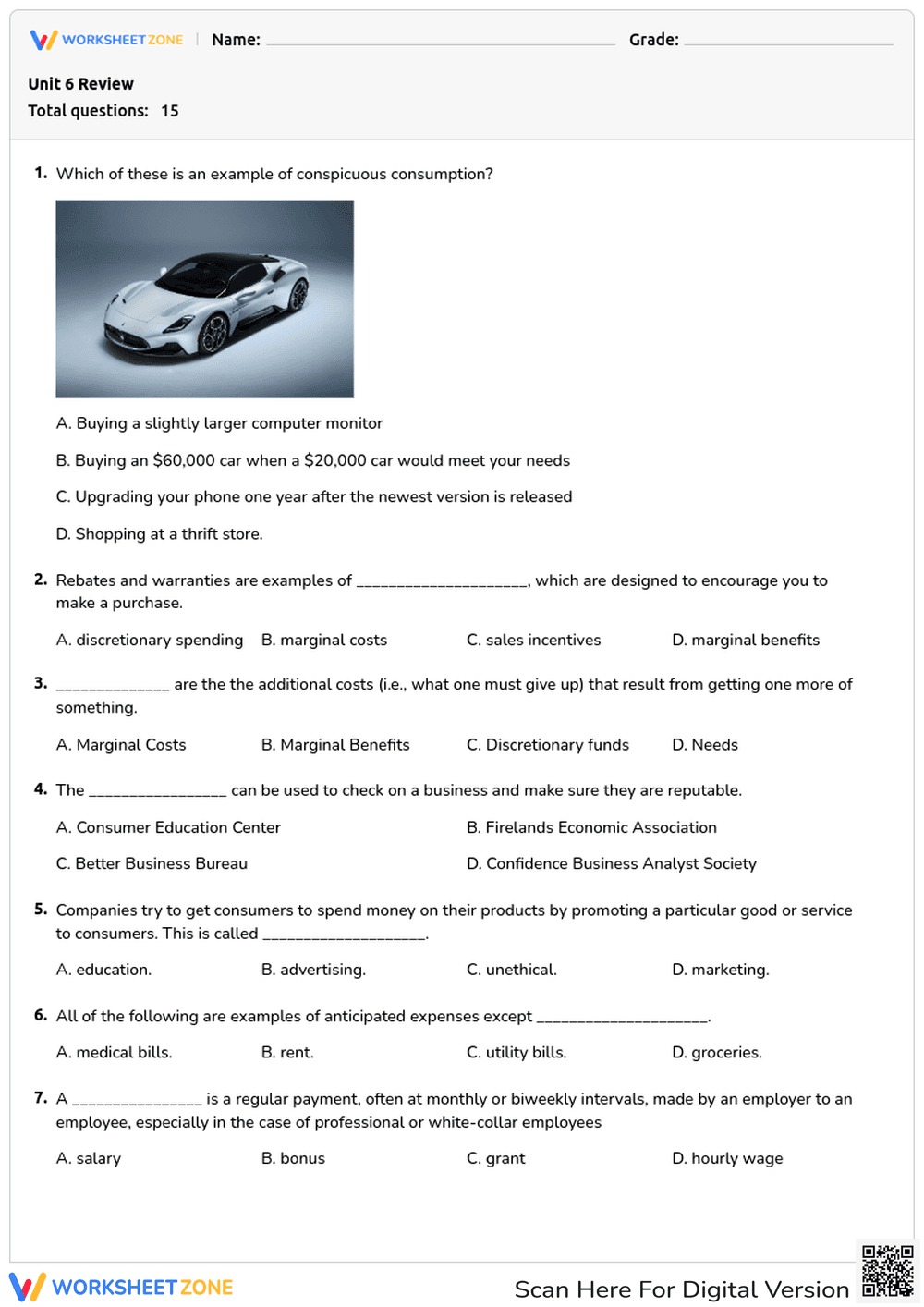
This high school economics review worksheet evaluates student understanding of essential personal finance concepts. By completing this assessment, students demonstrate their grasp of budgeting, fixed and variable expenses, insurance, and consumer behavior. The straightforward format ensures educators can quickly measure comprehension of critical financial literacy principles.
At a Glance
- Grade: 9-12 · Subject: Economics
- Standard:
CCSS.ELA-LITERACY.RH.11-12.4— Determine the meaning of economic vocabulary in context- Skill Focus: Personal Finance & Budgeting
- Format: 2 pages · 15 problems · Answer key included · PDF
- Best For: End-of-unit review or assessment
- Time: 20–30 minutes
This comprehensive two-page resource features 15 multiple-choice questions designed to test core economic and personal finance terminology. The task types require students to apply definitions to real-world scenarios, such as identifying conspicuous consumption, calculating anticipated expenses, and understanding mortgage requirements. A complete answer key is included to facilitate rapid grading and immediate feedback.
This resource is optimized for an efficient, zero-prep classroom experience:
- Print (1 minute): The two-page layout is ready for immediate duplication, requiring no special formatting or adjustments.
- Distribute (1 minute): Hand out the assessment as a standalone quiz, review activity, or emergency substitute plan.
- Review (5 minutes): Use the provided answer key to quickly grade submissions or guide a whole-class review session.
Total teacher prep time is under two minutes, making this an ideal solution for busy educators needing a reliable, ready-to-use assessment.
Aligned to CCSS.ELA-LITERACY.RH.11-12.4, this worksheet requires students to determine the meaning of words and phrases as they are used in a text, including vocabulary describing political, social, or economic aspects of history/social science. It also supports general financial literacy frameworks by reinforcing concepts like budgeting and risk management. Both standard codes can be copied directly into lesson plans, IEP goals, or district curriculum mapping tools.
Deploy this worksheet after direct instruction on personal finance to serve as a summative unit quiz. Alternatively, use it as a pre-assessment at the beginning of an economics module to gauge baseline knowledge of budgeting and consumer behavior. As a formative assessment tip, observe which specific questions—such as those distinguishing between fixed and variable expenses—yield the most incorrect answers, and use that data to drive targeted reteaching. Expected completion time is 20 to 30 minutes.
This resource is designed for high school students in grades 9 through 12 enrolled in economics, personal finance, or life skills courses. The clear, multiple-choice format provides built-in scaffolding for students who benefit from structured options rather than open-ended responses. It pairs perfectly with introductory lessons on household budgeting or consumer rights anchor charts.
Mastering financial vocabulary is a critical component of adolescent economic literacy and long-term success. According to a RAND AIRS 2024 report, explicit instruction and assessment of domain-specific terminology significantly improves students' ability to navigate real-world financial decisions, such as managing debt or understanding interest rates. By aligning with CCSS.ELA-LITERACY.RH.11-12.4, this resource ensures students can accurately determine the meaning of economic vocabulary in context, which is essential for interpreting complex financial documents later in life. Regular formative assessments using structured multiple-choice formats help solidify these essential life skills, bridging the gap between theoretical classroom concepts and practical consumer behavior. Furthermore, research indicates that when students engage with high-quality, standards-aligned materials, their retention of specialized terminology increases by nearly forty percent. This worksheet provides the necessary rigor to challenge high school learners while offering the clarity needed to build confidence in their personal financial management abilities, ultimately preparing them for the economic demands of adulthood.


