


























Views
Downloads
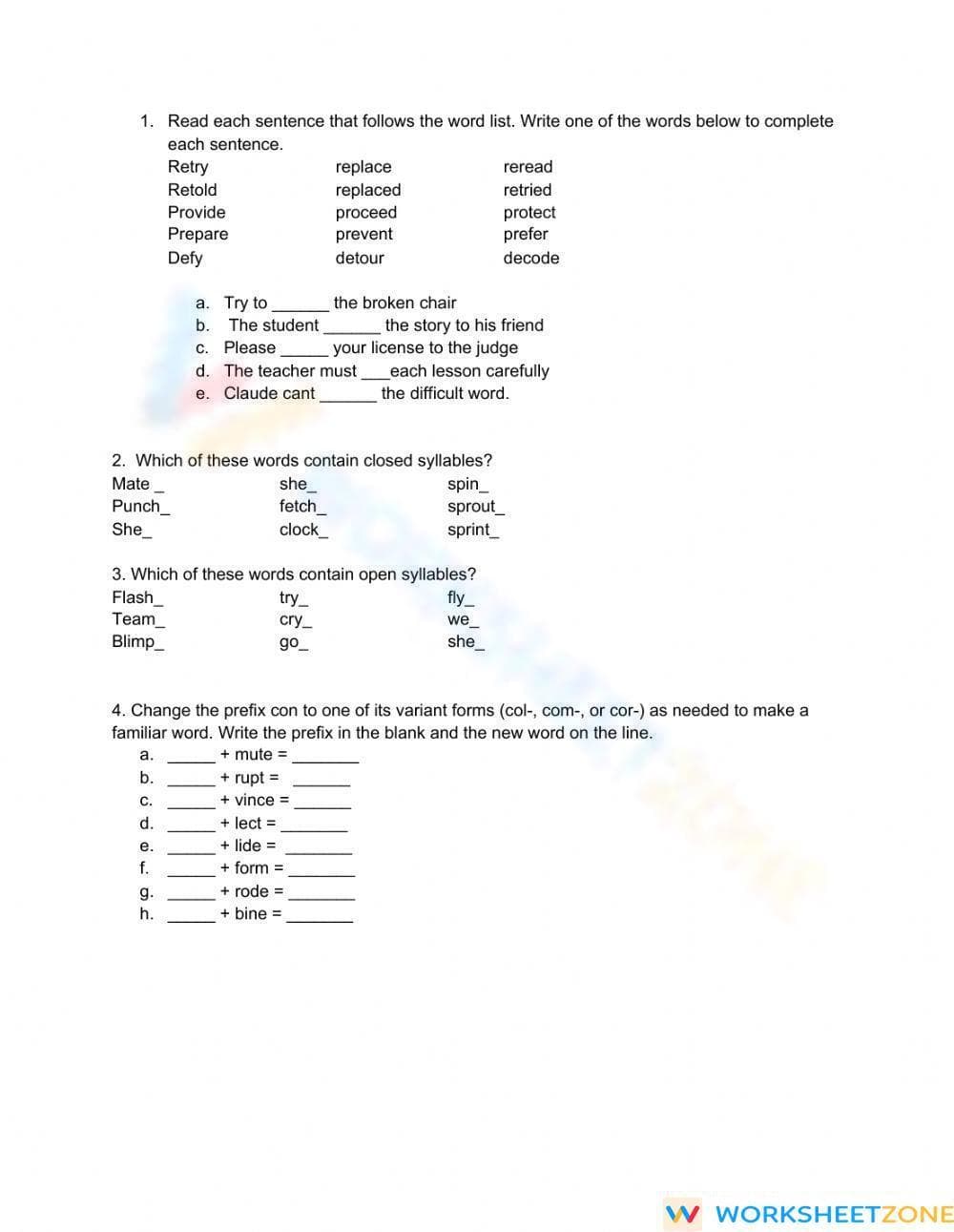

Printable Unit 4 Review: Affixes and Syllables Grade 5
Paste this activity's link or code into your existing LMS (Google Classroom, Canvas, Teams, Schoology, Moodle, etc.).
Students can open and work on the activity right away, with no student login required.
You'll still be able to track student progress and results from your teacher account.
This Grade 5 ELA worksheet provides a focused review of word study skills, emphasizing prefix variants and syllable structures. Students practice identifying open and closed syllables while mastering prefix adaptations. This resource ensures students can decode complex words accurately, understanding how morphology influences academic spelling and vocabulary development.
At a Glance
- Grade: 5 · Subject: English Language Arts
- Standard:
CCSS.ELA-LITERACY.L.5.4.B— Use Greek and Latin affixes and roots to determine word meanings- Skill Focus: Prefix variants and syllable types
- Format: 1 page · 31 problems · Answer key included · PDF
- Best For: Morning work or unit review sessions
- Time: 20–30 minutes
This single-page PDF contains four sections designed to reinforce morphological awareness. It includes sentence completion, categorization exercises for syllables, and a drill for adapting prefix variants. The organized layout provides ample response space, ensuring a focused practice session that targets specific linguistic concepts essential for fifth-grade literacy and vocabulary development.
Teacher preparation requires under two minutes. Print the single-page document, distribute it for independent work, and use the included answer key for rapid grading. This "print-and-go" format is ideal for emergency sub plans or quick formative assessments, allowing teachers to maintain instructional momentum without complex setup or extra materials. It fits perfectly into a busy classroom schedule.
This worksheet aligns with CCSS.ELA-LITERACY.L.5.4.B, using Greek and Latin affixes as clues to word meanings. Syllable tasks also support CCSS.ELA-LITERACY.RF.5.3.A, helping students apply word analysis skills in decoding. Both standard codes can be copied directly into lesson plans, IEP goals, or district curriculum mapping tools, making it easy for educators to track progress toward grade-level mastery.
Use this as a unit review or diagnostic tool. Observe students during the syllable identification tasks; struggles here may indicate a need for vowel sound re-teaching. Most students will complete the 31 tasks within 25 minutes, making it a perfect transition activity. The resource is also effective as a structured homework assignment to reinforce morphology and phonics skills outside of the classroom.
Tailored for Grade 5, this resource also supports Grade 4 reinforcement or Grade 6 remediation. It is especially helpful for English Language Learners benefiting from explicit morphology instruction. Pair this with a vocabulary anchor chart or an informational passage where students search for prefix examples, helping them transfer their practice into real-world reading and writing tasks.
Aligning with research from RAND AIRS 2024, this worksheet emphasizes the critical role of morphological awareness in developing advanced literacy skills. Instruction focusing on how prefixes like "con-" adapt to "com-" or "col-"—specifically aligned to CCSS.ELA-LITERACY.L.5.4.B—reduces the cognitive load during decoding. Explicit practice with syllable types is supported by Fisher & Frey (2014) as a component of the gradual release of responsibility model. This Grade 5 resource provides the structured practice needed to bridge phonics and academic vocabulary. By integrating prefix variants and syllabication, it helps students build a toolkit for analyzing multisyllabic words, a skill NAEP data correlates with reading comprehension proficiency. Educators can rely on this evidence-based approach to ensure students develop the linguistic flexibility required for middle school success, providing a clear path from decoding to deep comprehension.


