


























Views
Plays

Grade 9-12 ASVAB Reading — Printable No-Prep Worksheet
Paste this activity's link or code into your existing LMS (Google Classroom, Canvas, Teams, Schoology, Moodle, etc.).
Students can open and work on the activity right away, with no student login required.
You'll still be able to track student progress and results from your teacher account.
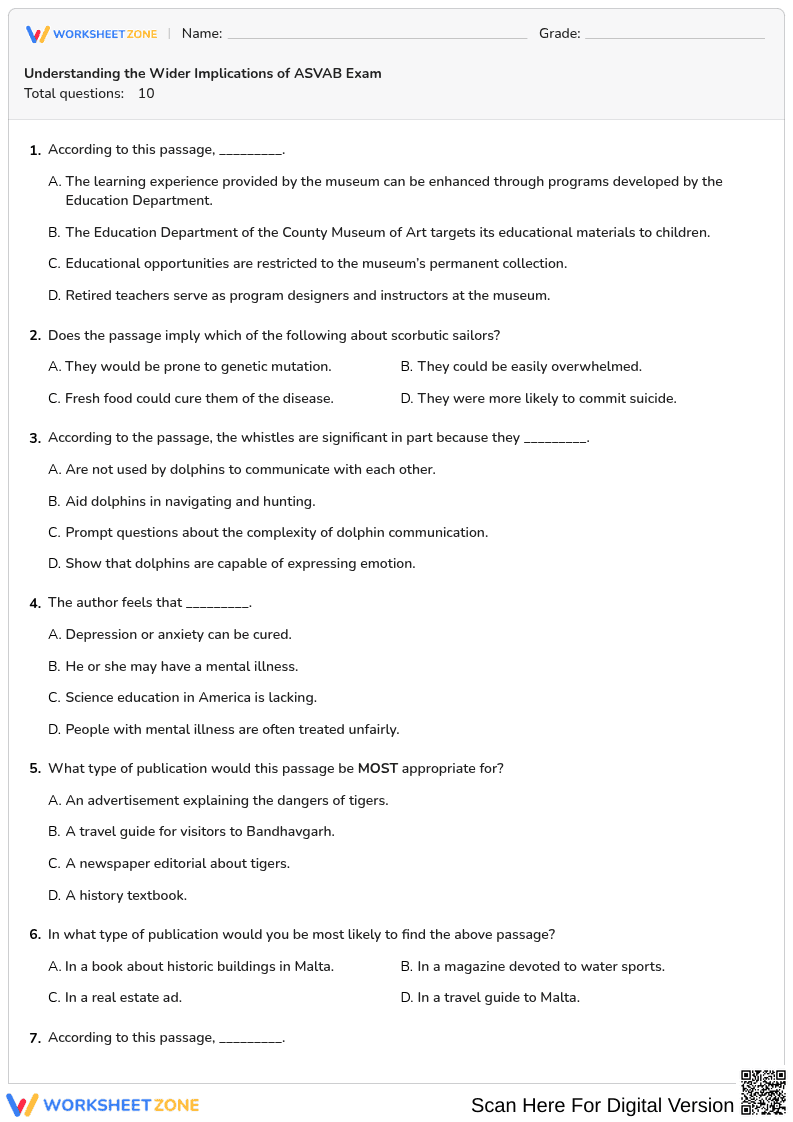
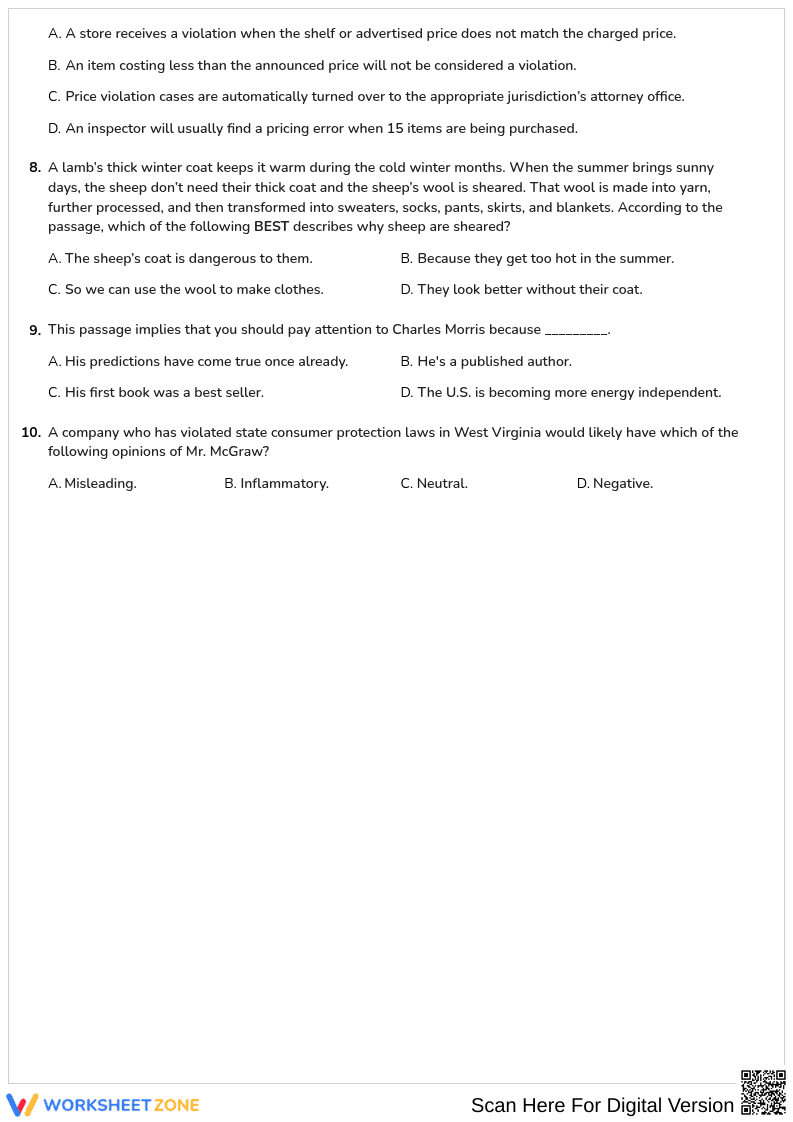
This ASVAB Paragraph Comprehension practice worksheet provides high school students with targeted reading assessment preparation. By analyzing various short passages, learners develop critical skills in identifying main ideas, making inferences, and determining author purpose to improve their overall exam readiness and reading proficiency.
At a Glance
- Grade: 9-12 · Subject: ELA
- Standard:
CCSS.ELA-LITERACY.RI.9-10.1— Cite textual evidence to support analysis of text.- Skill Focus: Reading Comprehension
- Format: 2 pages · 10 problems · PDF
- Best For: Test prep and independent practice
- Time: 15–20 minutes
This resource features a two-page assessment containing ten multiple-choice questions modeled after the ASVAB Paragraph Comprehension section. Students read brief, diverse informational texts covering topics from history to science, then answer targeted questions. The format mirrors standardized testing environments, requiring learners to quickly process information, deduce implicit meanings, and identify the most accurate conclusions based solely on the provided text.
Designed for immediate classroom implementation, this assessment requires minimal teacher preparation:
- Print (1 minute): Generate copies of the two-page PDF for each student.
- Distribute (1 minute): Hand out the assessment as a bell-ringer, exit ticket, or dedicated test prep activity.
- Review (5 minutes): Go over the correct responses as a class, discussing the textual evidence that supports each answer.
With a total prep time of under two minutes, this resource serves as an excellent emergency sub plan or a quick supplementary activity during testing season.
This practice aligns with CCSS.ELA-LITERACY.RI.9-10.1: "Cite strong and thorough textual evidence to support analysis of what the text says explicitly as well as inferences drawn from the text." It also supports broader high school reading comprehension goals by challenging students to evaluate diverse text types. Both standard codes can be copied directly into lesson plans, IEP goals, or district curriculum mapping tools.
Deploy this worksheet during dedicated test preparation units or as a formative assessment after teaching inference skills. Teachers can assign it as independent seatwork while conducting small group interventions. As students work, observe their annotation habits—encourage them to underline key phrases in the passages before selecting their multiple-choice answers. Expect completion within 15 to 20 minutes, depending on reading fluency.
This material is ideal for high school students preparing for the ASVAB, SAT, or ACT, as well as general education students needing extra practice with informational texts. For learners requiring accommodations, teachers might read the passages aloud or reduce the number of answer choices. Pair this worksheet with direct instruction on active reading strategies or a lesson on identifying author bias.
Effective standardized test preparation requires consistent exposure to varied text structures and question formats. Aligning practice materials with CCSS.ELA-LITERACY.RI.9-10.1 ensures students can cite textual evidence to support analysis of text, a critical competency for both academic success and vocational assessments like the ASVAB. According to a recent RAND AIRS 2024 report, students who engage in regular, timed reading comprehension exercises demonstrate significant improvements in their ability to process complex informational texts under pressure. This targeted practice helps bridge the gap between general literacy instruction and the specific demands of high-stakes testing environments. By systematically analyzing short passages and evaluating multiple-choice options, learners build the cognitive endurance necessary for extensive exams. Integrating these focused assessments into the regular curriculum provides educators with actionable data on student reading proficiency and inference capabilities.


