


























Views
Downloads
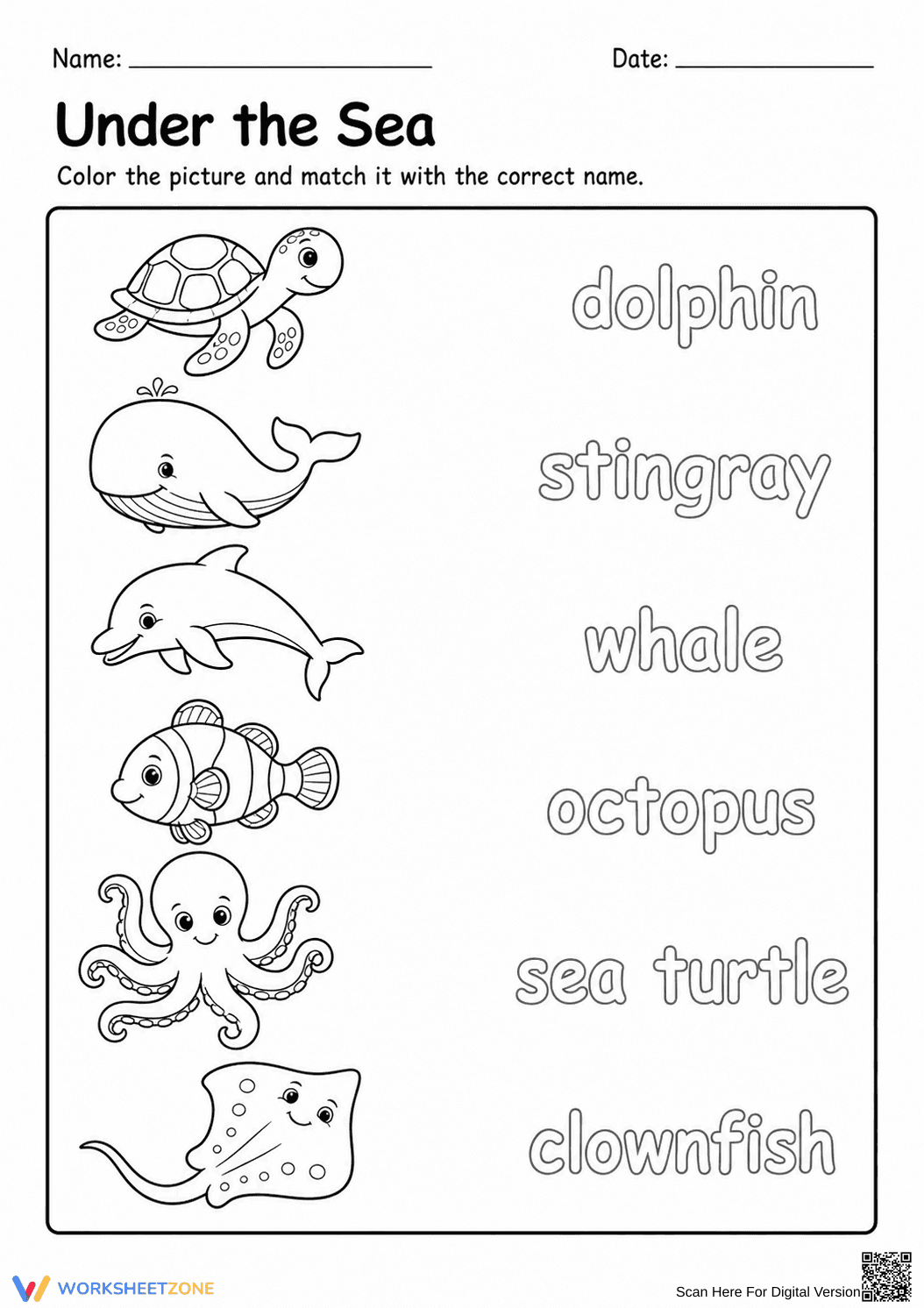

Grade K Ocean Animals — Printable No-Prep Worksheet
Paste this activity's link or code into your existing LMS (Google Classroom, Canvas, Teams, Schoology, Moodle, etc.).
Students can open and work on the activity right away, with no student login required.
You'll still be able to track student progress and results from your teacher account.
This printable "Under the Sea" worksheet helps young learners identify and name common marine animals through a structured matching and coloring activity. Students connect six distinct sea creatures to their names, reinforcing vocabulary acquisition and visual discrimination skills. It provides an immediate, engaging way to introduce marine biology.
At a Glance
- Grade: Kindergarten · Subject: Science
- Standard:
K-LS1-1— Identify and categorize marine animals by visual traits- Skill Focus: Marine animal identification
- Format: 1 page · 6 problems · Answer key included · PDF
- Best For: Independent practice or science center
- Time: 10–15 minutes
This resource contains a single-page activity featuring line art of a sea turtle, whale, dolphin, clownfish, octopus, and stingray. The names of these animals are printed in a clear, child-friendly font. The layout is intentionally spacious to allow for fine motor development during matching, and the black-and-white format is optimized for coloring. A full answer key is included to ensure accurate self-checking or quick teacher grading.
Zero-Prep Workflow
The zero-prep workflow for this worksheet is designed for maximum efficiency. First, print the single PDF page (30 seconds). Second, distribute the sheets to students with pencils and crayons (1 minute). Third, review the finished animal pairings as a group to reinforce correct pronunciation (2 minutes). Total teacher preparation time is under two minutes, making this an ideal resource for morning work or emergency substitute plans.
Standards Alignment
This activity is primarily aligned to K-LS1-1: Use observations to describe patterns of what plants and animals need to survive. By identifying specific animals that live in the ocean, students begin to categorize organisms by their habitat. This foundational understanding supports later exploration of biological needs and environmental adaptations. Both standard codes can be copied directly into lesson plans, IEP goals, or district curriculum mapping tools.
How to Use It
Use this worksheet during the independent practice phase of a lesson on habitats, or place it in a science center for self-guided exploration. It serves as an excellent formative assessment tool to gauge whether students can distinguish between different marine species based on visual cues. For a collaborative twist, have students compare their colored animals and describe one special feature of their favorite sea creature. Expected completion time is approximately 10 to 15 minutes.
Who It's For
This resource is tailored for Preschool, Kindergarten, and Grade 1 students developing their early literacy and science observation skills. It is particularly effective for English Language Learners as it pairs clear visual icons with high-frequency vocabulary. Naturally pair this activity with an ocean-themed picture book or an anchor chart showing marine life to provide additional scaffolding for students who may be unfamiliar with the ocean.
Research by Fisher & Frey (2014) highlights that pairing visual representations with academic vocabulary is critical for building schema in early childhood learners. This worksheet utilizes this principle by requiring students to decode animal names while referencing specific morphological features. By engaging in the dual task of matching and coloring, students reinforce their phonemic awareness of names like stingray while grounding those words in biological reality. This approach aligns with science literacy best practices, where the focus is on developing observation skills and foundational classification abilities. Standard K-LS1-1 emphasizes using such observations to understand animal patterns, and this structured practice provides the evidence necessary for students to identify and categorize marine animals by visual traits. The inclusion of coloring further supports fine motor development, ensuring the activity addresses multiple developmental domains within a single, high-signal instructional moment.


