


























Views
Downloads

Essential Uncountable Nouns Worksheet | Grade 1 ELA
Paste this activity's link or code into your existing LMS (Google Classroom, Canvas, Teams, Schoology, Moodle, etc.).
Students can open and work on the activity right away, with no student login required.
You'll still be able to track student progress and results from your teacher account.
This Grade 1 grammar resource helps students distinguish between countable and uncountable nouns through practical application. By focusing on mass nouns like water, sugar, and time, learners develop a foundational understanding of how English grammar treats different categories of objects. The worksheet ensures students can identify these nouns in context and use them correctly in sentences.
At a Glance
- Grade: 1 · Subject: ELA
- Standard:
CCSS.ELA-LITERACY.L.1.1— Use common, proper, and possessive nouns correctly in writing and speaking- Skill Focus: Uncountable Nouns Identification
- Format: 2 pages · 23 problems · Answer key included · PDF
- Best For: Independent practice or grammar centers
- Time: 15–20 minutes
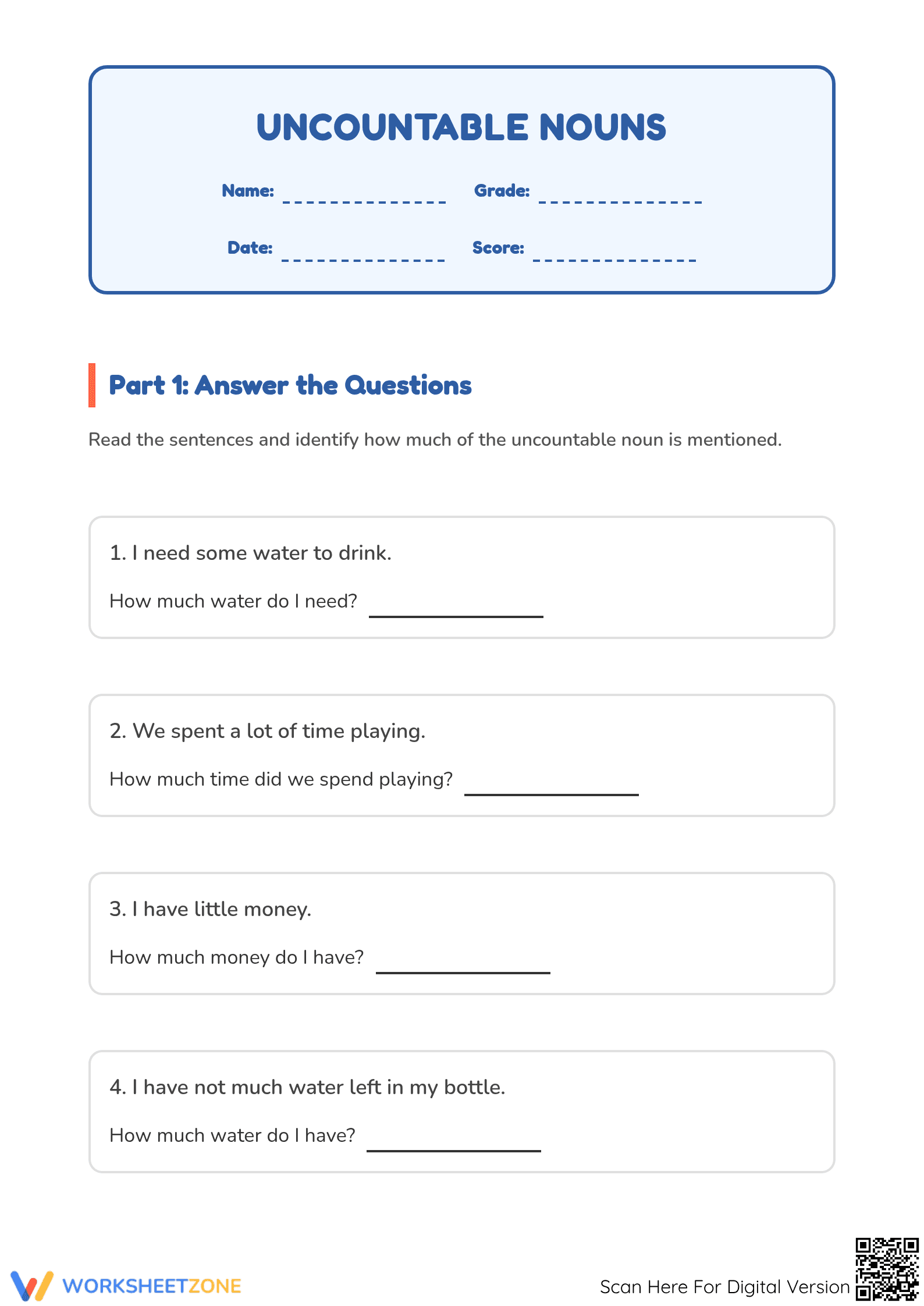
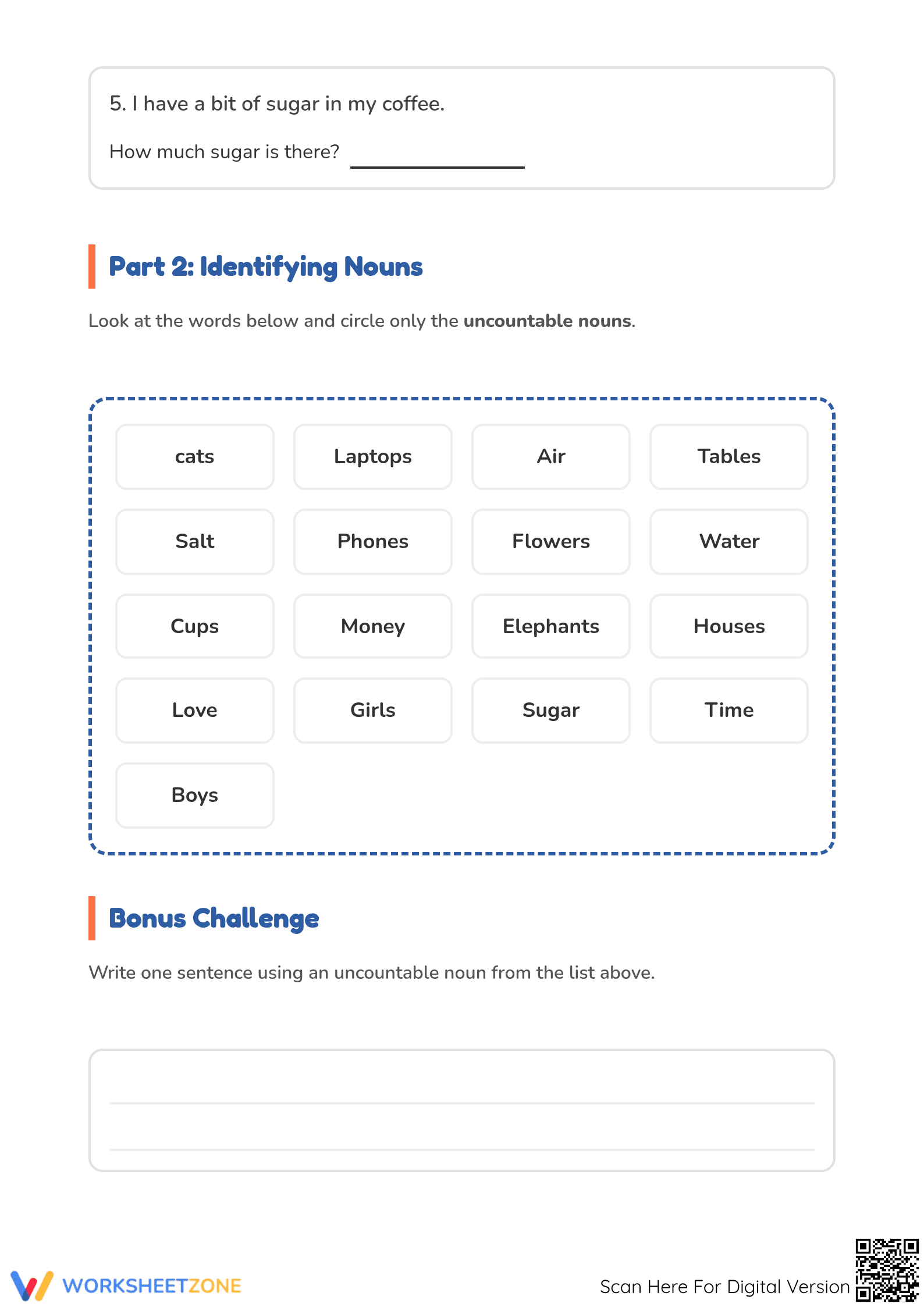
The resource contains two comprehensive pages designed for early elementary learners. Page one features five sentence-based questions where students must identify the quantity of a specific uncountable noun. Page two includes a sorting grid with 17 different words, requiring students to circle only the uncountable options. A bonus writing challenge at the end encourages students to generate their own original sentence using the target vocabulary.
This resource is designed for a zero-prep classroom workflow. Teachers can print the two-page PDF in less than 30 seconds. Distribution takes approximately 1 minute, and because the instructions are self-explanatory, students can begin working immediately. Reviewing the work is simplified by the included answer key, allowing for a total teacher time investment of under 2 minutes. It is an ideal choice for emergency sub plans or morning work.
Aligned to CCSS.ELA-LITERACY.L.1.1, this worksheet focuses on the command of standard English grammar. Specifically, it addresses the nuance of noun types, which is a prerequisite for mastering subject-verb agreement and the use of determiners later in the primary years. Both standard codes can be copied directly into lesson plans, IEP goals, or district curriculum mapping tools.
Use this worksheet as a formative assessment following a direct instruction lesson on nouns. As students work through the identification grid on page two, circulate the room to observe if they are confusing plural countable nouns (like "cats") with uncountable mass nouns (like "air"). The expected completion time is 15 to 20 minutes, making it a perfect exit ticket or independent practice block.
This activity is tailored for Grade 1 students but is also highly effective for English Language Learners (ELL) who often struggle with the concept of non-count nouns. It pairs naturally with a classroom anchor chart displaying common uncountable categories like liquids, gases, and abstract concepts.
Research by Fisher & Frey (2014) emphasizes the importance of the gradual release of responsibility model in literacy instruction. This worksheet supports that framework by moving from guided identification in sentences to independent categorization and finally to creative production in the bonus challenge. By isolating the specific skill of identifying uncountable nouns, the resource reduces cognitive load for 1st-grade learners. The inclusion of 23 distinct tasks provides sufficient repetition to move the concept from short-term memory to long-term mastery. Standard CCSS.ELA-LITERACY.L.1.1 requires students to demonstrate a command of grammar conventions, and targeted practice with mass nouns is a critical component of this developmental milestone. Educators can use the results of this worksheet to identify specific gaps in noun comprehension before moving on to more complex parts of speech or sentence structures.


