




























Views
Downloads




April Fools' Day News Worksheet | Essential ELA Practice

Paste this activity's link or code into your existing LMS (Google Classroom, Canvas, Teams, Schoology, Moodle, etc.).
Students can open and work on the activity right away, with no student login required.
You'll still be able to track student progress and results from your teacher account.
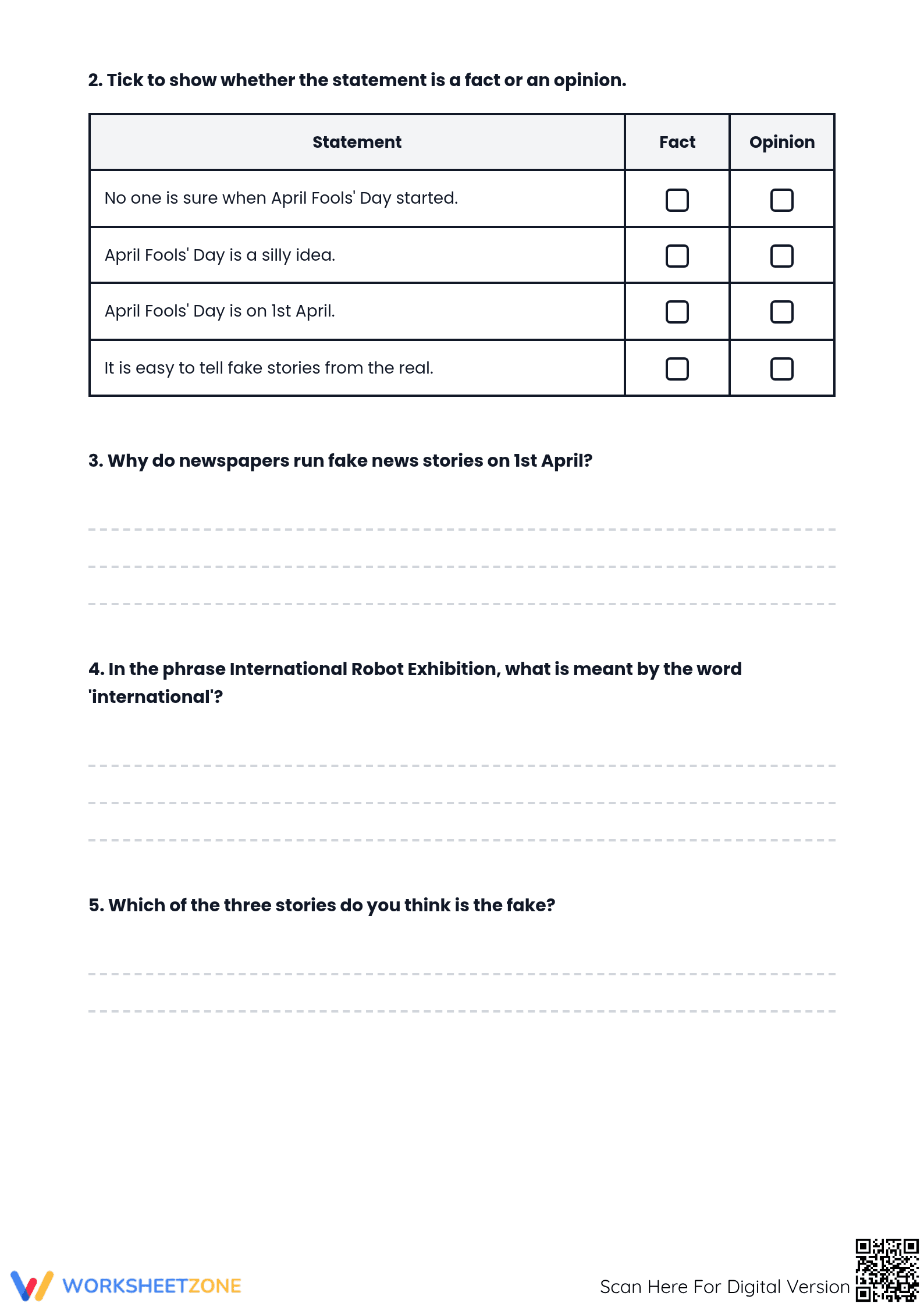
Students develop critical media literacy skills by evaluating news stories for authenticity. This worksheet challenges learners to distinguish between factual reporting and April Fools' Day hoaxes. By analyzing three distinct narratives, students practice identifying evidence and understanding author intent, resulting in improved reading comprehension and skeptical thinking during informational text analysis.
At a Glance
- Grade: 5 · Subject: ELA
- Standard:
CCSS.ELA-LITERACY.RI.5.8— Explain how an author uses reasons and evidence to support points- Skill Focus: Fact vs. Opinion & Media Literacy
- Format: 4 pages · 6 problems · Answer key included · PDF
- Best For: Holiday-themed reading and sub plans
- Time: 30–45 minutes
This 4-page resource features an engaging informational text about the history of April Fools' Day followed by three "news" stories. It includes a dedicated glossary for tier-two vocabulary like "terrain" and "commission." The assessment portion consists of six varied tasks, including a fact-versus-opinion sorting table, multiple-choice reliability checks, and open-ended reasoning questions. A full answer key is provided for quick grading.
Zero-Prep Workflow
- Print: Select the four-page PDF and print enough copies for your class in under 60 seconds.
- Distribute: Hand out the packets; the self-contained glossary ensures students can work independently without constant teacher intervention.
- Review: Use the included answer key to conduct a 5-minute whole-class debrief or peer-grading session. Total teacher preparation time is less than 2 minutes, making this an ideal emergency sub plan.
Standards Alignment
This resource is primarily aligned with `CCSS.ELA-LITERACY.RI.5.8`, which requires students to explain how an author uses reasons and evidence to support particular points in a text. It also supports RI.5.4 by focusing on domain-specific vocabulary through the integrated glossary. Both standard codes can be copied directly into lesson plans, IEP goals, or district curriculum mapping tools.
How to Use It
Assign this worksheet during a literacy block on or near April 1st to capitalize on seasonal interest. It serves as an excellent formative assessment for distinguishing between objective facts and subjective opinions. For best results, have students highlight specific "red flags" in the text that suggest a story might be fake before they begin the question set. Completion typically takes 35 minutes.
Who It's For
Designed for upper elementary and middle school students, this worksheet is particularly effective for learners who struggle with media literacy or identifying author bias. It pairs naturally with a lesson on "reliable sources" or an anchor chart about fact-checking. The clear layout and scaffolded glossary support English Language Learners and students with reading accommodations.
According to the RAND AIRS 2024 report, media literacy and the ability to evaluate the credibility of informational texts are critical components of modern ELA instruction. This worksheet addresses these needs by focusing on CCSS.ELA-LITERACY.RI.5.8, requiring students to differentiate between factual evidence and fabricated narratives. Research by Fisher & Frey (2014) emphasizes that scaffolded reading tasks, such as the glossary and structured question sets provided here, significantly improve student engagement with complex informational texts. By engaging with 6 targeted tasks across 4 pages, students build the cognitive stamina necessary for high-stakes testing environments. This resource provides a practical application of critical thinking skills, ensuring that learners can identify author intent and verify source reliability in real-world contexts. The inclusion of a comprehensive answer key allows for immediate feedback, a practice proven to accelerate learning gains in literacy.


