


























Views
Downloads

Kindergarten Beginning Sounds Worksheet | Essential Practice
Paste this activity's link or code into your existing LMS (Google Classroom, Canvas, Teams, Schoology, Moodle, etc.).
Students can open and work on the activity right away, with no student login required.
You'll still be able to track student progress and results from your teacher account.
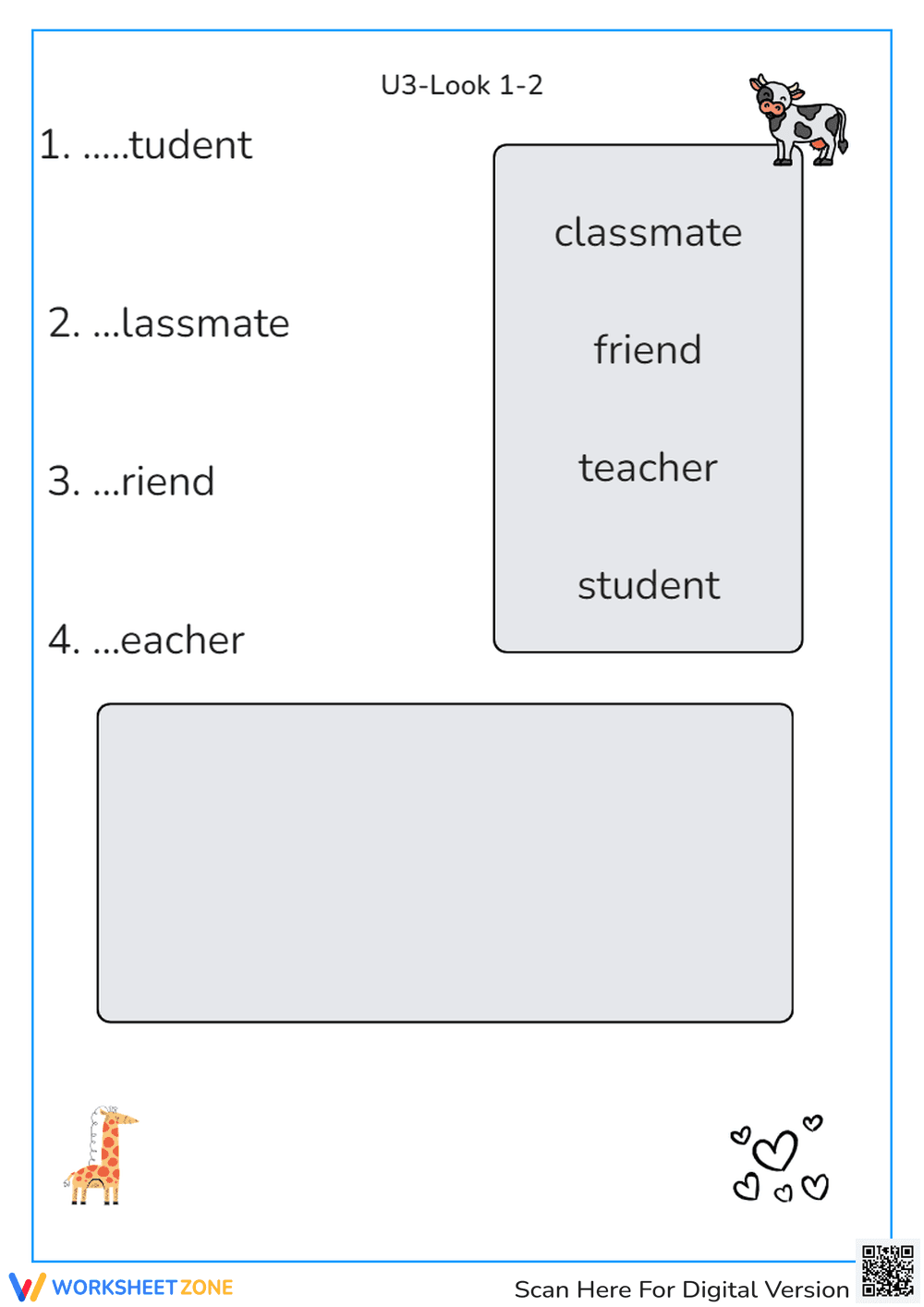
This Kindergarten beginning sounds worksheet helps young learners identify and write initial consonants for school-themed vocabulary. Students use a word bank to complete words like student and teacher, reinforcing phonemic awareness and letter-sound correspondence. It provides a clear, structured path for early writers to practice spelling through visual cues and word recognition.
At a Glance
- Grade: Kindergarten · Subject: ELA
- Standard:
CCSS.ELA-LITERACY.L.K.2.C— Write letters for consonant and vowel sounds in words- Skill Focus: Initial Consonants
- Format: 1 page · 5 tasks · Answer key included · PDF
- Best For: Morning work or phonics centers
- Time: 10–15 minutes
The worksheet features a single-page layout containing four fill-in-the-blank spelling prompts and a large creative space for drawing or sentence writing. A clear word bank is positioned on the right side to support emerging readers. The school-themed vocabulary—including classmate, friend, teacher, and student—is paired with friendly animal illustrations to maintain high student engagement during independent work.
This resource is designed for immediate classroom implementation with a three-step workflow. First, print the single-page PDF (30 seconds). Second, distribute to students during phonics blocks or as a transition activity (1 minute). Third, review the completed initial letters as a whole group or check against the included answer key (1 minute). Total teacher preparation time is under 2 minutes, making it an ideal choice for sub plans or unexpected schedule changes.
This activity aligns with CCSS.ELA-LITERACY.L.K.2.C, which requires students to write a letter or letters for most consonant and vowel sounds (phonemes). It also supports vocabulary acquisition by familiarizing students with common school-related nouns. Both standard codes can be copied directly into lesson plans, IEP goals, or district curriculum mapping tools.
Use this worksheet during the independent practice phase of a phonics lesson after introducing the sounds for /s/, /c/, /f/, and /t/. It serves as an excellent formative assessment; observe if students are looking at the word bank for support or attempting to sound out the words independently. Expected completion time ranges from 10 to 15 minutes depending on the complexity of the drawing task at the bottom.
This resource is tailored for Kindergarten students, English Language Learners (ELLs) needing vocabulary support, and special education students working on fine motor skills and letter formation. It pairs naturally with a classroom anchor chart displaying the alphabet or a read-aloud book about starting school to provide context for the vocabulary words.
According to the RAND AIRS 2024 report on early literacy, structured phonics practice that combines visual word banks with active writing tasks significantly improves letter-sound correspondence in Kindergarten learners. This worksheet targets the CCSS.ELA-LITERACY.L.K.2.C standard by requiring students to identify and write the missing initial consonant for four high-frequency school words. By bridging the gap between phonemic awareness and orthographic mapping, the activity provides the repetition necessary for foundational reading success. Research from Fisher & Frey (2014) emphasizes that such scaffolded independent practice is vital for moving students toward literacy mastery. The inclusion of a creative drawing space further reinforces the connection between written words and their real-world meanings, ensuring that students are not just memorizing letters but are engaging in meaningful language acquisition within a zero-prep, classroom-ready format.


