


























Views
Plays
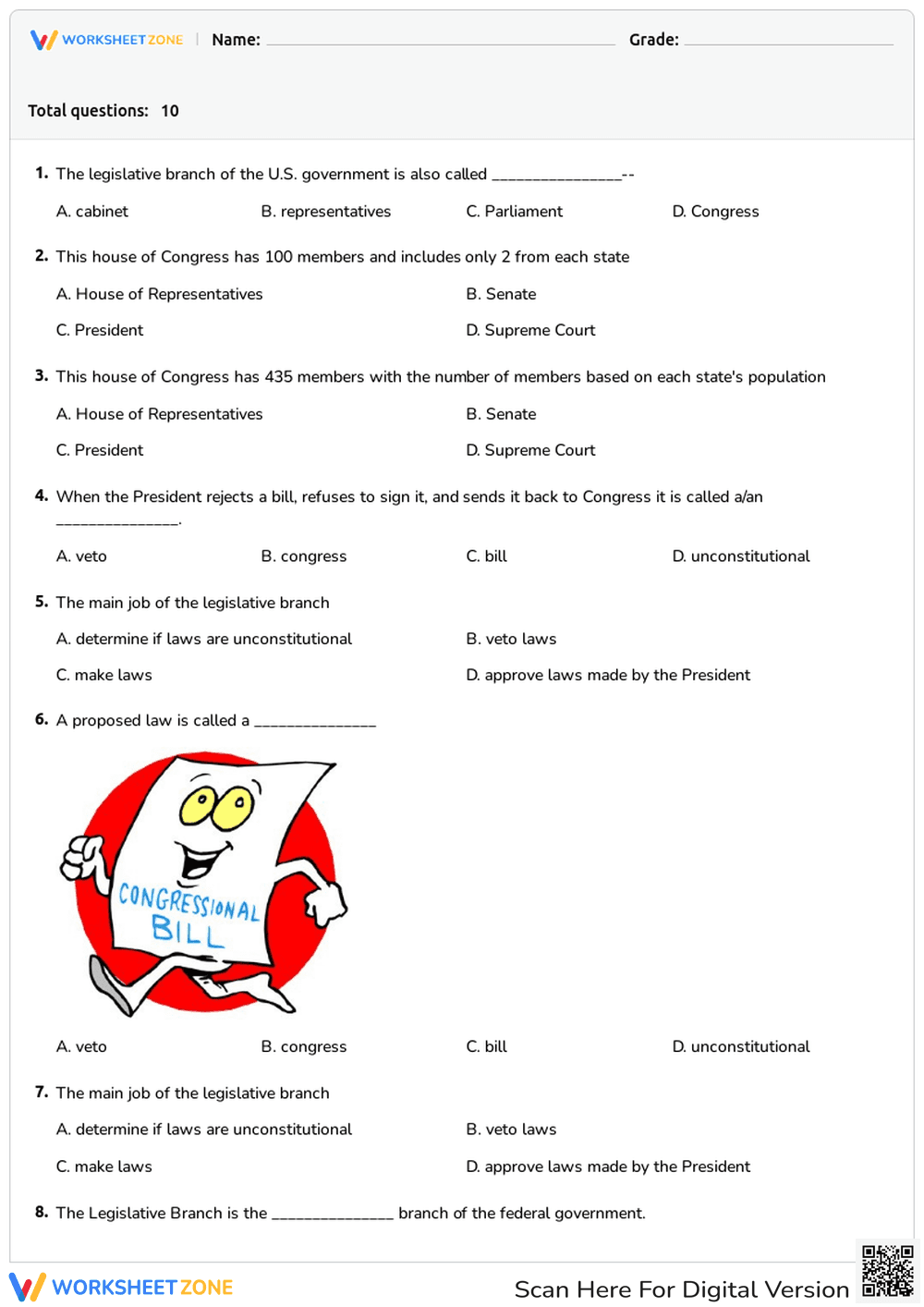


Grade 5 U.S. Congress — Printable No-Prep Worksheet
Paste this activity's link or code into your existing LMS (Google Classroom, Canvas, Teams, Schoology, Moodle, etc.).
Students can open and work on the activity right away, with no student login required.
You'll still be able to track student progress and results from your teacher account.
This U.S. Congress and legislative process worksheet helps students understand the structure and function of the federal government's legislative branch. By answering targeted questions about the Senate, House of Representatives, and lawmaking procedures, students build foundational civics knowledge essential for understanding how national laws are created and passed.
At a Glance
- Grade: 5 · Subject: Social Studies
- Standard:
D2.Civ.5.3-5— Explain the origins, functions, and structure of government- Skill Focus: U.S. Legislative Branch
- Format: 2 pages · 10 problems · Answer key included · PDF
- Best For: Formative assessment and review
- Time: 15–20 minutes
This resource features a straightforward, ten-question multiple-choice quiz spread across two pages. Students will encounter questions covering the specific member counts of the Senate and House of Representatives, the definition of a veto, and the primary responsibilities of the legislative branch. The clear layout minimizes distractions, while the included answer key ensures educators can quickly verify student comprehension of the congressional system.
This resource requires minimal teacher setup:
- Print (1 minute): The PDF is optimized for standard printing.
- Distribute (1 minute): Hand out the assessment after a lesson on the three branches of government or leave it in a sub folder.
- Review (3 minutes): Use the provided answer key to rapidly grade the ten multiple-choice questions, giving you instant data on student mastery.
With under two minutes of total teacher prep time, this worksheet is an ideal solution for busy educators or emergency substitute plans.
This worksheet is aligned to the C3 Framework standard D2.Civ.5.3-5, which requires students to "explain the origins, functions, and structure of different systems of government, including those created by the U.S. and state constitutions." It specifically targets the structural knowledge of the bicameral Congress and its lawmaking functions. Both standard codes can be copied directly into lesson plans, IEP goals, or district curriculum mapping tools.
Use this worksheet as a formative assessment after direct instruction on the legislative branch. By reviewing the results of the ten questions, educators can quickly identify if students are confusing the Senate with the House of Representatives. Alternatively, it serves as an excellent independent review activity during a broader unit on the U.S. Constitution. Expect students to complete the task within a 15 to 20-minute time frame.
This resource is primarily designed for fourth, fifth, and sixth-grade social studies students developing their initial understanding of American civics. The straightforward multiple-choice format provides built-in scaffolding for students who may struggle with open-ended responses, making it accessible for diverse learners. It pairs perfectly with an anchor chart detailing the three branches of government or a reading passage about how a bill becomes a law.
Developing a robust understanding of the U.S. legislative branch is a critical component of elementary civics education. Aligned with D2.Civ.5.3-5, this resource helps students explain the origins, functions, and structure of government by focusing on the specific roles of the Senate and House of Representatives. According to RAND AIRS 2024, explicit instruction and structured assessment in foundational civics concepts significantly improve students' long-term engagement with democratic processes and their ability to comprehend complex historical texts. By utilizing targeted multiple-choice questions, educators can efficiently measure comprehension of essential vocabulary like veto and bill while reinforcing the structural realities of Congress. This targeted practice ensures that learners build the necessary schema to analyze current events and understand the balance of power within the federal government, ultimately fostering more informed and capable future citizens.


